
Can ChatGPT Upload Video in 2026? What Works, What Fails, and the Reliable Link → Transcript Workflow (VideoToTextAI)
 Video To Text AI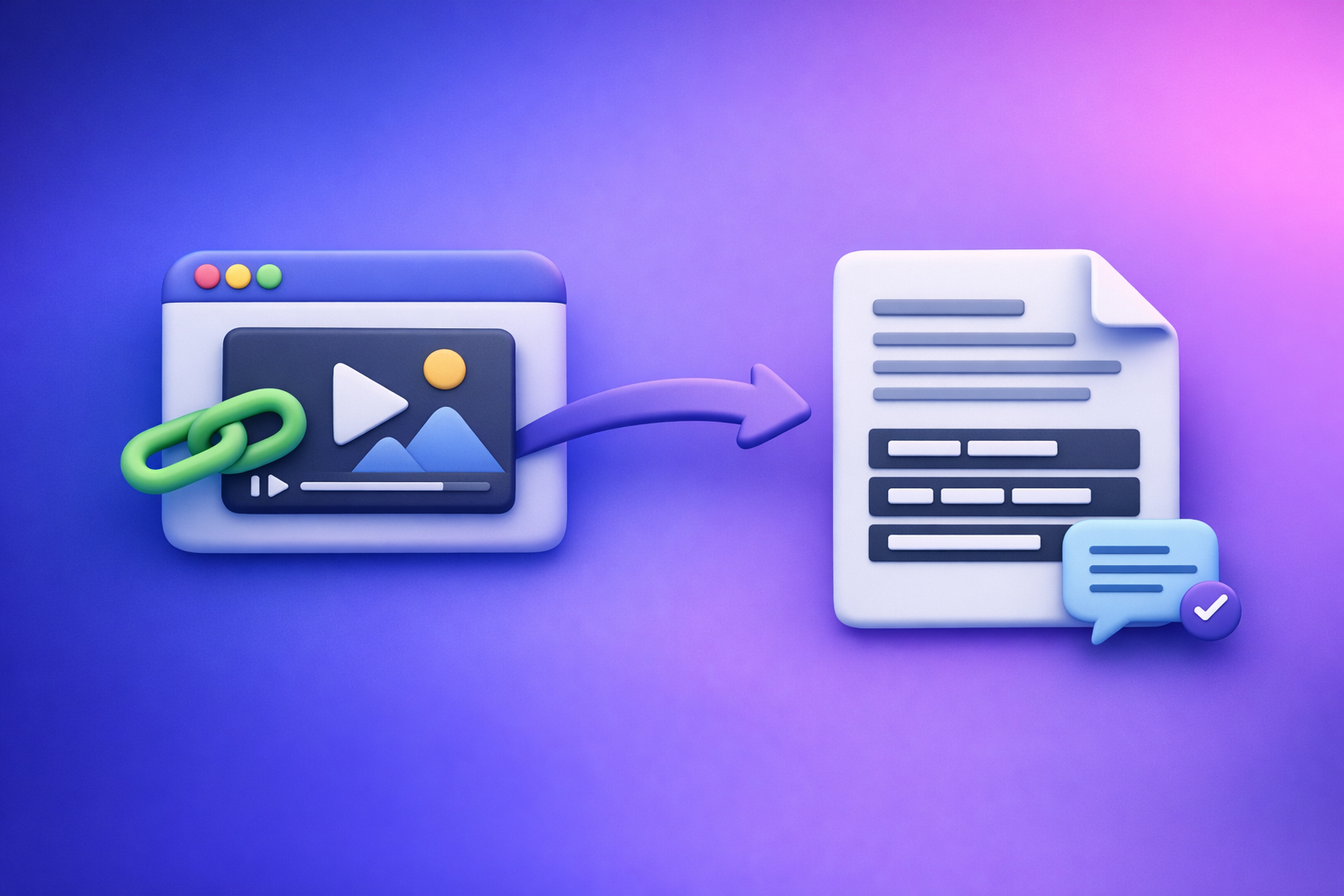
Can ChatGPT Upload Video in 2026? What Works, What Fails, and the Reliable Link → Transcript Workflow (VideoToTextAI)
If your goal is transcripts, subtitles, or captions, don’t bet your workflow on uploading video into ChatGPT. The reliable approach in 2026 is video link (or MP4) → export-ready transcript/captions → ChatGPT for cleanup + repurposing.
This matters because creator and marketing teams need repeatable outputs (TXT/SRT/VTT), not a “maybe it works today” upload experience. And from a productivity standpoint, downloading video files is an outdated workflow—link-based extraction is the future.
Quick Answer: Can ChatGPT Upload Video?
What “upload video” can mean (and why people get conflicting answers)
When someone asks “can chat gpt upload video,” they usually mean one of these:
- Uploading a video file (MP4/MOV) directly into ChatGPT
- Sharing a video link (YouTube/TikTok/Instagram) and asking ChatGPT to “watch it”
- Uploading frames/screenshots and asking for analysis
- Uploading audio/transcript files derived from the video (MP3/WAV/TXT/SRT/VTT)
These are different capabilities with different limits, and they change by plan, region, and UI rollout. That’s why you’ll see contradictory answers across forums and help threads.
The reliable reality in 2026
In 2026, ChatGPT is not a deterministic “video in → transcript/subtitles out” pipeline for most real-world workflows.
What stays stable is this:
- Use a dedicated tool to convert video link/MP4 → transcript/captions
- Use ChatGPT on the text outputs to polish, structure, and repurpose
If you want a repeatable system, treat ChatGPT as the editor and content repurposer, not the ingestion engine.
What Works vs What Fails (Real-World Scenarios)
Works reliably
These scenarios are consistent across teams because they rely on exportable text formats:
- Generate transcripts/captions with a video-to-text tool, then use ChatGPT to:
- summarize and extract key takeaways
- rewrite into a blog post or newsletter
- create chapters/sections and titles
- translate and localize
- generate social posts and hooks
- Use ChatGPT on TXT/SRT/VTT instead of raw video
If your workflow starts with clean text, everything downstream becomes faster and more controllable.
Often fails (or is inconsistent)
These are the failure modes that waste time:
- Uploading long videos and expecting consistent processing end-to-end
- Expecting ChatGPT to “watch” a link and produce accurate timestamps/subtitles
- Expecting consistent support across:
- different plans
- different countries/regions
- different app versions (web vs mobile)
- temporary feature rollouts
If you need transcripts for publishing, “inconsistent” is the same as “unusable.”
Why you might not be able to upload videos “anymore”
If video upload worked for you before and now it doesn’t, common causes include:
- Plan/feature gating changes
- File size or length limits (often undocumented or shifting)
- Temporary UI rollouts/rollbacks
- Policy restrictions on certain content types
The fix is not hunting settings. The fix is switching to a workflow that doesn’t depend on fluctuating upload access.
Step-by-Step: The Reliable Video Link/MP4 → Transcript Workflow (VideoToTextAI → ChatGPT)
This is the workflow you can standardize across a team. It’s built for speed, repeatability, and export-ready formats.
Step 1: Choose your input type (link or file)
Pick the input that matches how you work:
- Use a public video link when possible (YouTube/Instagram/TikTok)
- Best for creators, marketers, and agencies
- Avoids downloading and re-uploading large files (outdated workflow)
- Use MP4 upload when the video is private, internal, or not publicly accessible
- Best for customer calls, internal trainings, private webinars
If the video already exists online, link-based extraction is the future of creator productivity because it removes file handling from the process.
Step 2: Convert video to export-ready text with VideoToTextAI
Use VideoToTextAI to turn the video into text outputs you can actually ship.
Option A: Link-based workflows (fastest for creators/marketers)
Common use cases:
- YouTube → transcript/blog repurposing
Use the dedicated workflow: youtube to blog - TikTok/short-form → transcript for hooks and post variants
Use: tiktok to transcript
Link-based workflows are faster because they eliminate “download → rename → upload → wait” friction.
If you want to run the full system end-to-end, use VideoToTextAI once and keep ChatGPT focused on editing and repurposing: https://videototextai.com
Option B: MP4-based workflows (best for private files)
When you must use a file:
- MP4 → transcript (TXT): mp4 to transcript
- MP4 → subtitles (SRT): mp4 to srt
- MP4 → subtitles (VTT): mp4 to vtt
This keeps the “heavy lifting” in a tool designed for transcription/captions, not in a chat UI.
Step 3: Export in the right format for your use case
Choose formats based on outcomes, not convenience.
TXT (best for ChatGPT editing + blog drafts)
Use TXT when you want:
- summaries and structured notes
- SEO outlines and blog drafts
- email/newsletter drafts
- internal documentation and knowledge base entries
TXT is the cleanest input for ChatGPT because it avoids timestamp constraints.
SRT/VTT (best for captions/subtitles + platforms)
Use SRT/VTT when you need:
- timestamps for subtitle uploads
- accessibility compliance
- consistent caption sync across platforms
SRT/VTT is “publishable,” but it requires stricter editing rules.
Step 4: Use ChatGPT for post-processing (what it’s best at)
ChatGPT is strongest at language transformation, not dependable video ingestion. Use it where it wins.
Cleanup prompt (remove filler, fix punctuation, keep meaning)
Input: transcript TXT
Output: cleaned transcript + optional speaker labels
Prompt template:
You are editing a transcript for publication.
- Remove filler words (um, uh, like) without changing meaning.
- Fix punctuation and capitalization.
- Preserve technical terms and proper nouns.
- If multiple speakers are obvious, add Speaker 1/Speaker 2 labels.
Return the cleaned transcript only.
Repurposing prompt (turn transcript into assets)
Input: cleaned transcript TXT
Output set: blog outline + draft, LinkedIn variants, clip hooks, chapters
Prompt template:
Using the transcript below, create:
- An H2/H3 blog outline optimized for search intent.
- A 900–1,200 word blog draft with short paragraphs and bullets.
- 5 LinkedIn post variants (different angles).
- 10 short-form clip titles + 10 hooks.
- Chapter markers (title + 1–2 sentence summary per section).
Keep claims factual and avoid adding details not in the transcript.
Caption improvement prompt (keep timestamps intact)
Input: SRT/VTT
Output: improved readability without breaking timecodes
Prompt template:
Improve readability of the captions below.
Rules:
- Do NOT change timestamps or cue order.
- Only edit caption text.
- Keep lines short and easy to read.
- Preserve proper nouns and brand names.
Return the full SRT/VTT.
Implementation Walkthrough: Example Workflow (10–15 Minutes)
Goal: Turn a video into (1) transcript, (2) captions, (3) blog draft
This is a practical “one video → multiple assets” workflow you can repeat daily.
1) Generate transcript + captions in VideoToTextAI
- Start with a link if the video is already online (preferred)
- Otherwise upload the MP4 for private content
- Export:
- TXT for editing/repurposing
- SRT (or VTT) for captions
Tip: treat TXT as your source-of-truth for content creation, and SRT/VTT as your publishing artifact.
2) Paste TXT into ChatGPT for structure
Ask ChatGPT for:
- an H2/H3 outline that matches the video’s flow
- key takeaways and “what to do next” steps
- a draft you can edit quickly (not a final publish)
This is where ChatGPT saves the most time: turning raw speech into structured writing.
3) Paste SRT/VTT into ChatGPT for caption polish
Use strict rules:
- don’t change timestamps
- keep line length readable (captions should scan fast)
- preserve proper nouns (names, tools, brands)
If you need to change timing, do it in a caption editor—not in a chat window.
4) Publish outputs
- Upload SRT/VTT to YouTube, LinkedIn, or your player
- Publish the blog draft (edited) and embed the video
- Store TXT + SRT/VTT together so you can repurpose later without reprocessing
This is how you build a content system instead of redoing work every time.
Troubleshooting: Common Problems and Fixes
“ChatGPT won’t accept my video file”
Cause: file limits, plan gating, or UI changes.
Fix: convert video → TXT/SRT/VTT first, then upload/paste text outputs.
If your goal is text, skip the fragile “video upload” step entirely.
“ChatGPT can’t access my YouTube/Instagram link”
Cause: link access is not guaranteed; external fetching can be inconsistent.
Fix: use a link-based extractor to generate the transcript, then use ChatGPT on the transcript.
This is exactly why link-first transcription tools exist: they’re built to reliably process links.
“Captions are out of sync after editing”
Cause: timestamps were altered or cue structure changed.
Fix:
- only edit caption text
- do not alter timestamps
- keep cue order intact
- prefer SRT/VTT-safe edits (readability changes only)
When in doubt, re-export captions and reapply text-only edits.
“The transcript misses words or names”
Cause: audio quality, accents, overlapping speakers, or domain-specific terms.
Fix:
- regenerate with higher-quality settings (if available)
- run a proper-noun correction pass in ChatGPT
Prompt snippet:
Here is a list of correct proper nouns and terms: [paste list].
Update the transcript to match these spellings exactly.
Do not rewrite sentences beyond correcting these terms.
Checklist: Do This Instead of Trying to Upload Video to ChatGPT
- Decide: link-based (preferred) or MP4-based input
- Generate transcript with VideoToTextAI
- Export TXT for editing/repurposing
- Export SRT/VTT for captions/subtitles
- Use ChatGPT to clean transcript (no timestamps)
- Use ChatGPT to improve captions (timestamps unchanged)
- Repurpose into blog/social assets from the transcript
- Store transcript + captions as reusable source-of-truth
If you adopt only one principle: stop downloading videos just to re-upload them. Link-based extraction is the scalable path.
Competitor Gap
What top-ranking pages miss (and what this post adds)
Most top results for “can chat gpt upload video” are forum threads or vague feature summaries. They rarely give you a workflow you can operationalize.
This post adds:
- A deterministic workflow that doesn’t depend on fluctuating ChatGPT upload/link access
- A format-first approach (TXT vs SRT vs VTT) tied to outcomes
- A repeatable implementation walkthrough (link/MP4 → exports → ChatGPT prompts)
- Troubleshooting for the exact failure modes users report:
- upload blocked
- link not accessible
- caption sync issues
- A ready-to-run checklist for execution
If you need consistent transcripts and captions, you need a system—not a feature gamble.
FAQ
Can I upload a video to ChatGPT?
Sometimes, depending on your plan/UI and file limits—but it’s inconsistent for long videos and not a reliable transcription/caption pipeline. A stable approach is converting the video to TXT/SRT/VTT first, then using ChatGPT on the text.
Can ChatGPT support videos?
ChatGPT can support some video-related tasks, but most reliable workflows use ChatGPT after you’ve extracted text (transcript/captions). For consistent results, use a video-to-text tool first.
Why can’t I upload videos to ChatGPT anymore?
Common causes include feature gating by plan/region, file size/length limits, UI changes, or policy restrictions. If uploads fail, switch to a link/MP4 → transcript workflow and work from exported text.
Can ChatGPT view video files?
In many cases it can’t “watch” a video end-to-end in a way that produces dependable transcripts/subtitles. For accurate outputs, generate transcript/captions first, then ask ChatGPT to summarize, rewrite, and repurpose.
Related reading (internal)
Related posts
Reel Analyser (Instagram Reels): Transcript‑First Competitor Research, Hook/CTA Extraction, and Repurposing Workflow (VideoToTextAI)
Video To Text AI
A 2026 reel analyser should turn Instagram Reel links into a searchable transcript library you can tag for hooks, CTAs, objections, and topic clusters—then export into repurposing-ready drafts without a download/upload loop.
Traducir video de Instagram (Reels) en 2026: workflow transcript-first para traducir, sacar hooks/CTAs y repurpose (con VideoToTextAI)
Video To Text AI
Aprende a traducir un Reel de Instagram con un flujo URL→transcripción→traducción→subtítulos, y a convertir esa traducción en un activo de investigación para hooks, CTAs, objeciones y clusters de contenido.
Reel Analyzer: Transcript‑First Instagram Reels Research (Hooks, CTAs, Objections) + Workflow Guide (VideoToTextAI)
Video To Text AI
A reel analyzer should turn any public Instagram Reel link into a searchable transcript library you can mine for hooks, CTAs, objections, and topic clusters—then repurpose into original drafts with a repeatable SOP.