
ChatGPT “Upload Video” Feature (2026): How to Upload, What It Can Actually Analyze, Limits, Fixes, and the Reliable No-Upload Workflow
 Video To Text AI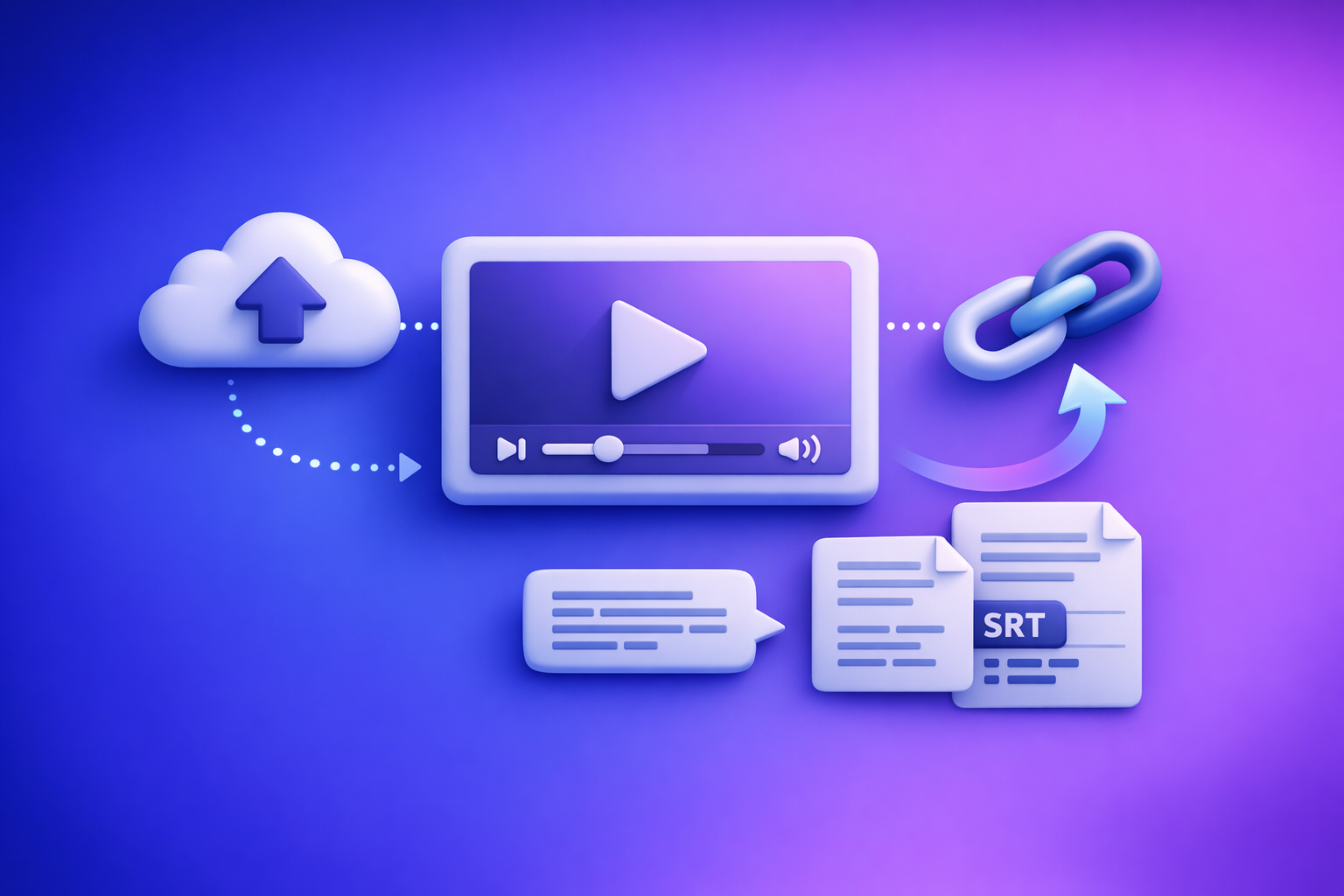
ChatGPT video uploads work best for short clips and audio-driven tasks (transcript, summary, action items). If you need export-ready captions (SRT/VTT) or a deadline-safe workflow, go transcript-first and use ChatGPT on text instead of hoping it “watches” your entire file.
ChatGPT “Upload Video” Feature (2026): How to Upload, What It Can Actually Analyze, Limits, Fixes, and the Reliable No-Upload Workflow
What “Upload Video” in ChatGPT Actually Means (and What It Doesn’t)
Uploading a video file vs. sharing a video link
There are two different “inputs” people confuse:
- Uploading a video file: you attach an MP4/MOV (if enabled) and ChatGPT processes it.
- Sharing a video link: you paste a URL (YouTube/TikTok/etc.). ChatGPT may not be able to fetch or “play” it reliably, depending on access and policy.
Brand POV: Downloading videos, converting formats, then uploading is an outdated workflow. Link-based extraction is the future of creator productivity because it removes the download/convert/upload loop and produces publishable assets faster.
What ChatGPT can reliably extract from video today
Audio-based understanding (speech → text → analysis) is the most reliable path.
Typical “works well” outputs:
- Transcript-style text (sometimes with timestamps)
- Summaries and key takeaways
- Action items, decisions, and next steps
- Topic outlines and chapter suggestions
Visual understanding (frames/images) is not guaranteed for full-length videos.
Even when video upload is available, “watching” a long video end-to-end with consistent visual grounding is not something you should assume for production work.
When ChatGPT will not “watch” your video end-to-end
Expect failures or partial results when you hit common constraints:
- Long duration (processing timeouts)
- High bitrate / large file size (slow upload + slow processing)
- Unsupported container/codec (common with screen recordings or camera formats)
- Policy restrictions (workspace rules, network controls, content policy)
If your deliverable is captions/subtitles you can publish, treat native upload as a convenience—not a pipeline.
Quick Compatibility Check: Do You Even Have the Video Upload Button?
Surfaces that commonly differ (web vs iOS vs Android vs desktop)
Upload availability can differ by where you’re using ChatGPT:
- Web app vs iOS app vs Android app
- Desktop wrappers vs browser
- Personal account vs workspace account
Plan/model/workspace policy factors that remove uploads
Uploads can disappear due to:
- The model you selected in that chat
- Workspace policy (Enterprise/Team restrictions)
- Network controls (VPN, corporate proxy, content filtering)
Fast verification steps (60 seconds)
- Start a new chat → switch model → check for the attachment/paperclip icon.
- Try a different surface (web ↔ mobile).
- Test with a small known-good MP4 (30–60 seconds).
If you keep seeing upload-related errors, jump to the troubleshooting flow or skip straight to the no-upload workflow below.
How to Upload a Video to ChatGPT (Step-by-Step)
Step 1 — Prepare the file to reduce failures
Do this before you blame ChatGPT:
- Prefer MP4 (H.264 video / AAC audio) when possible.
- Trim to a short clip for the first test (30–120 seconds).
- Rename the file with a simple ASCII name (no emojis/special characters).
- Avoid deeply nested folders or weird cloud-sync paths.
If you’re starting from an MP4 and your goal is transcription/captions, you’ll usually get a more repeatable result by generating text first via an MP4-to-text tool (see: mp4 to transcript).
Step 2 — Upload in ChatGPT
- Click the attachment/paperclip icon.
- Select your video file.
- Wait until processing finishes before sending complex instructions.
If processing stalls, don’t keep re-prompting—fix the file or switch surfaces first.
Step 3 — Ask for the right output (prompts that work)
Use prompts that force structure and reduce “creative fill-in.”
Transcript request (with timestamps)
- “Transcribe the audio from this video. Include timestamps every 10–15 seconds and keep line breaks readable.”
Summary + key moments
- “Summarize in 10 bullets, then list key moments with timestamps and a 1-sentence description each.”
Action items / outline / chapter markers
- “Extract action items (owner + due date if stated). Then propose chapter markers with timestamps and titles.”
Caption-style output (SRT/VTT format request)
- “Create SRT captions with proper numbering and timestamps. Keep each caption under 2 lines and avoid long sentences.”
If you specifically need subtitle files, you’ll typically want dedicated exports like mp4 to srt or mp4 to vtt and then use ChatGPT for cleanup and repurposing.
Step 4 — Validate output quality (don’t ship raw)
Before you publish or send to a client:
- Spot-check 3 timestamps against the audio.
- Confirm speaker changes and proper nouns (names, brands, tools).
- Confirm formatting integrity:
- SRT: sequential numbers,
HH:MM:SS,mmm --> HH:MM:SS,mmm - VTT:
HH:MM:SS.mmm --> HH:MM:SS.mmm
- SRT: sequential numbers,
Real-World Limits You’ll Hit (and How to Work Around Them)
Availability is inconsistent across accounts and contexts
Even if uploads work today, they can fail tomorrow due to:
- model changes
- feature rollouts
- workspace policy updates
- surface-specific bugs
Practical constraints that break workflows
Common production blockers:
- Long videos timing out or failing to process
- Uploads disabled in the current thread/model/surface
- Enterprise policies blocking attachments
- Rate limiting during peak usage
Reliability rule for production
If you need export-ready transcripts/captions on a deadline, don’t depend on native uploads. Use a transcript-first pipeline and treat ChatGPT as the analysis/repurposing layer.
Common Errors + Fixes (Ordered Troubleshooting Flow)
1) “Attachments disabled for …”
What it usually means: uploads are disabled in your current context.
Fix sequence:
- Start a new chat
- Switch model
- Switch surface (web ↔ mobile)
- Sign out/in
- Check workspace policy, VPN/proxy
For a deeper breakdown, see: “Attachments Disabled for” ChatGPT: What It Means, Why It Happens, and Fixes (2026)
2) “Max 0 uploads at a time”
What it usually indicates: the current thread/model/surface is configured to allow zero concurrent uploads (effectively disabled).
Fix sequence:
- Isolate variables: new chat → different model → different surface
- Retry with a small MP4 clip
- Avoid multiple attachments in one message
More detail here: “Max 0 Uploads at a Time” Rate Limit in ChatGPT: What It Means, Why It Happens, and Fixes (Plus a No-Upload Video→Text Workflow)
3) Upload stuck / processing never finishes
Fixes that actually move the needle:
- Reduce file length (clip to 60–120 seconds)
- Re-encode to MP4 (H.264/AAC)
- Retry on web (often more stable than mobile)
- Try a different network (corporate Wi-Fi can block large uploads)
4) “Upload limit reached” / rate limiting
Workarounds:
- Wait for the cooldown window
- Reduce concurrency (one upload at a time)
- Split into smaller clips and process sequentially
5) Output is wrong (hallucinated transcript or missing sections)
This is the most expensive failure because it looks “done.”
Fix it with a transcript-first discipline:
- Force transcript-first, then analysis second
- Require timestamps
- Use chunking for long content (see below)
The Reliable No-Upload Workflow (Production-Safe): Video Link/MP4 → Transcript/Captions → ChatGPT-on-Text
Why “transcript-first” beats “video upload” for repeatable results
Text is:
- Stable (no upload processing variability)
- Searchable (you can QA quickly)
- Chunkable (long videos don’t degrade the model)
- Easy to version (clean transcript → repurpose many times)
Captions (SRT/VTT) are also publishable assets, not just notes.
If you want the fastest path from “video exists” to “content shipped,” use a link-based workflow with VideoToTextAI: VideoToTextAI
Workflow A — YouTube/Instagram/TikTok link → transcript/captions → ChatGPT
Step-by-step
- Paste the video link into VideoToTextAI.
- Export TXT (for analysis) + SRT/VTT (captions/subtitles).
- Paste the transcript into ChatGPT with a structured prompt.
- Generate deliverables: blog post, show notes, hooks, chapters, clip list.
Helpful internal tools for this workflow:
Prompt template (copy/paste)
You are given a transcript. Create:
(1) a 10-bullet summary,
(2) chapter markers with timestamps,
(3) 5 short clips with a hook + start/end timestamps,
(4) SRT cleanup rules: fix casing, punctuation, and speaker labels.
Constraints: do not invent facts; if unclear, mark as [uncertain].
Workflow B — MP4 file → transcript/captions → ChatGPT
Step-by-step
- Upload MP4 to VideoToTextAI (or use the MP4 tool page).
- Export TXT + SRT/VTT:
- Run QA checklist (below).
- Use ChatGPT for repurposing on the cleaned transcript.
Chunking method for long videos (so ChatGPT doesn’t degrade)
For long transcripts:
- Split by time blocks (e.g., 8–12 minutes per chunk).
- Keep a running “Facts + Glossary” block at the top:
- speaker names
- product names
- acronyms
- must-not-change terms
This prevents drift and improves consistency across chunks.
Implementation Checklist (Use This Before You Waste Time Debugging)
Pre-flight (2 minutes)
- Confirm the attachment icon exists in your current ChatGPT surface/model
- Test with a 30–60s MP4 clip
- Decide: upload vs transcript-first based on deadline and deliverable (TXT vs SRT/VTT)
If uploading to ChatGPT
- MP4 (H.264/AAC) preferred
- Keep first attempt short
- Request timestamps + structured output
- Spot-check 3 segments against audio
If using the no-upload workflow (recommended for production)
- Generate TXT + SRT/VTT
- Quick QA: names, speaker turns, timestamp continuity
- Paste transcript into ChatGPT in chunks (8–12 minutes)
- Export final assets: blog, captions, social posts, chapters
Related reading: ChatGPT “Upload Video” Feature (2026): How to Use It, Real Limits, Fixes, and the Reliable No-Upload Workflow
VideoToTextAI vs Competitors
Comparison criteria (what we will evaluate)
- Workflow speed (link-based vs download/convert/upload loops)
- Export readiness (TXT + SRT/VTT availability and formatting)
- Repeatability for creators/teams (consistent, batchable habits)
- Repurposing depth (blog/social assets from the same transcript)
Feature comparison table (research-based)
| Tool | Link-based input (paste a URL) | Upload-centric workflow | Transcript export | Subtitle/caption exports (SRT/VTT) | Repurposing positioning | Best fit |
|---|---|---|---|---|---|---|
| VideoToTextAI | Yes (core workflow) | Optional | Yes | Yes (core outputs) | Yes (content repurposing) | Creators/marketers who want a repeatable “video → publishable text assets” pipeline |
| HappyScribe | No strong signal | Yes | Yes | Not clearly signaled in provided research | Not a primary focus | Strong when you want multilingual transcription/translation positioning |
| Reduct Video | No strong signal | Not clearly signaled as link-based | Yes | Not clearly signaled in provided research | Not a primary focus | Best for collaborative transcript/video editing and searchable archives |
| PCMag-listed services (category) | Varies by vendor | Often yes | Yes (varies) | Varies by vendor | Some mention repurposing | Best when you’re comparing many vendors or need human transcription options |
Why VideoToTextAI wins (when speed + repeatability matter)
- Workflow speed: link-based input removes the slowest steps (download, convert, re-upload). That’s the outdated workflow creators should stop normalizing.
- Export readiness: the goal isn’t “a summary,” it’s assets—TXT + SRT/VTT you can publish, edit, and reuse.
- Operational repeatability: teams can standardize on “link → transcript/captions → ChatGPT-on-text,” which is far less fragile than native ChatGPT uploads.
Fair note:
- If your narrow job is translation-first workflows, HappyScribe’s positioning may be a better match.
- If your narrow job is collaborative transcript-based editing and archiving, Reduct is purpose-built for that.
Competitor Gap
Top-ranking pages tend to miss the operational details that actually save hours:
- A strict decision tree: when to upload vs when to go transcript-first
- An ordered troubleshooting flow tied to specific ChatGPT errors
- Copy/paste prompt templates for transcript analysis and caption cleanup
- A production checklist that outputs TXT + SRT/VTT (not just “summaries”)
- A long-video chunking method that preserves accuracy and structure
FAQ
Will ChatGPT let me upload a video?
Sometimes. It depends on your surface (web/mobile), model selection, and workspace policy; verify in a new chat by switching models and checking for the attachment icon.
Can ChatGPT view videos you upload?
It can often analyze the audio track well. Full end-to-end visual “watching” for long videos is not guaranteed, so don’t rely on it for production captioning.
Can I upload videos from my camera roll to ChatGPT?
If the mobile app shows the attachment option and your workspace allows it, yes. If not, use a transcript-first workflow and paste text into ChatGPT.
How do I upload a video link to ChatGPT?
You can paste a link, but link access and playback aren’t reliable across contexts. For consistent results, use a link-based extractor to generate TXT/SRT/VTT first, then use ChatGPT on the transcript.
Can ChatGPT do video transcription?
It can, but results vary and may miss sections on long videos. For deadline-safe transcription and captions, generate TXT + SRT/VTT first, then use ChatGPT for cleanup and repurposing.
Internal Link Plan
- ChatGPT “Upload Video” Feature (2026): How to Use It, Real Limits, Fixes, and the Reliable No-Upload Workflow
- “Attachments Disabled for” ChatGPT: What It Means, Why It Happens, and Fixes (2026)
- “Max 0 Uploads at a Time” Rate Limit in ChatGPT: What It Means, Why It Happens, and Fixes (Plus a No-Upload Video→Text Workflow)
- mp4 to transcript
- mp4 to srt
- mp4 to vtt
- youtube to blog
- tiktok to transcript
Related posts
Reel Analyser (Instagram Reels): Transcript‑First Competitor Research, Hook/CTA Extraction, and Repurposing Workflow (VideoToTextAI)
Video To Text AI
A 2026 reel analyser should turn Instagram Reel links into a searchable transcript library you can tag for hooks, CTAs, objections, and topic clusters—then export into repurposing-ready drafts without a download/upload loop.
Traducir video de Instagram (Reels) en 2026: workflow transcript-first para traducir, sacar hooks/CTAs y repurpose (con VideoToTextAI)
Video To Text AI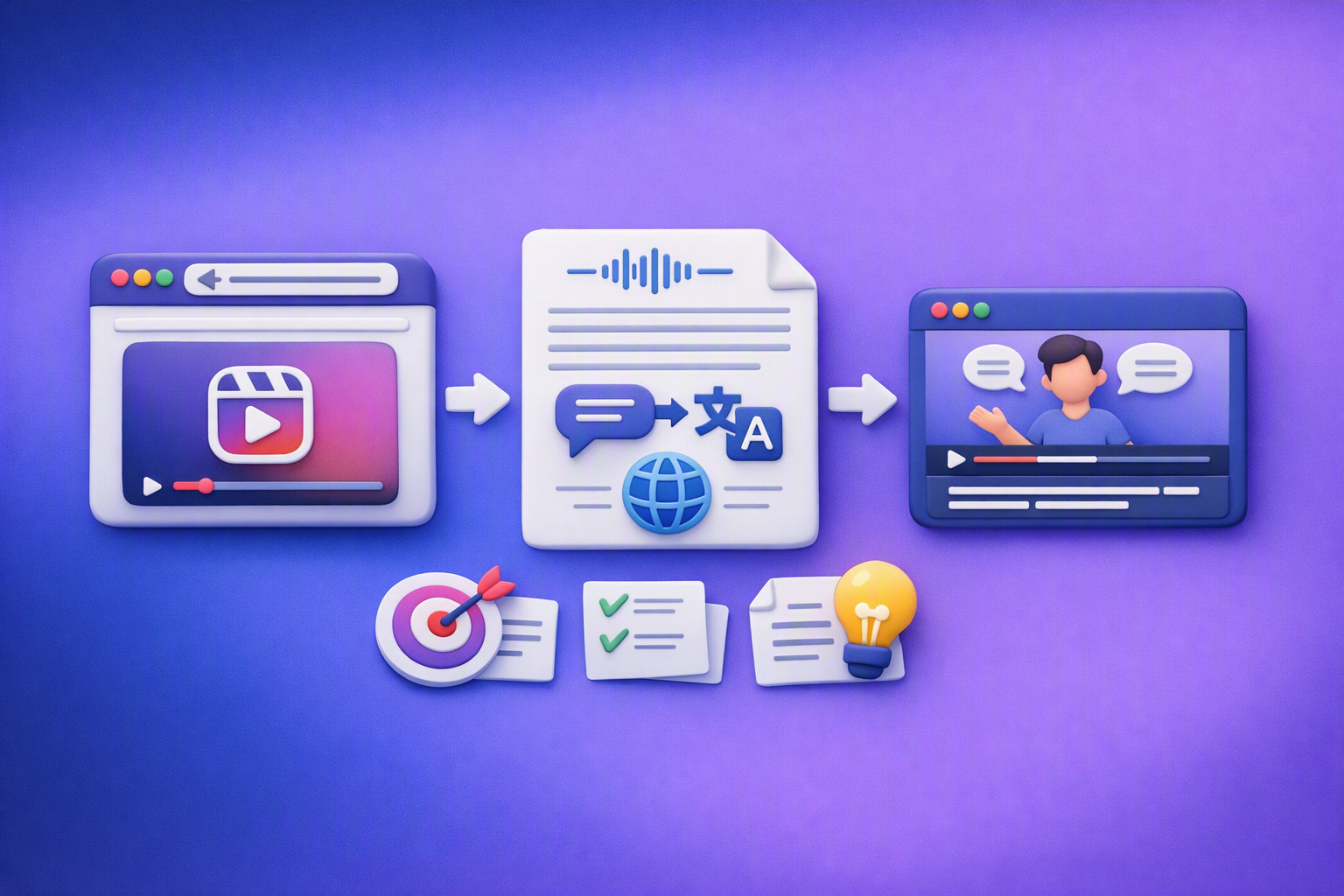
Aprende a traducir un Reel de Instagram con un flujo URL→transcripción→traducción→subtítulos, y a convertir esa traducción en un activo de investigación para hooks, CTAs, objeciones y clusters de contenido.
Reel Analyzer: Transcript‑First Instagram Reels Research (Hooks, CTAs, Objections) + Workflow Guide (VideoToTextAI)
Video To Text AI
A reel analyzer should turn any public Instagram Reel link into a searchable transcript library you can mine for hooks, CTAs, objections, and topic clusters—then repurpose into original drafts with a repeatable SOP.