
“Attachments Disabled for” ChatGPT: Meaning, Causes, Fixes, and the No-Upload Workflow (2026)
 Video To Text AI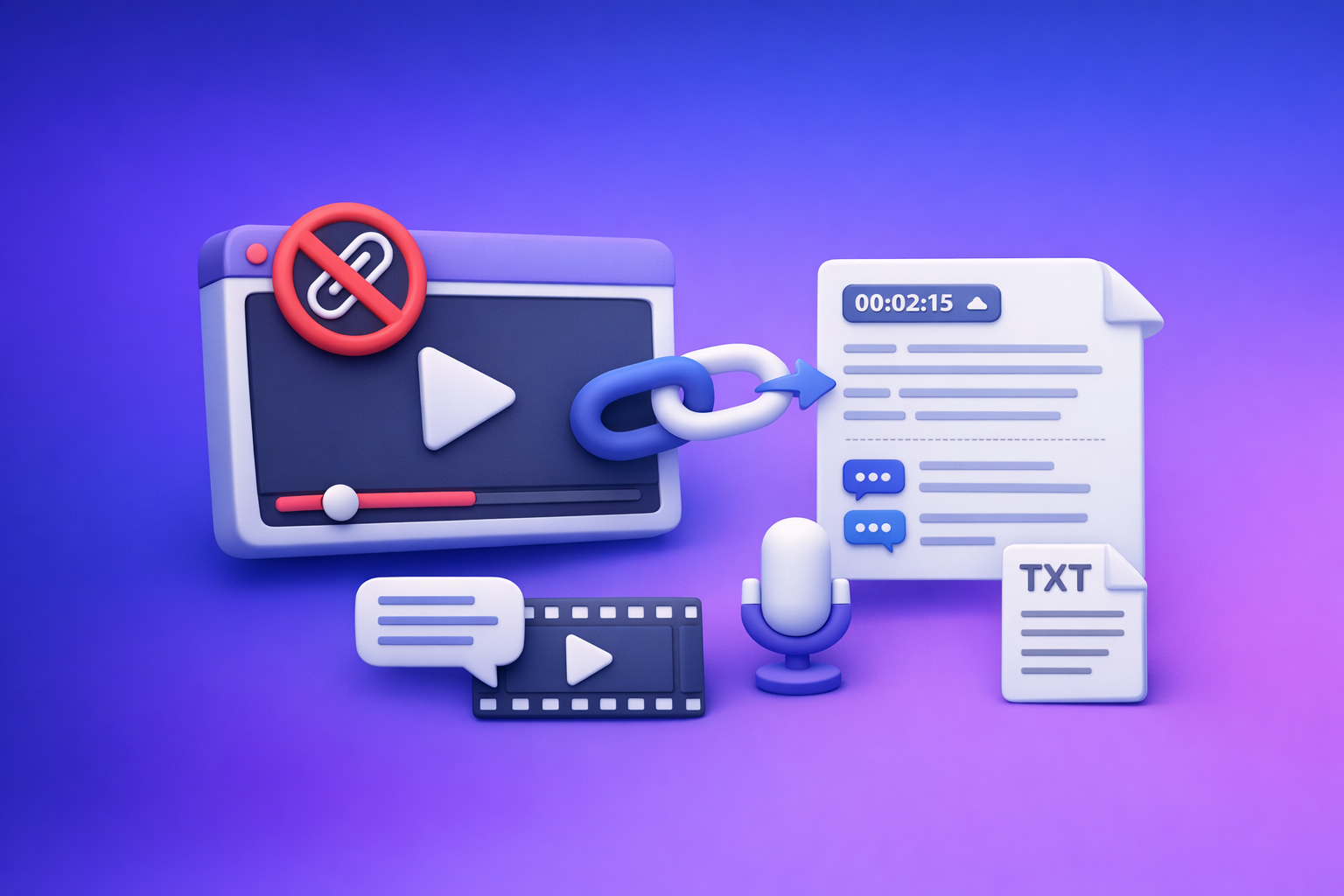
If you see “attachments disabled for …” or “Max 0 uploads at a time”, stop guessing and run a 2-minute isolation test (surface → model → thread → policy → network). If uploads still won’t come back, bypass file handling entirely with a transcript-first, link-based workflow that keeps production moving.
What “attachments disabled for” means (and what it does not mean)
The exact behavior you’ll see
Common symptoms include:
- The paperclip/upload button is missing or greyed out
- An error banner that reads “attachments disabled for …”
- A quota-like message such as “Max 0 uploads at a time” instead of a normal upload flow
These symptoms usually mean the upload tool is not available in your current context (chat thread, model/mode, surface, policy, or network).
What it’s not
Don’t assume:
- It’s proof your file is corrupted
- It’s always a plan/subscription issue
- It’s always a temporary outage
In practice, “disabled” is often deterministic: a specific setting, context, or restriction is blocking uploads.
Fast diagnosis: identify where uploads are blocked (2 minutes)
Step 1 — Confirm the surface (where you’re using ChatGPT)
Uploads can differ by surface. Verify:
- Web app vs desktop app vs mobile app
- An in-app browser (opening ChatGPT inside another app) vs a full browser (Chrome/Safari/Firefox)
Actionable test:
- Open ChatGPT in a full browser (not embedded) and check whether the upload control appears.
Step 2 — Confirm the model/tooling in the current chat
Uploads can be tied to the selected model/mode and the current thread state.
Do this:
- Switch to a model/chat mode that supports attachments (if available)
- Start a brand-new chat to rule out thread-level state
If uploads appear in a new chat, you’ve likely found a thread context issue.
Step 3 — Check account/workspace policy
If you’re in a managed environment:
- Personal account vs Team/Enterprise workspace
- Admin policy can disable uploads for the entire workspace
Quick confirmation:
- Ask a coworker in the same workspace to check if they also see “attachments disabled.”
Step 4 — Rule out local/network restrictions
Uploads can be blocked by:
- Corporate proxy/DLP tools
- VPNs
- School network filters
- Browser extensions that block scripts or upload endpoints
Fastest test:
- Try the same account on mobile data (cellular) vs office Wi‑Fi.
Step 5 — Validate it’s not a file-type/size constraint masquerading as “disabled”
Sometimes “disabled” is how the UI fails when it can’t initialize the upload flow.
Baseline tests:
- Try uploading a tiny TXT file first
- Then try a small image or PDF
If tiny files fail the same way, it’s likely not a file constraint.
Root causes (ranked by likelihood) + how to confirm each
Cause A — Uploads disabled in the current chat context (thread state)
Confirmation: uploads work in a new chat but not the current one.
Fix direction:
- Start a new thread
- Re-select the model/mode
- Re-check whether tools are enabled (where applicable)
Cause B — Model/surface mismatch (attachments not supported here)
Confirmation: uploads appear on web but not in desktop/mobile (or vice versa).
Fix direction:
- Switch surfaces (web ↔ desktop ↔ mobile)
- Switch model/mode and re-check tools
Cause C — Workspace/admin policy (Team/Enterprise)
Confirmation: multiple users in the same workspace see the same limitation.
Fix direction:
- Request admin enablement
- Use an approved no-upload workflow in the meantime
Cause D — Network controls (DLP/proxy/VPN) blocking upload endpoints
Confirmation: works on mobile data but not on office Wi‑Fi.
Fix direction:
- Change network (hotspot)
- Disable VPN temporarily
- Ask IT to whitelist required endpoints (if your org allows it)
Cause E — Browser/app issues (cache, extensions, outdated app)
Confirmation: works in incognito or another browser profile.
Fix direction:
- Clear site data for ChatGPT
- Disable extensions for the site
- Update the desktop/mobile app
Fixes that work (ordered, fastest-first)
1) Start a clean upload-capable session
Do this in order:
- Open ChatGPT in an incognito/private window (or a clean browser profile)
- Log in
- Create a new chat
- Check for the upload control
This isolates cached state, extensions, and thread-level issues quickly.
2) Switch surface (web ↔ desktop ↔ mobile)
Use surfaces as diagnostic tools:
- If mobile is blocked, test web on the same account
- If web is blocked, test mobile on cellular data
If one surface works, the issue is usually surface-specific (app version, embedded browser, or local restrictions).
3) Switch model/chat mode (and re-check tools)
In the same surface:
- Change the model selection
- If there’s a tools toggle, ensure file upload is enabled (when available)
If switching models restores uploads, the issue is likely mode/tool availability rather than your account.
4) Remove local blockers
Common culprits:
- Script blockers
- Privacy/security extensions
- Aggressive tracking protection settings
Fix steps:
- Disable extensions for the ChatGPT domain
- Clear cookies + cache for ChatGPT only
- Update the desktop/mobile app to the latest version
5) Isolate network restrictions
Run a simple A/B test:
- Test on a different network (mobile hotspot)
- Disable VPN temporarily
If uploads only fail on a corporate network, treat it as a policy/network issue, not a ChatGPT issue.
6) If you’re in a managed workspace: request the right policy change
Send your admin a specific request:
- Enable file uploads/attachments for the workspace
- Confirm allowed file types and size limits
- Confirm whether external link fetching is allowed (some orgs restrict it)
If you need more context on related symptoms, see:
- “Attachments Disabled for” ChatGPT: What It Means, Why It Happens, and Fixes (2026)
- “Max 0 Uploads at a Time” Rate Limit in ChatGPT: What It Means, Why It Happens, and Fixes (Plus a No-Upload Video→Text Workflow)
Step-by-step: ship your work without attachments (VideoToTextAI no-upload workflow)
When attachments are disabled, the fastest path is to stop trying to upload and move to a text-first pipeline. From a productivity standpoint, downloading video files is an outdated workflow; link-based extraction is the future of creator operations because it’s repeatable, shareable, and less fragile than uploads.
When to use this workflow
Use this immediately if:
- The upload button is missing/disabled
- You need reliable transcripts/captions/subtitles today
- You’re working with long videos where uploads often fail
Workflow A — Link-based video → transcript/captions → ChatGPT-on-text
-
Get a shareable link
Use a YouTube/Instagram/TikTok link or a public MP4 URL. -
Generate outputs in VideoToTextAI
Create:
- Transcript (TXT)
- Subtitles (SRT/VTT)
Helpful tool pages:
- Paste the transcript into ChatGPT (or split into chunks)
Then ask for:
- Summaries and outlines
- Blog drafts and email drafts
- Chaptering, titles, hooks, and repurposed posts
- Export final deliverables
Publish with:
- TXT transcript (for SEO, show notes, blogs)
- SRT/VTT captions (for platforms and editors)
If you’re specifically producing caption files, see:
One-time CTA: Run the no-upload workflow end-to-end at VideoToTextAI.
Workflow B — MP4 → text outputs (when links aren’t available)
If you only have a local file:
- Convert MP4 to transcript/subtitles in VideoToTextAI
- Treat the transcript as the source of truth for editing and repurposing
- Use ChatGPT only for text transformations, not file handling
Tool reference:
This keeps your pipeline stable even when ChatGPT upload tooling is unavailable.
Implementation checklist (copy/paste)
Uploads restoration checklist
- New chat created (thread reset)
- Tested web + mobile surfaces
- Tested incognito/clean profile
- Disabled extensions for ChatGPT
- Cleared site data for ChatGPT
- Tested different network / disabled VPN
- Confirmed workspace policy with admin (if applicable)
No-upload production checklist (VideoToTextAI)
- Video link or MP4 ready
- Generated TXT transcript
- Generated SRT or VTT captions
- Transcript cleaned (speaker labels, timestamps optional)
- ChatGPT prompts run on transcript (summary/chapters/repurpose)
- Final exports saved for publishing
VideoToTextAI vs Competitors
The competitor research block provided is disabled ("enabled": false) and contains no competitor profiles, so a factual, sourced comparison table can’t be produced without inventing claims. Below is a decision table that compares workflow approaches (not brands) so you can choose quickly without relying on attachments.
| Criteria | VideoToTextAI (link-based transcript-first) | Upload-to-ChatGPT workflow (attachments-dependent) | Manual transcription + editing |
|---|---|---|---|
| Reliability when ChatGPT attachments are disabled | High (doesn’t depend on ChatGPT uploads) | Low (blocked when uploads are disabled) | Medium (always possible, but slow) |
| Input options | Link-based ingestion + MP4 option | Requires upload availability | Any, but manual steps |
| Output formats | TXT + SRT/VTT export-ready | Depends on tools available in-session | Depends on your editor |
| Repurposing workflow | Transcript-first → paste into ChatGPT for transformations | Often starts with file handling inside ChatGPT | Manual copy/paste and rewriting |
| Speed to publish | Fast, repeatable steps | Variable; breaks when uploads fail | Slowest |
Where VideoToTextAI fits: it’s strongest when you want a repeatable, operational workflow that treats video as a source and text outputs as the production asset. That’s why link-based extraction is the future: it reduces “download → upload → fail → retry” loops and makes your pipeline resilient.
If your only task is a quick one-off analysis of a small file and uploads work, an attachments-dependent workflow can be fine. When uploads are blocked or unreliable, transcript-first wins on operational repeatability.
For more on video upload realities, see:
Competitor Gap
Most “attachments disabled” guides fail because they treat the problem like random troubleshooting. This post includes what’s usually missing:
- A deterministic isolation flow: surface → model → thread → policy → network
- A production-safe fallback that still ships deliverables: transcript-first, no-upload
- A checklist mapping each symptom to a specific test and fix
- Clear decision points for when to stop troubleshooting and bypass uploads
Decision point you can use:
If uploads are still disabled after (1) new chat + (2) surface switch + (3) different network, assume policy/network and move to the no-upload workflow.
FAQ (People Also Ask-aligned)
Why does ChatGPT say “attachments disabled for” my account?
Because the upload tool is unavailable in your current context. The most common causes are thread state, model/surface mismatch, workspace policy, or network controls.
Confirm by testing a new chat and a different surface (web vs mobile).
How do I enable attachments in ChatGPT?
You can’t always “enable” it yourself. Try:
- New chat + switch model/mode
- Switch surfaces (web/mobile)
- Clear site data and disable extensions
- If in Team/Enterprise, ask your admin to enable uploads
If it’s blocked by policy, use a no-upload transcript workflow.
Why do I see “Max 0 uploads at a time”?
It usually means the current session/thread/mode has no upload allowance or the upload tool failed to initialize due to policy/network restrictions.
Baseline-test with a tiny TXT file in a new chat and on a different network.
Does ChatGPT support video uploads, and why does it fail for long videos?
Video handling is often constrained by surface/tool availability, file size, and session stability. Long videos also increase the chance of timeouts and upload failures.
A transcript-first approach avoids long-file upload fragility entirely.
What’s the fastest workaround if uploads are blocked by my workplace policy?
Don’t fight the policy. Generate TXT + SRT/VTT outside ChatGPT, then paste the transcript into ChatGPT for summaries, chapters, and repurposing.
This keeps your workflow compliant and shippable even when attachments are disabled.
Related posts
Reel Analyser (Instagram Reels): Transcript‑First Competitor Research, Hook/CTA Extraction, and Repurposing Workflow (VideoToTextAI)
Video To Text AI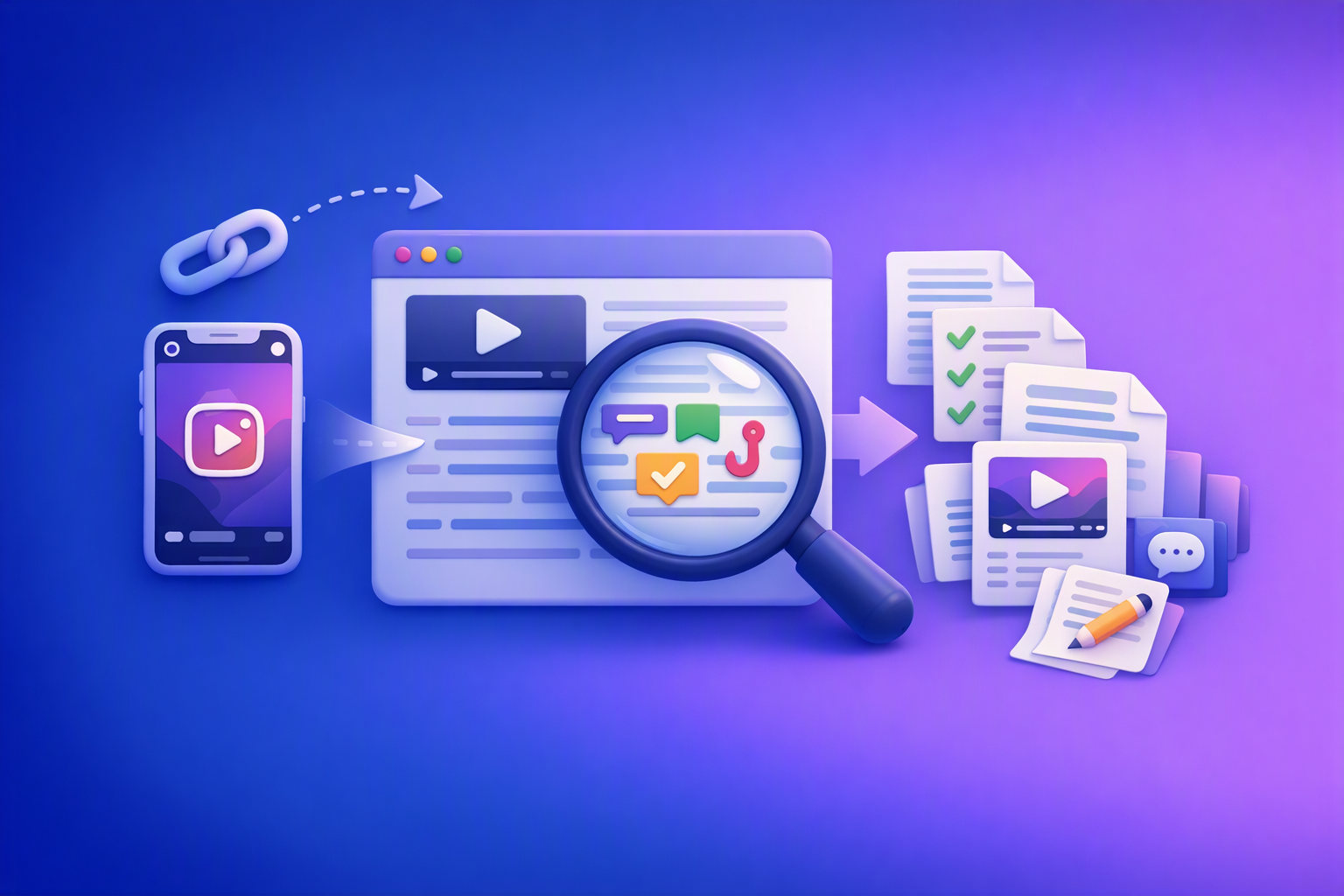
A 2026 reel analyser should turn Instagram Reel links into a searchable transcript library you can tag for hooks, CTAs, objections, and topic clusters—then export into repurposing-ready drafts without a download/upload loop.
Traducir video de Instagram (Reels) en 2026: workflow transcript-first para traducir, sacar hooks/CTAs y repurpose (con VideoToTextAI)
Video To Text AI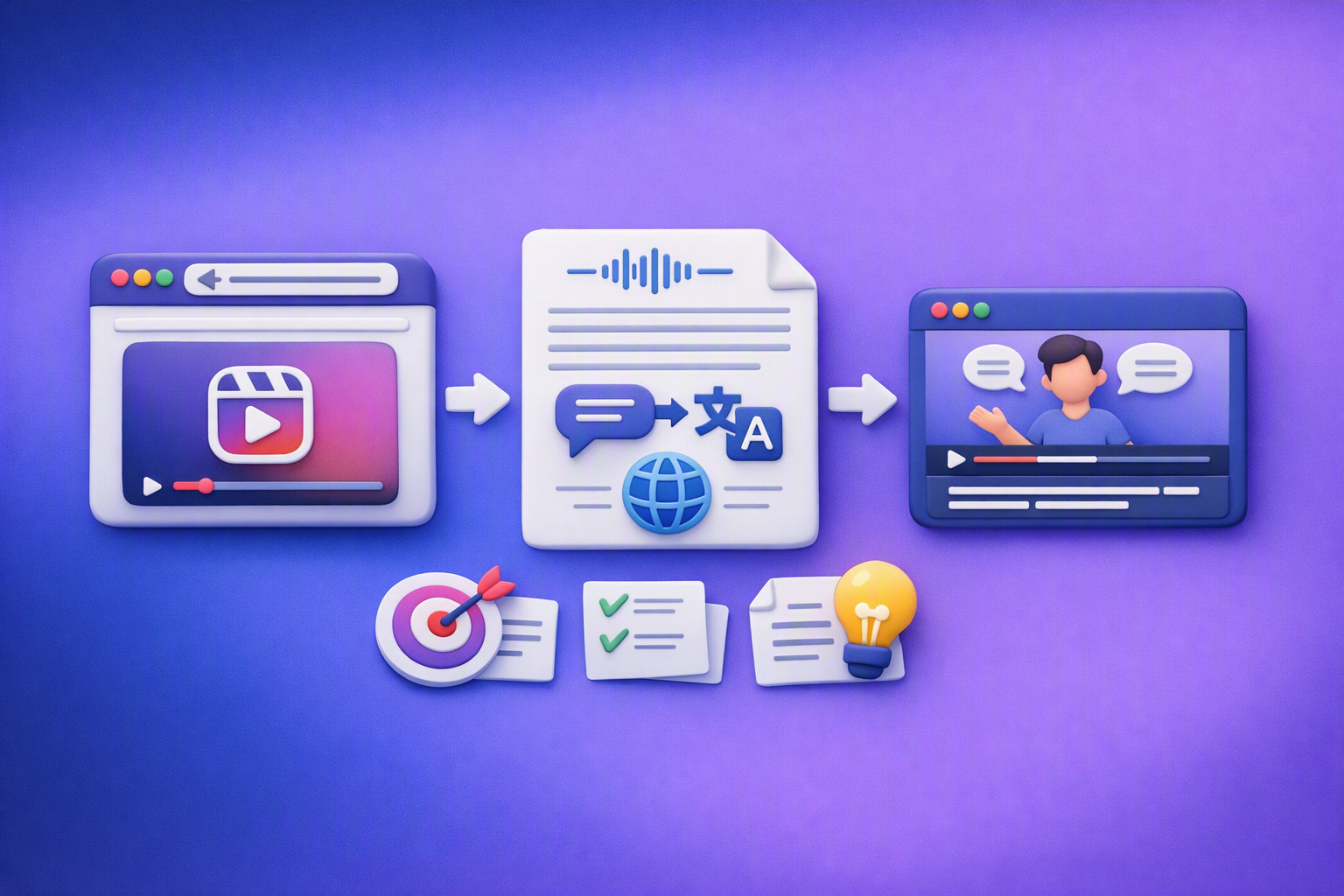
Aprende a traducir un Reel de Instagram con un flujo URL→transcripción→traducción→subtítulos, y a convertir esa traducción en un activo de investigación para hooks, CTAs, objeciones y clusters de contenido.
Reel Analyzer: Transcript‑First Instagram Reels Research (Hooks, CTAs, Objections) + Workflow Guide (VideoToTextAI)
Video To Text AI
A reel analyzer should turn any public Instagram Reel link into a searchable transcript library you can mine for hooks, CTAs, objections, and topic clusters—then repurpose into original drafts with a repeatable SOP.