
“Max 0 Uploads at a Time” Rate Limit in ChatGPT: What It Means, Why It Happens, and Fixes (Plus a No-Upload Video→Text Workflow)
 Video To Text AI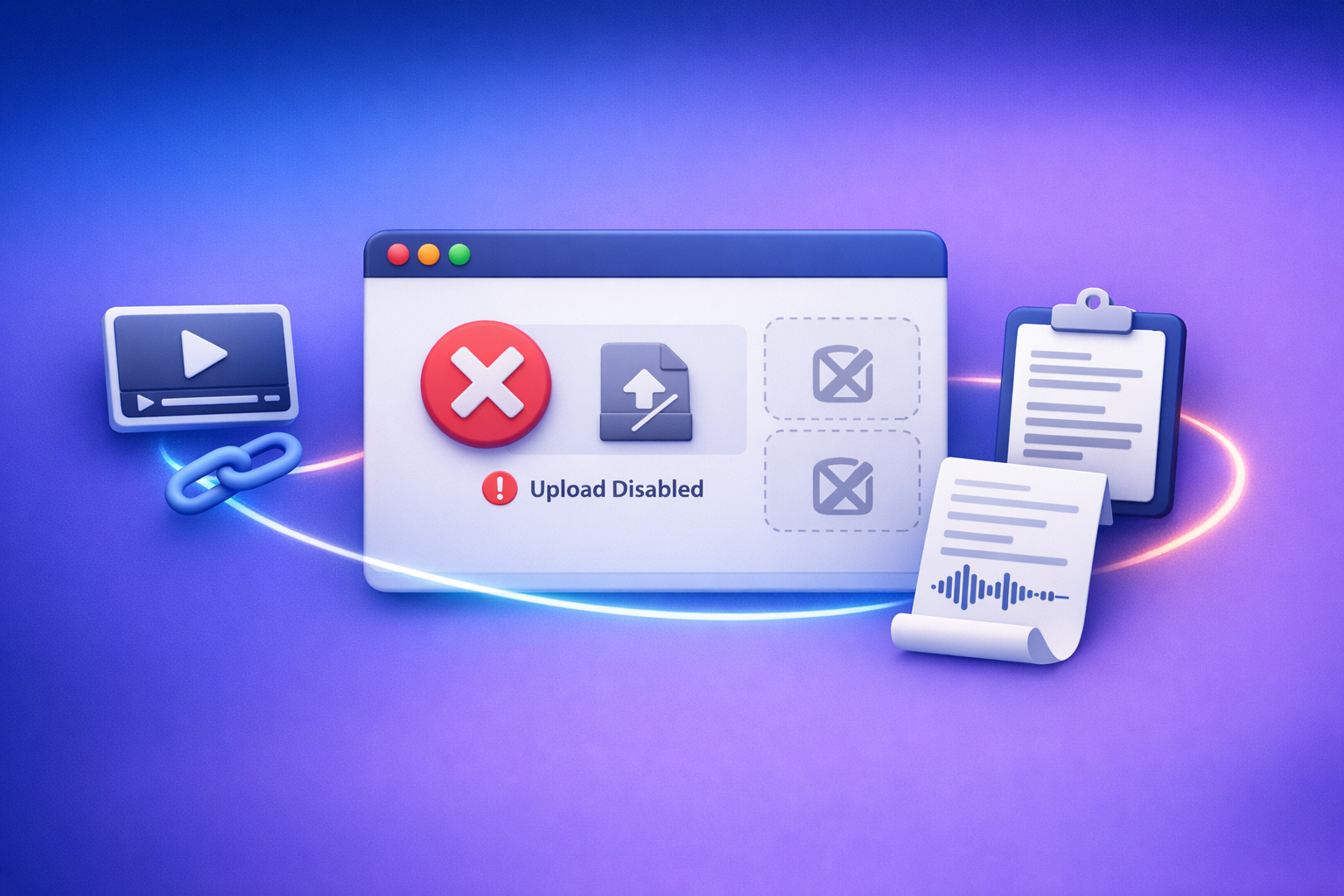
“Max 0 Uploads at a Time” Rate Limit in ChatGPT: What It Means, Why It Happens, and Fixes (Plus a No-Upload Video→Text Workflow)
Fix “max 0 uploads at a time” by isolating where uploads are disabled (thread, model, surface, workspace policy, or local/network) and applying the fastest fix for that layer. If you need output today, skip uploads entirely: generate a transcript + captions first, then use ChatGPT on text.
TL;DR (60 seconds)
What “max 0 uploads at a time” usually means
- Attachments are disabled in your current context, so ChatGPT reports a concurrent upload cap of 0.
- It feels like a rate limit, but it’s often a capability/policy/state issue.
Fastest fix path (do these in order)
- Start a new chat (thread reset).
- Switch models (pick an attachment-capable model if your UI offers it).
- Switch surfaces (web ↔ mobile ↔ desktop).
- Sign out/in + hard refresh.
- Incognito + extensions off, then alternate network (hotspot).
If you need output today: bypass uploads with a transcript-first workflow (VideoToTextAI)
- Downloading video files and re-uploading them is an outdated workflow.
- The future of creator productivity is link-based extraction → export-ready text assets → ChatGPT-on-text.
What “Max 0 Uploads at a Time” Means (and what it does NOT mean)
It’s a context-level attachment cap set to zero
“Max 0 uploads at a time” is a cap/permission flag: in this chat context, the maximum concurrent uploads is 0.
That can happen even if uploads work in another chat, another model, or another device.
Why it’s often misread as a “rate limit”
People search “max 0 uploads at a time” “rate limit” chatgpt because the symptom looks like throttling.
In practice, treat it as disabled attachments until you prove it’s a temporary cooldown.
What it does NOT indicate
Not a “bad file” / corrupted upload
- It’s not a file integrity error.
- You can see “max 0” even before selecting a file.
Not necessarily an unsupported format
- Unsupported formats usually fail after you attempt upload.
- “Max 0” is a pre-upload block.
Not proof your plan “lost” uploads permanently
- Many cases are thread/model/surface specific.
- Workspace policy can disable uploads, but that’s an admin setting—not “lost credits.”
Why You’re Seeing It: The 5 Places Uploads Get Disabled
1) Surface limitation (web vs iOS/Android vs desktop app)
Uploads can behave differently across:
- Browser sessions
- Mobile apps
- Desktop apps
2) Model limitation (attachment-capable vs not)
Some models/sessions support attachments; others don’t.
If the model you’re using doesn’t support attachments in your UI, you can see a “max 0” style cap.
3) Thread-level state (this chat is “stuck” without attachments)
A single conversation can get into a state where attachments are disabled.
This is why a new chat is often the fastest fix.
4) Workspace/admin policy (Team/Enterprise restrictions)
In Team/Enterprise environments, admins can restrict:
- Attachments
- Specific surfaces (web only, etc.)
- Which models are available
5) Local environment blocks (browser extensions, cookies, VPN, DLP/network)
Common culprits:
- Ad blockers / privacy tools / script blockers
- Corrupted cookies or local storage
- VPNs or corporate networks with DLP/proxy rules
Related: “Attachments Disabled for” ChatGPT: What It Means, Why It Happens, and Fixes (2026)
2-Minute Diagnosis: Identify the Block (Surface vs Model vs Thread vs Workspace vs Local)
Step 1 — Confirm it’s thread-specific (new chat test)
Open a brand-new chat and try attaching any small file.
Expected outcomes
- Works in new chat → the original thread is “stuck.” Use Fix 1.
- Fails in new chat too → move to Step 2 (model) and Step 3 (surface).
Step 2 — Confirm it’s model-specific (switch model test)
Switch to another model option in your UI and re-test attachments.
How to verify the model supports attachments in your UI
- Look for an attach/paperclip control that is enabled.
- If the UI disables the control or shows “max 0,” treat it as model capability (or policy).
Step 3 — Confirm it’s surface-specific (web ↔ mobile ↔ desktop)
Try the same action on another surface.
Quick matrix: where uploads commonly fail first
- Web browser: extensions, cookies, strict tracking protection
- Corporate desktop: DLP/proxy rules, managed devices
- Mobile: sometimes more permissive networks, fewer extensions
Step 4 — Confirm it’s workspace/policy-related (personal vs workspace)
If you can, test:
- Personal account (or personal workspace)
- Work Team/Enterprise workspace
Signals it’s an admin policy
- Uploads work personally but fail in workspace.
- Colleagues report the same limitation.
- Only certain models are available.
Step 5 — Confirm it’s local/network-related (clean browser + clean network)
Incognito + extensions off
- Open an incognito/private window.
- Disable extensions that can modify requests.
Alternate network (hotspot) test
- Switch from corporate Wi‑Fi to a mobile hotspot.
- If it works on hotspot, it’s likely network/DLP/proxy.
Fixes That Work (Ordered: fastest → slowest)
Fix 1 — Start a new chat (thread reset)
- Create a new conversation.
- Re-try the upload immediately.
Fix 2 — Switch surface (web ↔ mobile ↔ desktop)
- If web fails, try mobile.
- If mobile works, the issue is often browser/session/network.
Fix 3 — Switch to an attachment-capable model (if available)
- Use a model option in your UI that clearly supports attachments.
- Re-test in a new chat for clean isolation.
Fix 4 — Sign out/in + hard refresh (session reset)
- Sign out of ChatGPT.
- Hard refresh the page after signing back in.
Fix 5 — Remove local blockers
Disable extensions that modify requests (ad blockers, privacy tools, script blockers)
Temporarily disable:
- Ad blockers
- Privacy/tracker blockers
- Script blockers
- “Security” extensions that rewrite headers
Clear site data for ChatGPT domain (cookies + local storage)
- Clear cookies and local storage for the ChatGPT site.
- Restart the browser.
Fix 6 — Network isolation
Turn off VPN
VPNs can trigger security controls or route through restricted egress.
Try a different network (mobile hotspot)
If hotspot works, your primary network is the issue.
Corporate network/DLP: what to request from IT
Ask IT to confirm whether your network blocks:
- File upload endpoints
- WebSockets or streaming requests
- Domains/CDNs required for attachments
Fix 7 — Workspace/admin resolution (when it’s policy)
Exact admin ask: enable attachments for your workspace + confirm allowed surfaces/models
Send this to your admin:
- “Please confirm attachments/file uploads are enabled for our workspace.”
- “Which models and surfaces (web/mobile/desktop) are permitted for attachments?”
- “If restricted, can you enable attachments for my role or a test group?”
When It’s Actually a Rate Limit (and how to handle it)
Signals it’s a temporary cooldown (vs disabled attachments)
You’re more likely rate-limited if:
- Uploads worked recently in the same surface/model.
- The UI mentions waiting or trying later.
- The block appears after many rapid uploads.
How long to wait vs when to stop troubleshooting
- If you suspect a cooldown, wait 15–60 minutes and retry.
- If “max 0” persists across new chat + model + surface, stop waiting and treat it as policy/local/network.
How to reduce re-triggering limits
- Batch fewer files (avoid multi-file bursts).
- Space uploads (don’t rapid-fire).
- Prefer smaller artifacts: TXT exports over media whenever possible.
Implementation: Production-Safe No-Upload Workflow (Video → Text → ChatGPT)
Why “download → upload” is the fragile path
Downloading videos and re-uploading them creates avoidable failure points:
- Upload caps and attachment blocks
- Network/DLP restrictions
- Large file failures and timeouts
Downloading video files is an outdated workflow. Link-based extraction is the future because it’s faster, repeatable, and resilient when ChatGPT uploads are blocked.
Step-by-step: Link/MP4 → Transcript + Captions → ChatGPT-on-text (VideoToTextAI)
Step 1 — Start with a video link (YouTube/Instagram/TikTok) or MP4
Use the source you already have:
- Public link (best for speed)
- MP4 when you must work from a local file
Helpful tools:
Step 2 — Generate transcript + captions in export-ready formats
Export formats matter because they plug into editors, platforms, and QA workflows.
Choose outputs by use case
- TXT: editing, summarization, repurposing in ChatGPT
- SRT: subtitles for editors/platforms
- VTT: web captions + players
Tools:
Step 3 — Paste transcript into ChatGPT (chunking rules that prevent truncation)
Use text, not media.
Chunk size guideline
- Aim for ~1,000–2,000 words per message (or smaller if you see truncation).
- Keep speaker labels and timestamps if you need precise clip extraction.
Formatting template
PART 1/4
TITLE: <video title>
SOURCE: <link>
TRANSCRIPT:
[00:00] Speaker 1: ...
[00:12] Speaker 2: ...
...
END PART 1/4
Step 4 — Run repurposing prompts on text (not media)
Once the transcript is in ChatGPT, generate deliverables reliably.
Blog outline prompt
Using the transcript above, create:
1) A SEO blog outline with H2/H3s
2) 5 key takeaways
3) A meta title (<=60 chars) and meta description (<=155 chars)
Target audience: <...>
Primary keyword: <...>
Short-form clip captions prompt
From the transcript, identify 8 clip-worthy moments.
For each: timestamp range, hook line, on-screen captions (2 lines max), and a suggested title.
LinkedIn post prompt
Write 3 LinkedIn posts based on the transcript:
- 1 contrarian insight
- 1 tactical checklist
- 1 short story + lesson
Keep each under 1,200 characters.
If your goal is blog production from a video source, see: YouTube to Blog
Step 5 — QC checklist (accuracy + timestamps + speaker labels if needed)
- Spot-check unclear sections (names, numbers, jargon).
- Confirm timestamps align if you’re cutting clips.
- Normalize speaker labels if multiple voices matter.
If you want the fastest link-to-assets pipeline in one place, use VideoToTextAI: VideoToTextAI
Checklists (Fix uploads fast OR ship without uploads)
Upload fix checklist (10 minutes)
- New chat test
- Model switch test
- Surface switch test
- Sign out/in + hard refresh
- Incognito + extensions off
- Alternate network test
- Workspace policy confirmation
No-upload shipping checklist (15–30 minutes)
- Source link/MP4 ready
- Export TXT + SRT/VTT
- Paste transcript in chunks
- Generate deliverables (summary, blog, captions)
- Final QA pass + export
Common Scenarios (fastest correct response)
“Works on mobile but not web”
- Likely extensions/cookies or browser privacy settings.
- Fix: incognito + extensions off → clear site data → retry.
“Works in personal account but not Team/Enterprise”
- Likely workspace policy.
- Fix: ask admin to enable attachments and confirm allowed models/surfaces.
“Only fails in one specific chat”
- Likely thread-level state.
- Fix: start a new chat and continue there.
“Fails on corporate Wi‑Fi but works on hotspot”
- Likely DLP/proxy/network filtering.
- Fix: request IT review upload endpoints/domains; use transcript-first workflow meanwhile.
“Need captions today and can’t wait out a cooldown”
- Stop fighting uploads.
- Generate SRT/VTT first, then use ChatGPT on the transcript for repurposing.
VideoToTextAI vs Competitors
Below is a fair workflow comparison based on publicly observable positioning/features from the research set (no invented pricing/limits).
| Tool | Link-based input (paste a URL) | Export-ready formats (TXT/SRT/VTT) | Best fit | Where it can be slower / less resilient |
|---|---|---|---|---|
| VideoToTextAI | Yes (brand focus: link-based workflows) | Yes (transcript + captions exports) | Fast URL → publishable text assets, reliable when ChatGPT uploads are blocked (work on text exports) | Not positioned as a full collaborative video editor; it’s optimized for transcript/captions/repurposing workflows |
| Reduct Video | Not a strong public signal (research shows collaboration + transcript platform) | Transcript export is emphasized; subtitle export not strongly signaled | Team collaboration around transcripts, searching, highlighting, organizing spoken content | Less “link-first extraction” signaling; may be slower if your priority is URL → exports → repurpose rather than collaborative review |
| HappyScribe | Primarily upload-first in positioning (research shows “Upload your video”) | Transcript export is core; subtitle workflow exists but “no-upload resilience” is weaker | Multilingual transcription/translation options; editing in their environment | Upload-heavy flow adds friction when attachments/uploads are blocked elsewhere; link-first speed is not the main positioning |
| PCMag (buyer’s guide) | N/A | N/A | Shortlisting transcription services and understanding categories | Not a tool; won’t solve ChatGPT upload failures or provide an operational workflow |
Why VideoToTextAI wins for this specific problem (uploads blocked):
- Operational repeatability: you can keep shipping by moving to text-first inputs in ChatGPT.
- Workflow speed: link-based extraction avoids the slow “download → upload” loop.
- Export readiness: TXT/SRT/VTT outputs plug into editors, platforms, and QA without depending on ChatGPT attachments.
Where competitors can be better (narrower jobs):
- If you need a collaborative transcript archive with heavy team review features, Reduct Video can be a better fit.
- If you need broad language/translation options in a transcription suite, HappyScribe may be stronger.
Competitor Gap
What top results miss (and how this post will be better)
- They treat “max 0 uploads” as a generic rate limit instead of isolating the actual layer (thread/model/surface/workspace/local).
- They don’t provide a timed diagnosis flow (2-minute isolation + ordered fixes).
- They don’t offer a production-safe alternative when uploads stay blocked.
- They rarely specify export formats (TXT/SRT/VTT) and how to use them with ChatGPT.
Content additions to outperform
Decision tree: disabled vs rate-limited vs policy-blocked
- Only one chat fails → thread state → new chat.
- Only one model fails → model capability → switch model.
- Only one device fails → surface/local → incognito/extensions/network.
- Only workspace fails → admin policy → request enablement.
- Fails everywhere after heavy usage → possible cooldown → wait + reduce bursts.
Two checklists (10-minute fix + ship-without-uploads)
Use the checklists above to either restore uploads quickly or ship via transcript-first.
Step-by-step transcript-first pipeline with copy/paste templates
Use the chunking template and repurposing prompts above to keep output consistent.
FAQ
Does ChatGPT have a max upload limit?
Yes, but it’s not a single universal number you can rely on. Limits can vary by plan, model, surface, workspace policy, and temporary system conditions.
How long before ChatGPT allows more uploads?
If it’s a true cooldown, waiting 15–60 minutes often resolves it. If “max 0 uploads at a time” persists across new chat + model + surface, treat it as disabled attachments/policy/local blocks.
How many uploads does ChatGPT Plus allow per day?
There isn’t a stable public “per day” number that applies to all users and contexts. In practice, design workflows that don’t depend on uploads for critical delivery.
Can ChatGPT do video transcription?
Sometimes, but it’s not the most reliable production workflow. A transcript-first approach (generate TXT/SRT/VTT, then use ChatGPT on text) is more repeatable and resilient.
Is there a free AI to transcribe video to text?
Some tools offer free tiers, but free plans often limit minutes, exports, or features. For consistent publishing, prioritize export-ready outputs and link-based ingestion over one-off free conversions.
Internal Link Plan
- “Max 0 Uploads at a Time” Rate Limit in ChatGPT: What It Means, Why It Happens, and Fixes + a No-Upload Video→Text Workflow
- “Attachments Disabled for” ChatGPT: What It Means, Why It Happens, and Fixes (2026)
- ChatGPT “Upload Video” Feature (2026): How to Use It, Real Limits, Fixes, and the Reliable No-Upload Workflow
- MP4 to Transcript
- MP4 to SRT
- MP4 to VTT
- YouTube to Blog
- TikTok to Transcript
Related posts
Reel Analyser (Instagram Reels): Transcript‑First Competitor Research, Hook/CTA Extraction, and Repurposing Workflow (VideoToTextAI)
Video To Text AI
A 2026 reel analyser should turn Instagram Reel links into a searchable transcript library you can tag for hooks, CTAs, objections, and topic clusters—then export into repurposing-ready drafts without a download/upload loop.
Traducir video de Instagram (Reels) en 2026: workflow transcript-first para traducir, sacar hooks/CTAs y repurpose (con VideoToTextAI)
Video To Text AI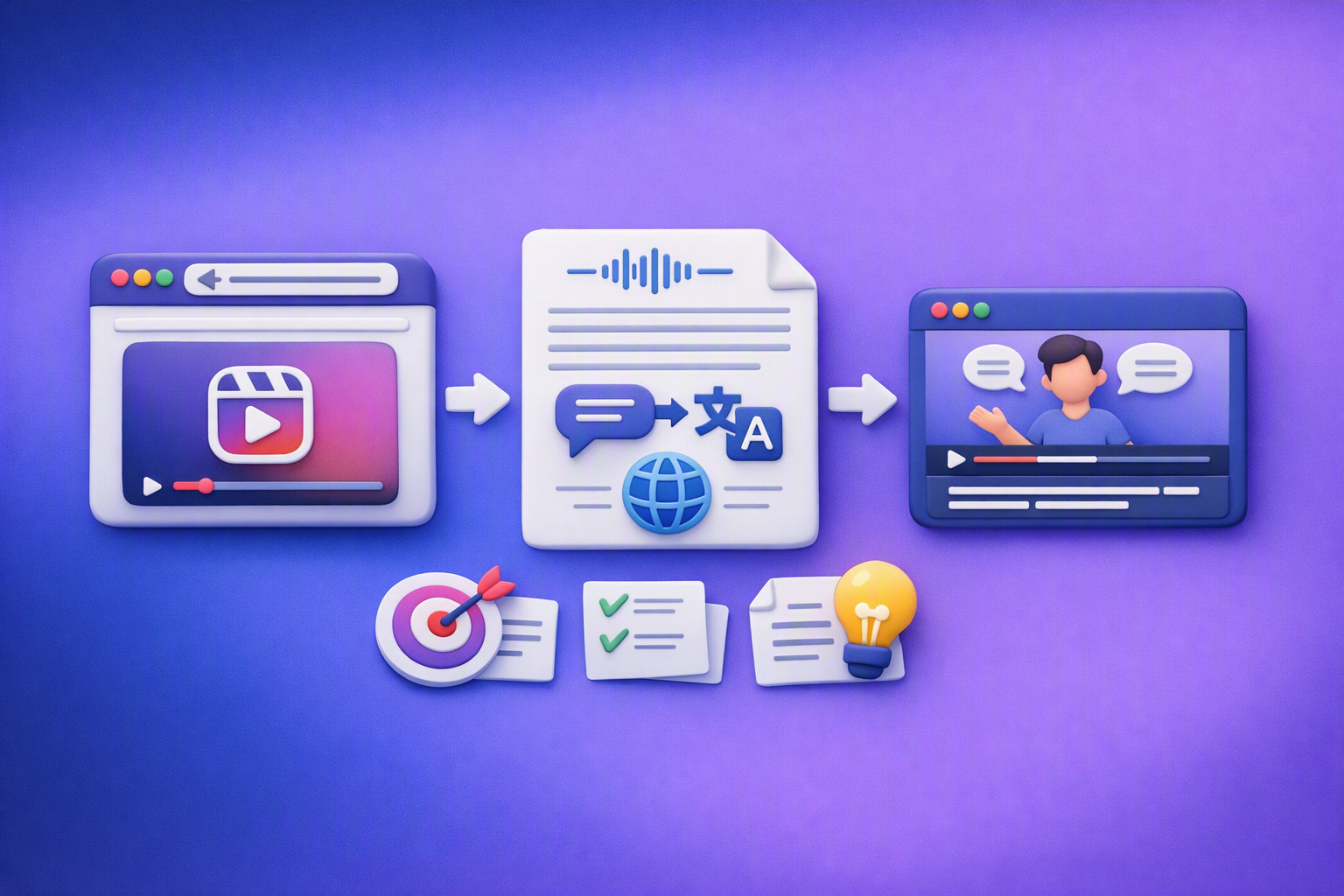
Aprende a traducir un Reel de Instagram con un flujo URL→transcripción→traducción→subtítulos, y a convertir esa traducción en un activo de investigación para hooks, CTAs, objeciones y clusters de contenido.
Reel Analyzer: Transcript‑First Instagram Reels Research (Hooks, CTAs, Objections) + Workflow Guide (VideoToTextAI)
Video To Text AI
A reel analyzer should turn any public Instagram Reel link into a searchable transcript library you can mine for hooks, CTAs, objections, and topic clusters—then repurpose into original drafts with a repeatable SOP.