
ChatGPT “Upload Video” Feature (2026): What Works, Why Uploads Fail, and the Production-Safe Link → Transcript Workflow
 Video To Text AI
ChatGPT “Upload Video” Feature (2026): What Works, Why Uploads Fail, and the Production-Safe Link → Transcript Workflow
If your goal is a ship-ready transcript and captions, stop treating ChatGPT “upload video” as the primary workflow. Use a deterministic link → transcript → captions pipeline first, then use ChatGPT on the text for repurposing.
Quick Answer: Can ChatGPT Upload Video?
Yes—sometimes, depending on your device/app, plan, and feature rollout. In practice, “upload video” can mean three different things, and that’s why expectations break.
What “upload video” means in practice (file upload vs. link access vs. frame analysis)
When people search for the "chatgpt" "upload video" feature, they usually mean one of these:
- File upload: attach an MP4/MOV directly in chat.
- Link access: paste a YouTube/Drive/Dropbox/social link and ask ChatGPT to “watch it.”
- Frame analysis: the model processes some visual frames (and sometimes audio) to answer questions.
These are not equivalent. A link paste is not guaranteed “access,” and an upload is not guaranteed “decoding + full-length processing.”
What ChatGPT is good at with video (analysis) vs. not reliable for (export-ready transcripts/captions)
Good at (when it works):
- High-level summaries and Q&A
- Topic extraction and chapter suggestions
- Identifying visible objects/scenes (depending on what it can actually process)
Not reliable for (production deliverables):
- Deterministic transcripts you can QA and ship
- Export-ready captions (SRT/VTT) with consistent timing
- Long-form processing without timeouts or partial coverage
If you need TXT + SRT/VTT that survives review, edits, and publishing, you want an artifact-first workflow.
When to stop trying native upload and switch workflows (decision rule)
Use this decision rule:
- If you need analysis-only and the clip is short, try ChatGPT upload/link access.
- If you need deliverables (TXT + SRT/VTT) or the video is long / client-facing / compliance-sensitive, switch immediately to a transcript-first pipeline.
Production rule: If you can’t tolerate “maybe it works,” don’t build on uploads.
What Works vs. What Fails (Real-World Scenarios)
Works reliably (low-risk use cases)
These are the safest uses of ChatGPT video handling:
- Short clips for quick Q&A (no need for perfect timecodes)
- Extracting high-level topics, objects, scenes (when upload/link access succeeds)
- Drafting hooks/titles based on what you describe or paste as notes
The key is you’re not depending on it for canonical outputs.
Often fails or becomes inconsistent
These scenarios commonly break:
- Long videos, high-res files, and variable codecs
- Links behind auth/paywalls/region locks (YouTube age-gate, Drive permissions, IG/TikTok restrictions)
- Anything requiring deterministic deliverables you can QA and ship (TXT + SRT/VTT)
If you’re doing creator or marketing ops at scale, downloading files and re-uploading them repeatedly is an outdated workflow. Link-based extraction is the future of creator productivity because it eliminates the “where is the file / which version / who has access” loop.
Requirements & Limits That Commonly Break “Upload Video”
Availability issues (why you don’t see the upload button)
If you don’t see an upload option, it’s usually not user error. Common causes:
- Client differences: web vs iOS vs Android vs desktop apps
- Plan/rollout variance: feature flags, staged rollouts, regional availability
- Account policy constraints: org/workspace restrictions
If your team needs a repeatable pipeline, don’t anchor it to UI availability.
File constraints that trigger failures
Even “supported” formats fail in real life because container ≠ codec.
Common failure triggers:
- Container vs codec mismatch: MP4 container doesn’t guarantee decodability (codec matters)
- Duration/size thresholds: timeouts, processing caps, unstable uploads
- Variable frame rate (VFR): common from phones and screen recorders; can break timing
- Audio track issues: multi-track audio, odd sample rates, or corrupted headers
Practical standardization (when you must upload a file):
- MP4 (H.264 video + AAC audio) is the safest baseline.
Link constraints that trigger failures
Link-based “watching” fails for predictable reasons:
- 403/401 permission errors (private Drive, unlisted but restricted, enterprise auth)
- Expiring signed URLs (temporary CDN links)
- Robots/anti-bot blocks and embedded players that don’t expose media directly
- Platform restrictions: TikTok/Instagram often block automated fetching
If the link isn’t truly public and directly accessible, assume it will fail.
Step-by-Step: Production-Safe Workflow (Video Link/MP4 → TXT + SRT/VTT → ChatGPT-on-Text)
This is the workflow you can standardize across a team and reuse for every video.
Goal and outputs (what you should end with)
Your canonical outputs should be:
- Transcript (TXT) as the source of truth
- Captions/subtitles (SRT/VTT) generated from the same pass for timing consistency
- Repurposed assets (blog, LinkedIn, X/Twitter, summaries) derived from the transcript
Step 1 — Choose your input type (link vs MP4)
Pick the input that reduces friction:
- Use a public link when possible (fastest). This avoids downloading, renaming, and version drift.
- Use MP4 upload when link access is restricted. If the platform blocks access, upload the file once to your transcription workflow.
If you’re still downloading videos “just to upload them again,” that’s the outdated part. The modern default is link-first.
Step 2 — Generate deterministic artifacts in VideoToTextAI
In VideoToTextAI, treat the transcript as the canonical artifact:
- Create the transcript first (source of truth)
- Generate SRT/VTT from the same transcript pass to keep sync consistent
Useful tool paths for teams:
If your input is a platform link, route it through purpose-built link workflows:
Step 3 — QA the artifacts before involving ChatGPT
Do a quick QA pass before you generate downstream content. Keep it lightweight and consistent:
- Spot-check names, numbers, acronyms (these are the highest-cost errors)
- Verify caption timing around cuts/scene changes
- Confirm speaker turns if needed (or label consistently as Speaker 1/2)
This is how you prevent “polished nonsense” from propagating into blogs and social posts.
Step 4 — Use ChatGPT on the text (what it’s best at)
Once you have clean text, ChatGPT becomes extremely effective:
- Summaries, chapters, titles, hooks, cut lists
- SEO blog draft from transcript
- Social post variants from the same transcript
This division of labor is the point: deterministic artifacts first, creative transformation second.
Step 5 — Export and publish (repeatable deliverables)
Make the workflow repeatable:
- Store TXT + SRT/VTT as canonical production outputs
- Keep prompts + settings as a reusable template for the team
- Regenerate captions after edits (don’t “patch” timing by hand unless necessary)
For an end-to-end link-based workflow, use exactly one canonical tool entry point: VideoToTextAI.
10–15 Minute Implementation Walkthrough (Copy/Paste Prompts Included)
Inputs you need
- Video URL (preferred) or MP4
- Target outputs:
- Transcript only, or
- Transcript + captions, or
- Transcript + captions + blog/social
Workflow runbook
- Paste link (or upload MP4) into VideoToTextAI
- Generate transcript (TXT)
- Generate captions (SRT and/or VTT)
- Open ChatGPT and paste transcript (or key sections)
- Run structured prompts (below)
Prompts (use on transcript text, not raw video)
1) Chaptering prompt (use transcript time markers if available)
You are an editor. Create 6–12 chapters from the transcript below.
Output as a table with: Chapter Title | Start Time | End Time | 1-sentence summary.
Use the transcript’s time markers when present; otherwise estimate based on context and note “estimated.”
Transcript:
[PASTE]
2) Summary + key takeaways prompt (bullet + short paragraph)
Summarize the transcript for a busy reader.
Output: (1) 5 bullet takeaways, (2) a 120–160 word summary paragraph, (3) 3 recommended next actions.
Transcript:
[PASTE]
3) Blog outline + draft prompt (H2/H3 + meta title/description)
Turn this transcript into an SEO blog post.
Requirements: H2/H3 structure, short paragraphs, include a meta title (<=60 chars) and meta description (<=155 chars).
Include a “Key Points” section and a “FAQ” section with 4 questions.
Transcript:
[PASTE]
4) Clip finder prompt (identify 5–10 quoteable moments with context)
Identify 5–10 clip moments from the transcript that would perform well as short-form content.
For each: timestamp (or approximate), the exact quote, 1 sentence of context, and a suggested hook text.
Transcript:
[PASTE]
Troubleshooting: “ChatGPT Video Upload Failed” (Fixes by Symptom)
Symptom: No upload button
- Check client/app version, plan, and region rollout
- Don’t block your workflow on UI availability—use the link-based transcript workflow as default
Symptom: Upload stuck / processing failed
- Re-encode to H.264 + AAC in MP4
- Reduce resolution/bitrate
- Trim to a short segment if you only need analysis (not deliverables)
Symptom: “Failed 403” / “Can’t access link”
- Remove auth requirements; set link to public
- Avoid expiring signed URLs
- If the platform blocks access, switch to MP4 upload into your transcript workflow, then use ChatGPT on text
Symptom: Transcript missing words / wrong names
- Treat ChatGPT output as non-canonical
- Regenerate transcript in VideoToTextAI and re-run repurposing
- Add a custom vocabulary QA list: names, products, acronyms, locations
Symptom: Captions out of sync after editing
- Regenerate SRT/VTT from the final cut
- Avoid mixing transcript from Cut A with captions from Cut B
- If you must edit video after captioning, plan a final “caption regen” step
Checklist: The Reliable Alternative to “Upload Video to ChatGPT”
Before you try ChatGPT upload
- Confirm the goal: analysis vs export-ready transcript/captions
- Confirm link accessibility: public, no login, no region lock
- Confirm file encoding (if uploading): MP4 (H.264/AAC) recommended
Production-safe default (recommended)
- Video link/MP4 → VideoToTextAI → TXT + SRT/VTT → ChatGPT-on-text
- Use artifact-first outputs as your canonical source:
- TXT for editorial
- SRT/VTT for publishing
Quality control (ship-ready)
- Spot-check 2–3 minutes per 10 minutes of content
- Verify proper nouns, numbers, and CTA lines
- Validate caption timing around cuts and music beds
- Keep a single source of truth per version (final cut = final captions)
Competitor Gap
What top-ranking pages typically miss
- A deterministic artifact-first pipeline (TXT + SRT/VTT as canonical outputs)
- Fast triage rules to stop wasting time on inconsistent uploads
- Concrete failure-mode mapping:
- 403/auth
- codec/container mismatch
- VFR timing drift
- timeouts/processing caps
- A QA checklist that matches real production needs (caption sync after edits, names/numbers)
What this post adds (differentiators)
- A clear decision rule: when ChatGPT upload is acceptable vs when it’s the wrong tool
- A step-by-step runbook with deliverables and QA gates
- Troubleshooting by symptom with production-safe fallbacks
- A modern POV: downloading video files is an outdated workflow; link-based extraction is the future for creator productivity and team throughput
FAQ
Does ChatGPT allow you to upload videos?
Sometimes. Availability varies by web vs iOS vs Android, plan tier, and rollout flags, and even when it’s available it’s not a dependable production pipeline for transcripts/captions.
Why can’t I upload videos to ChatGPT anymore?
Common causes include app version differences, feature rollbacks/flags, workspace restrictions, or regional availability. If you need consistent outputs, don’t wait on the button—use a link → transcript workflow.
Can I upload a video to ChatGPT to analyze?
Yes, for short clips and analysis-only tasks (Q&A, high-level summaries). For export-ready deliverables, generate TXT + SRT/VTT first, then use ChatGPT on the text.
Can you add videos from your camera roll to ChatGPT?
On some mobile clients, yes. Long duration, high resolution, VFR, or unstable networks often cause failures, so treat it as best-effort and keep a transcript-first fallback.
Can you upload videos to ChatGPT for free?
Free access and upload capabilities vary and change over time. Even with access, the reliability constraints (codecs, link permissions, timeouts) still apply—so the production-safe approach remains the same.
Internal Link Plan
Related posts
Reel Analyser (Instagram Reels): Transcript‑First Competitor Research, Hook/CTA Extraction, and Repurposing Workflow (VideoToTextAI)
Video To Text AI
A 2026 reel analyser should turn Instagram Reel links into a searchable transcript library you can tag for hooks, CTAs, objections, and topic clusters—then export into repurposing-ready drafts without a download/upload loop.
Traducir video de Instagram (Reels) en 2026: workflow transcript-first para traducir, sacar hooks/CTAs y repurpose (con VideoToTextAI)
Video To Text AI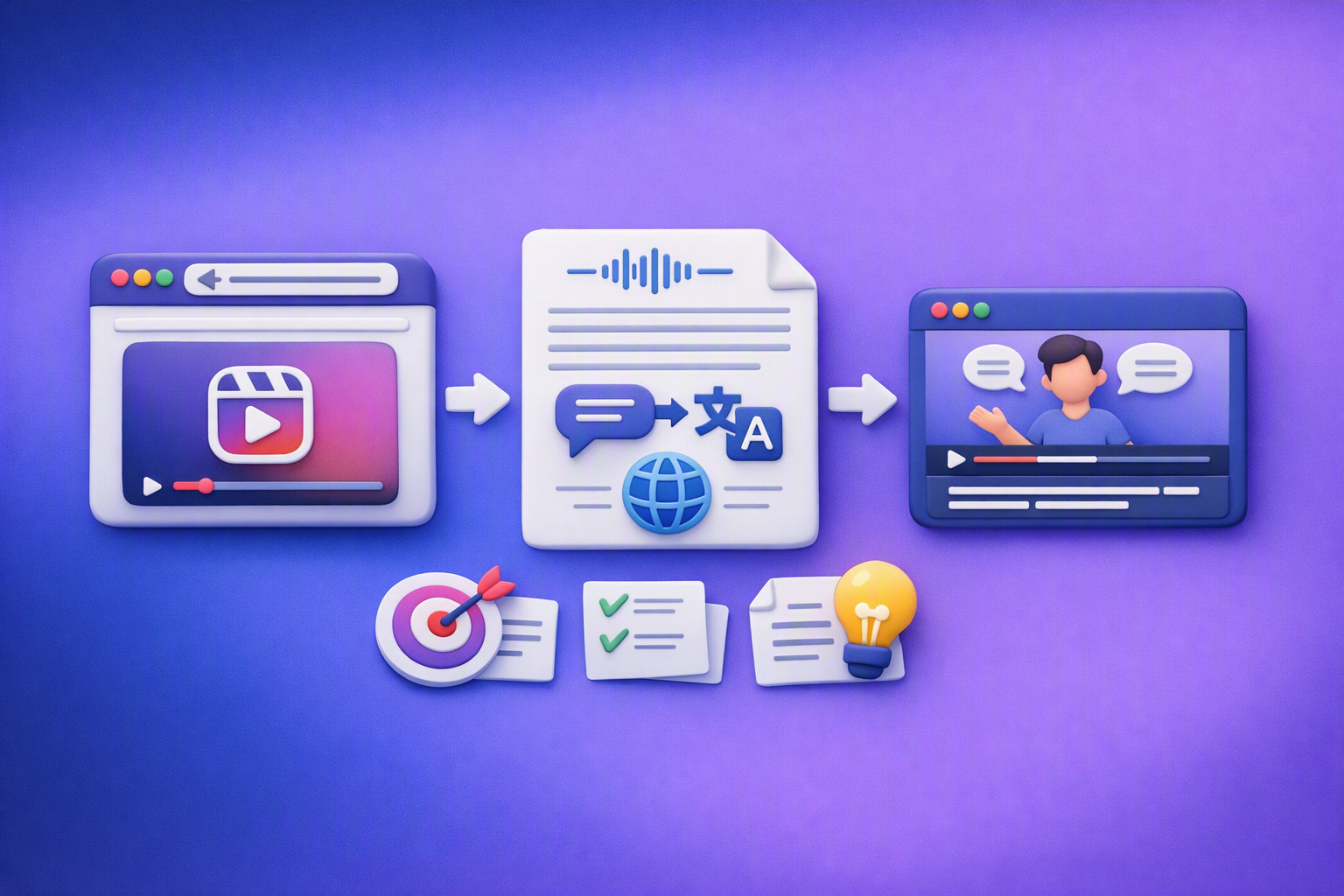
Aprende a traducir un Reel de Instagram con un flujo URL→transcripción→traducción→subtítulos, y a convertir esa traducción en un activo de investigación para hooks, CTAs, objeciones y clusters de contenido.
Reel Analyzer: Transcript‑First Instagram Reels Research (Hooks, CTAs, Objections) + Workflow Guide (VideoToTextAI)
Video To Text AI
A reel analyzer should turn any public Instagram Reel link into a searchable transcript library you can mine for hooks, CTAs, objections, and topic clusters—then repurpose into original drafts with a repeatable SOP.