
ChatGPT “Upload Video” Feature: What Works, Why Uploads Fail, and the Production-Safe Link → Transcript Workflow
 Video To Text AI
ChatGPT video upload is best for quick, low-stakes clip understanding, not for shipping transcripts and captions. If you need export-ready TXT + SRT/VTT today, use a production workflow: video link/MP4 → transcript/subtitles → ChatGPT-on-text.
ChatGPT “Upload Video” Feature: What Works, Why Uploads Fail, and the Production-Safe Link → Transcript Workflow
TL;DR (for teams who need transcripts/captions today)
- Use ChatGPT video upload for fast comprehension of short clips (summary, Q&A, rough outline).
- For deliverables (accurate transcript + SRT/VTT), use a deterministic pipeline: video link/MP4 → TXT + SRT/VTT → ChatGPT-on-text.
- This post includes:
- A failure triage you can run in 10 minutes
- A step-by-step workflow you can standardize across a team
- A QA checklist to avoid caption/transcript surprises
What “ChatGPT upload video” actually means (and what it doesn’t)
“Upload video” typically means ChatGPT can accept a video file (or sometimes a link, depending on client/plan) and attempt to interpret what happens in the clip. That’s different from producing repeatable, exportable transcription artifacts you can ship.
What ChatGPT can do with an uploaded video (best-case)
When everything works, ChatGPT can help with:
- High-level scene understanding and Q&A on short clips
- Rough summaries, topic extraction, and key points
- Basic timestamp references (often inconsistent across runs)
This is useful for quick analysis, internal review, or brainstorming.
What it’s not reliable for
If your output must be correct and reusable, video upload is not the safest path for:
- Complete, word-accurate transcripts for long videos
- Consistent subtitle exports (SRT/VTT) with correct timing
- Repeatable production workflows across teams, devices, and accounts
If you’re publishing captions, localizing content, or repurposing at scale, you want artifacts (TXT/SRT/VTT) you can store, edit, and QA.
When to use ChatGPT video upload vs. a link-based transcription workflow
The decision is simple: use upload for understanding, and use artifact-first for shipping.
Use ChatGPT upload video when
- The clip is short and you only need:
- a summary
- key moments
- a rough outline
- You can tolerate:
- missing segments
- imperfect wording
- inconsistent timestamps
- You don’t need SRT/VTT exports
Use a link/MP4 → transcript workflow when
- You need deliverables: TXT + SRT/VTT
- You need repeatability: same input → same output
- You need QA and editing before publishing
- You need downstream repurposing:
- blogs
- social posts
- scripts
- chapters
- cut lists
Brand POV (VideoToTextAI): downloading video files to “make AI work” is an outdated workflow. Link-based extraction is the future of creator productivity because it’s faster, more scalable, and easier to standardize across a team.
Why ChatGPT video uploads fail (root causes you can actually diagnose)
Most failures aren’t mysterious. They cluster into a few categories you can test quickly.
Access + permissions failures
Common issues:
- Private/unlisted links without access
- Region/account restrictions
- Signed URLs expiring mid-processing
- Corporate SSO or gated CDNs blocking retrieval
Diagnostic signal: the same video works for one teammate but not another, or works only when you make it public.
File/format failures
Even “MP4” isn’t a single format in practice. Failures often come from:
- Unsupported codec/container combinations (e.g., unusual H.265 profiles)
- Variable frame rate edge cases
- Audio track issues:
- missing audio track
- extremely low bitrate audio
- multiple tracks (wrong track selected)
- dual-mono or channel mapping weirdness
Diagnostic signal: upload completes, but processing fails or output is clearly missing speech.
Size/time failures
Limits vary by plan, client, and rollout, and can change without notice. Typical failure modes:
- File size limits and duration caps
- Timeouts on slow uploads
- Long processing windows that fail mid-way
Diagnostic signal: a short clip works, but the full-length video fails repeatedly.
Product/rollout variability
Even if documentation says “available,” real-world behavior differs:
- Feature not enabled on your account
- Different behavior on web vs. mobile vs. desktop app
- Temporary regressions during rollout
Diagnostic signal: you can’t reproduce the same result across devices or accounts.
10-minute triage: confirm whether the problem is the video, the upload, or the workflow
This triage isolates the failure domain quickly so you stop wasting cycles “trying again.”
Step 1: Identify your input type
Pick the bucket that matches your situation:
- Uploaded file (MP4/MOV)
- Public link (YouTube, TikTok, Instagram, etc.)
- Private link (Drive, Loom, internal CDN)
If it’s private, assume permissions are the first suspect.
Step 2: Run a fast “minimum viable test”
Create or export a 30–60s clip from the same source and try again.
Interpretation:
- Short clip works, full video fails → size/time limits
- Short clip fails too → format/audio/permissions (or feature rollout)
This single test prevents hours of guesswork.
Step 3: Check audio viability (the real transcript bottleneck)
Transcription quality is mostly an audio problem.
Verify:
- There is a clear primary audio track
- Speech is not buried under music
- Speakers aren’t constantly overlapping
- The mic isn’t clipping or heavily distorted
If audio is noisy, expect errors regardless of tool. Your best “fix” is often audio cleanup or re-recording, not a different uploader.
Step 4: Decide the path
If you need exports + reliability, stop debugging uploads and switch to an artifact-first workflow.
That means: generate TXT + SRT/VTT first, then use ChatGPT on text.
Production-safe workflow: video link/MP4 → TXT + SRT/VTT → ChatGPT-on-text (VideoToTextAI)
This is the workflow you can standardize across a team, document in SOPs, and QA before publishing.
Why “artifact-first” beats “upload-first”
Artifact-first wins because:
- You get exportable assets (TXT/SRT/VTT) you can store, edit, and QA.
- You can rerun prompts on the same transcript without re-uploading video.
- You can standardize outputs across creators, editors, and marketers.
- You reduce dependency on client/plan variability in “upload video” features.
Most importantly: link-based extraction avoids the “download, re-upload, wait, fail” loop that kills creator productivity.
Step-by-step implementation (repeatable)
Step 1: Choose your input method (link or MP4)
- Use a video link when the source is hosted (YouTube/Instagram/TikTok).
- Use MP4 upload when the file is local or internal.
If you’re building a modern pipeline, prefer links whenever possible. Downloading source files just to move them between tools is friction you don’t need.
Helpful internal tools/pages:
Step 2: Generate transcript + subtitles in VideoToTextAI
Your output targets should be explicit:
- Transcript (TXT) for editing, search, and prompting
- Subtitles (SRT/VTT) for publishing and video players
If your downstream needs include web players or accessibility compliance, generate both formats:
Step 3: QA the transcript before prompting ChatGPT
Do a quick pass to fix high-impact issues:
- Correct names, acronyms, and product terms
- Normalize speaker labels (Speaker 1/2 → real names)
- Remove intros/outros if repurposing into a post
- Confirm timestamps align if you’ll create chapters/cut lists
This is where you turn “AI output” into “publishable asset.”
Step 4: Use ChatGPT on the transcript (not the video)
Now ChatGPT becomes extremely reliable because the input is stable text.
Inputs:
- TXT transcript (primary)
- Optional: SRT/VTT if you want timestamp-aware outputs
Outputs you can standardize:
- Summaries (executive + detailed)
- Chapters and titles
- Hooks and short-form scripts
- Blog drafts and newsletters
- LinkedIn posts and threads
- Cut lists for editors
For blog repurposing workflows, see:
Step 5: Export and ship
Treat artifacts as your source-of-truth:
- Store final TXT + SRT/VTT in your project folder
- Keep the prompt + ChatGPT output as a derivative asset
- Version changes (e.g., “Transcript v2 - names fixed”)
This makes your workflow auditable and repeatable.
Implementation recipes (copy/paste workflows)
Recipe A: Create accurate captions for publishing
- Video link/MP4 → generate SRT
- Spot-check timing around:
- fast speech
- music transitions
- speaker changes
- Publish SRT to YouTube/IG/your player
If you need WebVTT for web players, generate VTT as well.
Recipe B: Turn a video into a blog post without rewatching
- Video link/MP4 → generate TXT transcript
- Prompt ChatGPT with:
- target audience
- angle/thesis
- desired structure (H2s, FAQ, examples)
- must-include product mentions/CTAs (if applicable)
- Edit for voice, add screenshots/links, publish
If your source is a podcast-style recording, a dedicated workflow helps:
Recipe C: Create chapters + cut list with timestamps
- Generate VTT/SRT
- Prompt ChatGPT: “Propose 6–10 chapters with titles using the provided timestamps; also output a cut list of the best 8 clips with start/end times and a one-line hook.”
- Export the cut list to your editor (Premiere/Resolve/CapCut)
This is where timestamped artifacts beat “video upload” every time.
Checklist: production-ready “ChatGPT upload video” alternative
Use this checklist to ship transcripts/captions with fewer surprises:
- Source video is accessible (public link or stable file)
- Transcript exported as TXT
- Captions exported as SRT or VTT
- Names/acronyms corrected in transcript
- Timestamp alignment spot-checked (start, middle, end)
- ChatGPT prompts run on text artifacts, not raw video
- Final assets stored (TXT + SRT/VTT + prompt/output)
Competitor Gap
What most posts miss (and this outline covers)
Most “ChatGPT upload video” posts stop at “try again” troubleshooting. That advice fails the moment you need consistent deliverables across a team.
This guide closes the gap with:
- A deterministic artifact-first pipeline (TXT/SRT/VTT) instead of “upload and hope”
- A 10-minute triage to isolate:
- permissions vs. format vs. size/time vs. rollout
- A QA checklist for transcript/caption readiness (not just “it worked for me”)
- Implementation recipes for captions, chapters, cut lists, and repurposing using the same source artifacts
The strategic takeaway: link-based extraction is the scalable path. Downloading and re-uploading video files is legacy workflow debt.
FAQ (People Also Ask-aligned)
Can ChatGPT upload and transcribe a video?
It can sometimes interpret and summarize uploaded clips, but it’s not consistently reliable for long, word-accurate transcripts or export-ready SRT/VTT. For production work, generate TXT + SRT/VTT first, then use ChatGPT on the transcript.
Why does ChatGPT fail to upload my video?
The most common root causes are:
- Permissions/access (private links, expired signed URLs, region restrictions)
- Format/codec/audio issues (unsupported encoding, missing audio track)
- Size/time limits (duration caps, timeouts)
- Rollout variability (feature not enabled, different behavior by client)
Run the 30–60s clip test and an audio check to isolate the category quickly.
Is there a file size or length limit for ChatGPT video uploads?
Limits can exist and may vary by plan, client, and rollout, and they can change over time. If a short clip works but the full video fails, assume you’re hitting size/time constraints and switch to an artifact-first transcript workflow.
What’s the best way to get SRT/VTT captions if ChatGPT upload is inconsistent?
Use a deterministic pipeline: video link/MP4 → generate SRT/VTT → QA timing → publish. Then use ChatGPT on the transcript text for summaries, chapters, and repurposing—without re-uploading the video.
If you want a production-safe, link-first workflow for transcripts, subtitles, captions, and repurposing, use VideoToTextAI: VideoToTextAI
Internal Link Plan
Related posts
Reel Analyser (Instagram Reels): Transcript‑First Competitor Research, Hook/CTA Extraction, and Repurposing Workflow (VideoToTextAI)
Video To Text AI
A 2026 reel analyser should turn Instagram Reel links into a searchable transcript library you can tag for hooks, CTAs, objections, and topic clusters—then export into repurposing-ready drafts without a download/upload loop.
Traducir video de Instagram (Reels) en 2026: workflow transcript-first para traducir, sacar hooks/CTAs y repurpose (con VideoToTextAI)
Video To Text AI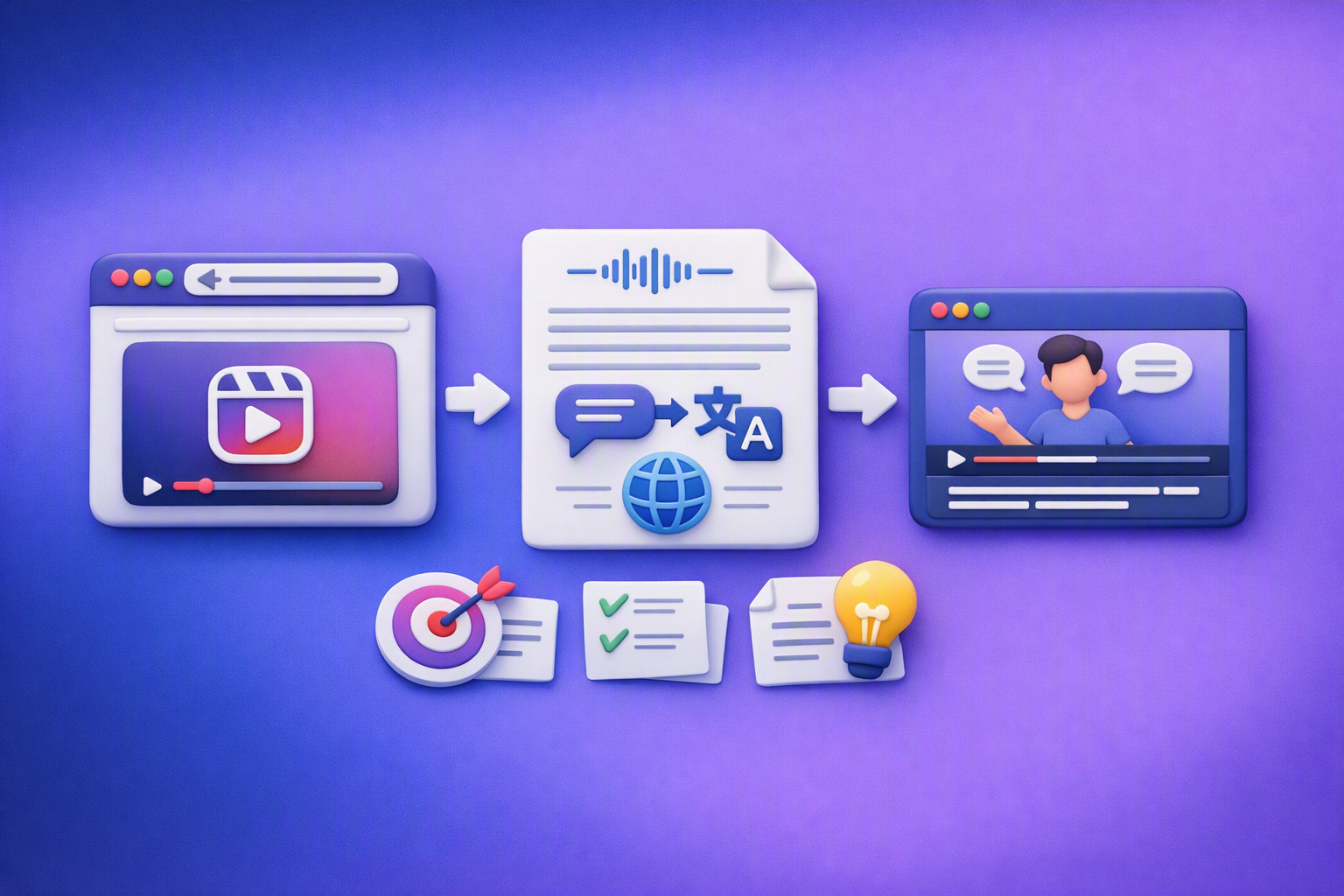
Aprende a traducir un Reel de Instagram con un flujo URL→transcripción→traducción→subtítulos, y a convertir esa traducción en un activo de investigación para hooks, CTAs, objeciones y clusters de contenido.
Reel Analyzer: Transcript‑First Instagram Reels Research (Hooks, CTAs, Objections) + Workflow Guide (VideoToTextAI)
Video To Text AI
A reel analyzer should turn any public Instagram Reel link into a searchable transcript library you can mine for hooks, CTAs, objections, and topic clusters—then repurpose into original drafts with a repeatable SOP.