
Can I Send U Videos? The Fastest Ways to Share Videos (Plus a Link-Based Workflow for Transcripts, Captions, and Repurposing)
 Video To Text AI
Can I Send U Videos? The Fastest Ways to Share Videos (Plus a Link-Based Workflow for Transcripts, Captions, and Repurposing)
Send a shareable link instead of the video file to avoid size limits, compression, and “failed to send” errors. If the recipient truly needs the original, use a large-file transfer—but treat file sending as the exception, not the default.
What “can i send u videos” usually means (and why it fails)
Most people asking “can i send u videos” are really asking: “What’s the fastest way to get this video to you without it breaking?” The failure usually isn’t user error—it’s the method.
The 3 common scenarios
- Personal sharing: “Here’s a clip from my phone.”
- Work/creator review: “Can you review this draft cut?”
- Support/proof: “Here’s a screen recording showing the issue.”
Each scenario has different requirements for speed, quality, privacy, and access.
The 3 constraints that break sending (size, length, quality)
- Size limits: Messaging apps, email, and carriers cap attachments.
- Length limits: Longer videos trigger compression or outright failure.
- Quality loss: Many “send” methods downscale resolution, bitrate, and audio.
If you care about readability (screen recordings) or audio clarity (interviews), compression can make the video less useful than a transcript.
Decide first: “send a file” vs “send a link”
- Send a file when someone needs the original asset for editing or archiving.
- Send a link when someone needs to watch, review, approve, or extract info.
Brand POV (VideoToTextAI): downloading and shuttling video files around is an outdated workflow. Link-based sharing and link-based extraction is the future of creator productivity—faster, searchable, and easier to reuse.
Quick answer: the best way to send a video (pick one)
Best for speed: send a shareable link (cloud/hosted)
Use:
- Google Photos link
- iCloud link
- Google Drive link
- YouTube (Unlisted) link
Why it wins:
- No attachment limits
- Minimal friction for the recipient
- Easy to resend, update, or revoke
Best for quality: send the original file (transfer service)
Use when the recipient needs the original bitrate/codec:
- Large-file transfer services (e.g., WeTransfer-style tools)
- Shared Drive/Dropbox folder with download enabled
Tip: If you’re sending for editing, include frame rate, resolution, and audio notes.
Best for privacy: expiring link + access control
Use:
- “Only people with access” permissions
- Expiration dates (where supported)
- Password-protected transfer links
Rule: Private by default, then grant access intentionally.
Best for collaboration: shared folder + naming convention
Use a shared folder when you’ll send multiple versions:
ProjectName/YYYY-MM-DD/01_raw/ 02_selects/ 03_exports/
Naming convention example:
clientname_topic_v03_1080p.mp4clientname_topic_v03_notes.txt
Step-by-step: Send a video from iPhone to another phone
Option A: iMessage (when it works) + settings to check
- Open Messages → choose a conversation.
- Tap + → Photos → select the video.
- Send.
Check these settings if quality looks bad:
- Settings → Messages → Low Quality Image Mode: turn off.
- Ensure you’re sending as iMessage (blue bubble), not SMS (green bubble).
If it flips to SMS, you’ll likely hit compression and size limits.
Option B: AirDrop to nearby device (fastest local transfer)
- Enable Wi‑Fi and Bluetooth on both devices.
- Open the video in Photos → Share → AirDrop.
- Select the nearby device → accept on the recipient phone.
AirDrop is best when:
- You’re in the same room
- You need the original file quickly
- You don’t want uploads
Option C: iCloud link (best for longer videos)
- Open Photos → select the video.
- Tap Share → Copy iCloud Link (or “Share” → iCloud link option).
- Paste the link in Messages, email, or chat.
This avoids the “video too long” iMessage problem.
Checklist: iPhone sending success checklist (before you hit send)
- Are you sending a link instead of a file for anything longer than ~30–60 seconds?
- Is the chat iMessage (blue), not SMS (green)?
- Is Low Quality Image Mode off?
- Do you need original quality (editing) or just viewing (review)?
- Did you include context (what to watch for + timestamp)?
Step-by-step: Send a video from Android to another phone
Option A: Google Photos link (fast + reliable)
- Open Google Photos → select the video.
- Tap Share → choose Create link (or share to a contact).
- Send the link via any app.
This is the most reliable method across iPhone/Android recipients.
Option B: Nearby Share / Quick Share (local transfer)
- Turn on Nearby Share / Quick Share.
- Open the video → Share → choose Nearby/Quick Share.
- Select the recipient device → accept.
Use this when you want no upload and you’re physically close.
Option C: Drive link with permissions (view vs download)
- Upload to Google Drive.
- Tap Share → set access:
- Viewer for review
- Commenter if you want notes (where supported)
- Copy link → send.
If the recipient needs the file, ensure download is allowed.
Checklist: Android sending success checklist
- Upload complete (don’t share mid-upload).
- Link permissions set to Anyone with the link (if appropriate) or specific emails.
- Recipient can access without requesting permission.
- If it’s a screen recording, avoid aggressive compression.
Step-by-step: Send videos through messages (SMS/MMS) without quality loss
Why SMS/MMS compresses and fails (carrier limits)
SMS/MMS is built for tiny media payloads. Carriers often:
- Cap attachment size
- Downscale resolution
- Reduce bitrate and audio quality
Result: blurry video, desynced audio, or “not delivered.”
Use RCS/iMessage when available (and how to confirm)
- iMessage: blue bubbles on iPhone-to-iPhone.
- RCS: in Google Messages (availability depends on carrier/region).
How to confirm:
- If you see “Text message / SMS” indicators, you’re not on a rich protocol.
- If sending takes forever or fails, assume you hit a size limit.
If you must message: send a link instead of the file
Best practice:
- Upload once (Photos/Drive/iCloud/YouTube unlisted).
- Paste link into the message.
- Add a one-line instruction: “Open in browser/app.”
Step-by-step: Send a video that’s too long (or too big)
Option A: Upload and share a link (fastest fix)
This is the default fix for “too long to send.” It avoids:
- Attachment caps
- App-specific compression
- Re-sending multiple times
Option B: Use a large-file transfer service (when recipients can’t access cloud)
Use this when:
- The recipient can’t use Google/iCloud
- You need original quality
- You need a simple “download” experience
Set expectations:
- Download time depends on their connection.
- Some services expire links quickly.
Option C: Split the video (only if link sharing isn’t possible)
Split only when necessary:
- Part 1 / Part 2 / Part 3
- Keep each segment under the platform limit
- Include a note: “Watch in order”
Option D: Compress intentionally (settings that preserve readability)
If you must compress:
- Prefer 1080p for talking-head; higher for screen recordings.
- Keep audio at a reasonable bitrate (speech clarity matters).
- Avoid extreme compression that makes on-screen text unreadable.
Checklist: “Too long to send” decision tree
- Need viewing only? → Send a link.
- Need original for editing? → Transfer service / shared folder.
- Recipient can’t access cloud? → Transfer service.
- No cloud + no transfer? → Split, then label parts clearly.
- Screen recording? → Avoid heavy compression; consider sending transcript + key timestamps.
Step-by-step: Can you email videos? (Yes—usually via links)
When attachments work (and when they don’t)
Attachments work only for small files. Most inboxes cap attachments around:
- ~20–25MB (varies by provider)
Modern phone videos exceed that quickly.
Best practice: paste a cloud link + set permissions
- Upload to Drive/iCloud/Photos/YouTube unlisted.
- Set permissions to Viewer (or specific emails).
- Paste link in the email with a short access note.
Email template: “Here’s the video” (subject + body + access notes)
Subject: Video for review: [Project/Topic] + [Version/Date]
Body:
- Link:
PASTE LINK HERE - What to look for:
1–2 bullets - Key timestamps:
00:45, 02:10, 04:05 - Access: “View-only. If you can’t open it, reply with the email address to grant access.”
Troubleshooting: Why your video won’t send (and exact fixes)
“Message not delivered” / stuck sending
Fixes:
- Switch from file send → link share.
- Move to Wi‑Fi (uploads fail on weak mobile data).
- Restart the app; resend as a link.
“File too large” / “video too long”
Fixes:
- Upload and share a link (fastest).
- Use a transfer service for original quality.
- Compress only if necessary.
Recipient can’t open the file (format/codec issues)
Common issue: the video plays on your device but not theirs due to codec/container support.
Fixes:
- Export as MP4 (H.264) for maximum compatibility.
- If you used HEVC/H.265, try a compatibility export.
- If you can’t re-export, send a hosted link (platform handles playback).
Link opens but says “no access” (permissions checklist)
Check:
- Is it restricted to your account/org?
- Did you share to the correct email?
- Is “Anyone with the link” required for this recipient?
- Did the link expire?
Slow upload on mobile data (practical workarounds)
- Use Wi‑Fi.
- Upload while charging (background uploads are more reliable).
- If you must use mobile data, lower resolution slightly (but protect readability).
After you send the video: turn it into text (transcript, subtitles, captions) with VideoToTextAI
When a transcript is the better “deliverable” than the video
A transcript is often more useful than the video when you need:
- Searchability (find quotes fast)
- Skimmability (review without watching)
- Accessibility (captions/subtitles)
- Repurposing (blogs, posts, summaries)
This is where link-based workflows outperform file downloads: you can extract value without moving heavy assets around.
The reliable workflow: video link/MP4 → transcript/subtitles → reuse everywhere
Instead of “download → upload → re-upload,” use:
- Share link → transcribe → export → publish
If you’re evaluating what AI tools can and can’t accept, also see:
- Can ChatGPT Upload Video? What Works in 2026 (and the Reliable Link → Transcript Workflow)
- Can ChatGPT Transcribe Videos? What Works in 2026 + The Reliable Link → Transcript Workflow (VideoToTextAI)
Outputs to generate (TXT, SRT, VTT) and when to use each
- TXT: best for editing, quoting, summarizing, and turning into articles.
- SRT: standard captions for many editors and platforms. (Tool: mp4 to srt)
- VTT: web-friendly captions (common for HTML5 players). (Tool: mp4 to vtt)
If you’re starting from a file, you can also use: mp4 to transcript
Step-by-step: Link-based video → transcript/subtitles workflow (VideoToTextAI)
Step 1: Get a clean share link (YouTube, Drive, Instagram, TikTok)
Use the simplest link that opens without login (when appropriate):
- YouTube (Unlisted)
- Google Drive (Viewer access)
- Public social links (Instagram/TikTok)
Helpful starting points:
Step 2: Run the link through VideoToTextAI
Paste the video link into VideoToTextAI and generate your transcript/captions. This avoids the outdated “download the file just to upload it again” loop.
Step 3: Export the right format (TXT vs SRT vs VTT)
- Choose TXT for content repurposing and editing.
- Choose SRT/VTT for captions/subtitles publishing.
Step 4: Repurpose the text into posts, summaries, and blogs
Turn one video into multiple assets:
- A short summary for email/Slack
- A blog post outline
- Quote pull-outs for social
- A FAQ section for your landing page
If your source is YouTube and you want a written draft quickly: youtube to blog
Checklist: “Send + Transcribe” workflow checklist (copy/paste)
- Decide: link (default) vs file (only if original needed)
- Create share link and set permissions to Viewer
- Send with context: title + what you need + timestamps
- Generate transcript (TXT) for search/quotes
- Generate captions (SRT/VTT) for publishing
- Repurpose transcript into: summary, post, blog draft, and key takeaways
- Store links + outputs in a shared folder with consistent naming
Common mistakes (and how to avoid them)
Sending the wrong permission level (view vs edit vs download)
- Use View for review.
- Use Edit only when collaboration is required.
- Confirm whether download is allowed if they need the file.
Sending a link that expires too soon (or never expires)
- For clients: avoid 24-hour links unless you warn them.
- For sensitive content: use expiration + restricted access.
Losing context: no title, no timestamp, no ask
Always include:
- What the video is
- What feedback you want
- Where to look (timestamps)
Not capturing the content in text (hard to search, quote, or reuse)
If the video contains decisions, instructions, or key messaging, a transcript is the durable asset. Link-based extraction makes that fast and repeatable.
Competitor Gap
What top results miss (and what this guide adds)
Most top results are short forum replies or generic tips. They rarely cover the full reality: size limits, codec issues, permissions, and cross-device sharing.
Implementation-first walkthroughs for iPhone, Android, messaging, and email
This guide provides:
- iPhone: iMessage vs AirDrop vs iCloud link
- Android: Photos link vs Nearby/Quick Share vs Drive permissions
- Messaging: SMS/MMS vs RCS/iMessage realities
- Email: link-first templates that actually work
Troubleshooting matrix tied to real failure modes (size, codec, permissions)
You get specific fixes for:
- “Not delivered”
- “Too large”
- “Can’t open”
- “No access”
- Slow uploads
Reusable checklists + templates for sending and follow-up
Included:
- iPhone/Android send checklists
- “Too long to send” decision tree
- Email subject/body template
- “Send + Transcribe” workflow checklist
Link → transcript/subtitles workflow to make videos searchable and reusable
Competitors focus on sending. This guide adds the next step that saves the most time: turn the video into text outputs (TXT/SRT/VTT) so the content is searchable, quotable, and reusable.
FAQ
How do I send a video to someone?
Send a shareable link from Google Photos/iCloud/Drive/YouTube (Unlisted) with Viewer permissions. Send the original file only when the recipient needs it for editing.
Can I send videos through messages?
Yes, but SMS/MMS compresses and often fails. Use iMessage or RCS when available, or send a link inside the message to avoid quality loss.
How do I send a video from my phone to another phone?
- iPhone: AirDrop (nearby) or iCloud link (remote).
- Android: Nearby/Quick Share (nearby) or Google Photos link (remote). For cross-platform sharing, links are the most reliable.
How can I send a video that is too long?
Upload it and send a link. If the recipient can’t access cloud links, use a large-file transfer service; split/compress only as a last resort.
Can you email videos?
Usually not as attachments (size limits). Email the cloud link and include access notes and timestamps.
Related posts
Reel Analyser (Instagram Reels): Transcript‑First Competitor Research, Hook/CTA Extraction, and Repurposing Workflow (VideoToTextAI)
Video To Text AI
A 2026 reel analyser should turn Instagram Reel links into a searchable transcript library you can tag for hooks, CTAs, objections, and topic clusters—then export into repurposing-ready drafts without a download/upload loop.
Traducir video de Instagram (Reels) en 2026: workflow transcript-first para traducir, sacar hooks/CTAs y repurpose (con VideoToTextAI)
Video To Text AI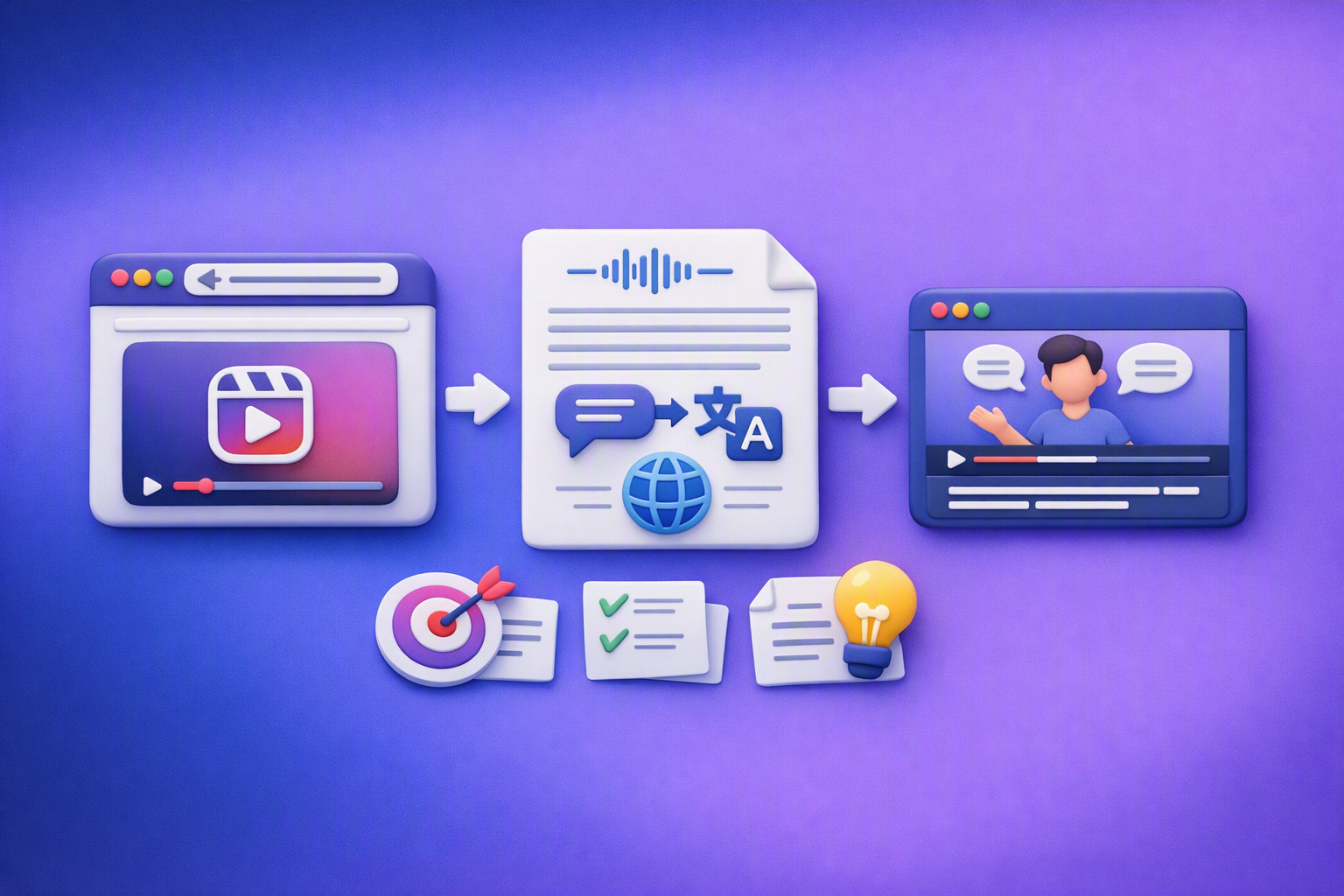
Aprende a traducir un Reel de Instagram con un flujo URL→transcripción→traducción→subtítulos, y a convertir esa traducción en un activo de investigación para hooks, CTAs, objeciones y clusters de contenido.
Reel Analyzer: Transcript‑First Instagram Reels Research (Hooks, CTAs, Objections) + Workflow Guide (VideoToTextAI)
Video To Text AI
A reel analyzer should turn any public Instagram Reel link into a searchable transcript library you can mine for hooks, CTAs, objections, and topic clusters—then repurpose into original drafts with a repeatable SOP.