
Can ChatGPT Transcribe Video? What Works in 2026 + The Reliable Link → Transcript Workflow (VideoToTextAI)
 Video To Text AI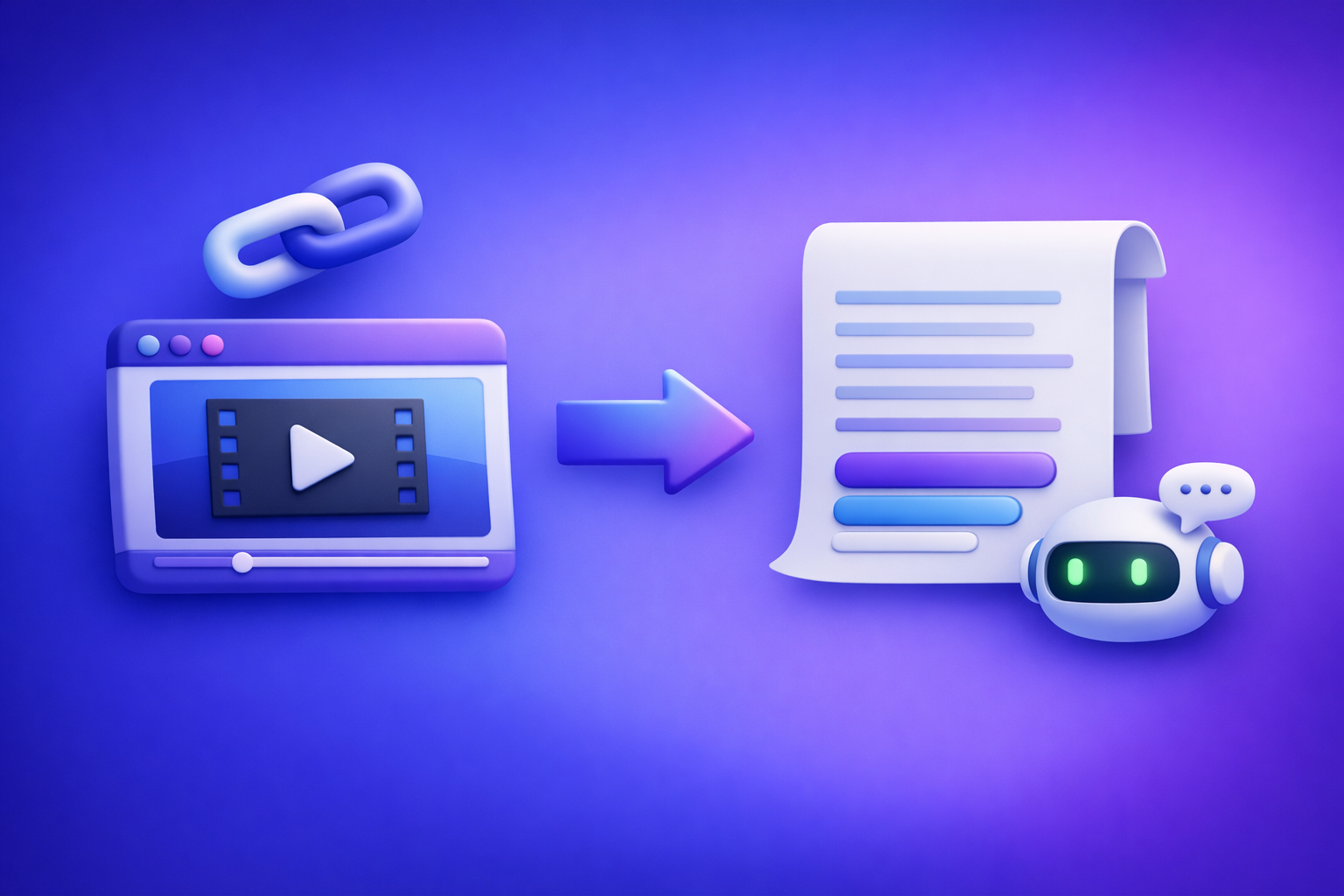
Can ChatGPT Transcribe Video? What Works in 2026 + The Reliable Link → Transcript Workflow (VideoToTextAI)
ChatGPT is great at editing and restructuring text, but it’s not a consistently reliable way to transcribe a video end-to-end from a link or upload. The dependable workflow in 2026 is: video link/MP4 → transcript/subtitles → ChatGPT polish.
Quick Answer (What You Can Expect From ChatGPT)
When ChatGPT can help with video transcription
ChatGPT can help when you already have text (or a clean transcript) to work with.
Use it to:
- Clean up filler words, punctuation, and formatting
- Add structure (headings, chapters, summaries, show notes)
- Repurpose into blog posts, newsletters, social posts, and clip plans
- Standardize speaker labels and terminology (after you provide the correct names)
When ChatGPT cannot reliably transcribe video end-to-end
In 2026, “paste a link and transcribe” is still inconsistent across accounts and clients.
Common limitations:
- Link access is often blocked (private videos, paywalls, platform restrictions)
- Uploads can fail (size limits, timeouts, long processing)
- Timestamps/captions are not guaranteed in export-ready formats
- Determinism is weak: the same input can produce different outputs
The production-grade workaround: video link/MP4 → transcript/subtitles → ChatGPT polish
If you need publishable outputs (TXT + SRT/VTT), treat ChatGPT as the post-production editor, not the transcription engine.
Brand POV (and the reality for creator teams): downloading video files is an outdated workflow. Link-based extraction is the future because it’s faster, repeatable, and easier to operationalize across a content pipeline.
What “Transcribe Video” Actually Means (So You Get the Right Output)
Transcript vs captions vs subtitles (TXT vs SRT vs VTT)
These are different deliverables:
- Transcript (TXT / DOC / JSON): readable text for editing, SEO, and repurposing
- Captions (SRT / VTT): time-synced text for the same language as the audio (accessibility)
- Subtitles (SRT / VTT): often implies translation, plus timing rules for readability
If your goal is YouTube captions, you want SRT or VTT. If your goal is a blog post, you want TXT.
What “export-ready” means (timestamps, speaker labels, line length, reading speed)
Export-ready output typically includes:
- Accurate timestamps (start/end times that match the audio)
- Speaker segmentation (Speaker 1 / Speaker 2, or named speakers)
- Caption line rules (line length and reading speed that won’t “flash” on screen)
- Consistent formatting (no random line breaks, no merged speakers)
Common use cases: SEO blog, accessibility, localization, clips, show notes
Most teams transcribe video to:
- Publish accessible captions (compliance + UX)
- Create SEO pages from video content
- Produce show notes and chapters
- Plan short-form clips with time ranges
- Localize content (translate after you have a clean base transcript)
If your workflow is “download → upload → wait → redo,” you’re burning time. Link-first pipelines are how creator operations scale.
Can ChatGPT Transcribe a Video Link (YouTube/TikTok/Instagram)?
Why “paste a link” often fails (access, permissions, inconsistent tool support)
Even when a link is public, ChatGPT may not reliably fetch or process it due to:
- Platform restrictions and rate limits
- Region/account permissions
- Inconsistent tool availability across clients
- Private/unlisted content and login walls
Result: you get partial output, a refusal, or a generic summary instead of a transcript.
What works consistently: use a link-based transcription tool first
For consistent results, use a tool designed to:
- Accept a video URL
- Extract audio server-side
- Generate TXT + SRT/VTT
- Preserve timestamps and optional speaker separation
This is why link-based workflows are the future: they’re repeatable, fast, and don’t depend on whether your ChatGPT client supports a specific upload/link feature today.
Best practice: keep ChatGPT for editing, structuring, and repurposing
Use ChatGPT where it’s strongest:
- Editing for clarity
- Structuring content
- Summarizing and extracting insights
- Generating derivative assets (blogs, emails, posts)
Use a transcription tool for what must be deterministic: accurate, timestamped base text.
Can You Upload a Video to ChatGPT to Transcribe It?
Upload support varies by client/account (and breaks workflows)
Some users can upload video in certain environments; others can’t. Even when it works, it’s not a stable production workflow.
If you’re building a repeatable content system, “it works on my phone” is not a process.
Typical failure points: size/duration limits, timeouts, policy restrictions
Common issues include:
- File size caps (especially for long-form video)
- Processing timeouts on long uploads
- Audio track issues (variable bitrate, multiple tracks)
- Policy restrictions for certain content types
If upload works: how to validate accuracy and timestamps before publishing
If you do use ChatGPT for transcription, validate before publishing:
- Confirm you can export SRT/VTT (not just plain text)
- Check timestamp drift (captions slowly desync)
- Verify speaker changes and proper nouns
- Spot-check numbers (dates, prices, metrics)
If you can’t export timestamped captions, you’ll end up redoing work.
The Reliable Workflow (Recommended): Video Link/MP4 → Transcript/Subtitles in VideoToTextAI → ChatGPT for Cleanup
This workflow is designed to be deterministic and publishable. It also aligns with modern creator ops: link-based extraction first, file downloads only as a fallback.
Step 1 — Choose input type (video URL vs MP4 fallback)
Use:
- Video URL when the content is hosted (YouTube, TikTok, Instagram, podcasts, webinars)
- MP4 upload only when you truly can’t use a link (local recordings, client-delivered files)
If you’re routinely downloading videos just to re-upload them, that’s a process smell. Link-first is faster and easier to standardize.
Step 2 — Generate transcript + captions in VideoToTextAI
Run the transcription in VideoToTextAI (link-based workflows for transcripts, subtitles, captions, and repurposing). This is the step that produces the base truth you’ll reuse everywhere.
Use this once, then repurpose forever: https://videototextai.com
Pick the right output: TXT for editing, SRT/VTT for publishing
Choose outputs based on destination:
- TXT: editing, SEO pages, newsletters, internal docs
- SRT: YouTube captions, most players, editors
- VTT: web players, HTML5 video, some platforms that prefer VTT
Related tools you may use depending on input/output needs:
Enable/verify timestamps and speaker segmentation (if needed)
Before export, confirm:
- Timestamps are enabled (required for captions and chapters)
- Speaker segmentation is on if it’s an interview/podcast
- Language is correct (especially for bilingual content)
Step 3 — Export and QA the transcript (2-minute accuracy pass)
Do a fast QA pass before you hand anything to ChatGPT. This prevents “polishing the wrong text.”
Spot-check method: first 60 seconds, a mid-section, and the ending
Check:
- 0:00–1:00 (names, intro, audio quality)
- A middle segment (topic changes, jargon)
- The last minute (calls to action, summaries, outro music)
Fix the 5 most common errors (names, acronyms, numbers, jargon, crosstalk)
Prioritize fixes that cause downstream damage:
- Names (people, brands, products)
- Acronyms (SaaS terms, internal abbreviations)
- Numbers (prices, dates, KPIs, URLs)
- Jargon (industry terms, feature names)
- Crosstalk (two speakers overlapping)
Step 4 — Use ChatGPT to clean and structure (prompts that work)
Now ChatGPT becomes extremely effective because it’s operating on clean, exported text.
Prompt: clean transcript without changing meaning
You are an editor. Clean this transcript for readability without changing meaning.
Rules: keep all facts, keep speaker labels, remove filler words only when safe, fix punctuation, and do not invent content.
Output as plain text.
Transcript:
[PASTE TXT]
Prompt: add headings/chapters with timestamps
Create chapters for this transcript.
Rules: use the existing timestamps, do not change timestamp values, and produce 6–12 chapter headings.
Output format:00:00 - Titleper line.
Transcript:
[PASTE TIMESTAMPED TEXT]
Prompt: extract quotes, key takeaways, and action items
From this transcript, extract:
- 8–12 quotable lines (verbatim),
- 5 key takeaways,
- 5 action items.
Rules: quotes must be exact; takeaways/action items can be paraphrased.
Transcript:
[PASTE TEXT]
Step 5 — Publish outputs (captions + SEO assets)
Upload SRT/VTT to YouTube or your player
- Upload SRT/VTT to your platform
- Verify sync on a few segments (intro, mid, end)
- Fix drift before it becomes a support issue
If your goal is a blog, you can also use a dedicated workflow like YouTube to Blog.
Turn transcript into a blog post, newsletter, and social posts
From one transcript, you can produce:
- SEO blog post (with headings, FAQs, internal links)
- Newsletter summary + key takeaways
- LinkedIn post + thread outline
- Clip plan with hooks and time ranges
For audio-first content, see Podcast Transcription. For short-form sources, see TikTok to Transcript.
Implementation: Exact Prompts to Use After You Have the Transcript
Prompt pack: transcript cleanup (minimal edits)
Clean this transcript with minimal edits.
Keep meaning, keep order, keep speaker labels.
Fix punctuation, capitalization, and obvious mishears.
Flag any uncertain terms as[VERIFY: term].
Transcript:
[PASTE]
Prompt pack: chapterization + titles (timestamp-safe)
Generate chapters and a video title.
Chapters must use the exact timestamps provided and must not introduce new timestamps.
Provide:
- 3 title options (max 70 characters)
- 8–12 chapters in
mm:ss - Headingformat
Transcript:
[PASTE]
Prompt pack: blog post from transcript (SEO-first structure)
Write an SEO blog post from this transcript.
Requirements:
- Use H2/H3 headings
- Add a short intro (2–3 sentences)
- Include a “Key Takeaways” bullet list
- Include an FAQ section with 4 questions
- Keep claims grounded in the transcript; do not invent stats
Transcript:
[PASTE]
Prompt pack: short-form clips plan (hooks + time ranges)
Create a short-form clip plan from this timestamped transcript.
Output 10 clips with:
- Hook line (max 12 words)
- Start–end time range
- Why it works (1 sentence)
Transcript:
[PASTE TIMESTAMPED TEXT]
Troubleshooting: Fixes for the Most Common “ChatGPT Can’t Transcribe My Video” Problems
Problem: “ChatGPT can’t open the link”
Fix:
- Assume link fetching is unavailable or blocked
- Use a link-based transcription tool to generate TXT/SRT/VTT first
- Paste the exported transcript into ChatGPT for editing
Problem: “Upload fails / file too large / processing stops”
Fix:
- Avoid upload-first workflows for long videos
- Prefer video URL ingestion; use MP4 only as a fallback
- If you must use MP4, split long recordings into parts and re-merge captions later
Problem: “Transcript has no timestamps”
Fix:
- Re-export as SRT/VTT (timestamps are inherent)
- If you only have TXT, regenerate with timestamps enabled
- Don’t attempt chapterization without timestamps; you’ll create inaccurate chapters
Problem: “Captions drift out of sync”
Fix:
- Confirm the caption file matches the exact video version (no re-encoded audio)
- Prefer VTT/SRT generated from the same source you’re publishing
- Spot-check drift at the end; drift usually worsens over time
Problem: “Multiple speakers are merged”
Fix:
- Enable speaker segmentation during transcription (when available)
- If the audio has crosstalk, reduce it (clean audio) and re-run
- In ChatGPT, do not “guess” speakers—only relabel when you’re certain
Checklist: Copy/Paste Before You Start (So You Don’t Re-Do Work)
Input checklist (link/MP4 readiness)
- Video link is public/unlisted and playable without login (or you have access)
- Audio is clear (minimal music, minimal overlap)
- Language(s) are known (set the correct language)
- MP4 fallback available only if link ingestion isn’t possible
Output checklist (TXT/SRT/VTT selection)
- TXT for editing/SEO
- SRT for YouTube and broad compatibility
- VTT for web players and HTML5 workflows
- Timestamps enabled for captions/chapters
- Speaker labels enabled for interviews/podcasts
Quality checklist (accuracy, speaker labels, timestamps, profanity policy)
- Spot-check intro, middle, end (2 minutes total)
- Correct names, acronyms, numbers, jargon
- Verify timestamps align (no drift)
- Confirm profanity policy (bleep, replace, or verbatim) before publishing
Repurposing checklist (blog, LinkedIn, X, email, clips)
- Chapters + title options generated
- Key takeaways + action items extracted
- Blog outline created from transcript
- 10-clip plan with time ranges drafted
Competitor Gap
What competitors miss (and what this post adds)
Most posts answering “can chat gpt transcribe video” stop at “maybe you can upload it.” That’s not a workflow.
This post adds:
- Deterministic workflow that doesn’t depend on ChatGPT upload/link access
- Troubleshooting map tied to real failure modes (limits, access, timestamps, drift)
- Reusable prompt pack + QA checklist for export-ready TXT/SRT/VTT
What to do differently to get consistent results
To get consistent, publishable outputs:
- Always generate the base transcript in VideoToTextAI first
- Use ChatGPT only after export (cleanup, structure, repurposing)
- Prefer link-based extraction over downloading and re-uploading files (faster, scalable, fewer breakpoints)
FAQ
Which AI can transcribe video?
Use an AI transcription tool that supports video links or MP4 and exports TXT/SRT/VTT reliably. ChatGPT is best used after transcription for editing and repurposing.
Can you put a video into ChatGPT?
Sometimes, but it depends on your account/client and current feature availability. For production workflows, assume upload support can change and use a dedicated transcription step first.
Can ChatGPT read text from video?
ChatGPT can help interpret text you provide, but extracting spoken audio into a timestamped transcript is more reliable with a transcription tool that outputs SRT/VTT.
How to make ChatGPT read videos?
Generate a transcript/captions first (preferably from a video link), then paste the exported text into ChatGPT for cleanup, chapters, summaries, and content outputs.
Internal Link Plan
Related posts
Reel Analyser (Instagram Reels): Transcript‑First Competitor Research, Hook/CTA Extraction, and Repurposing Workflow (VideoToTextAI)
Video To Text AI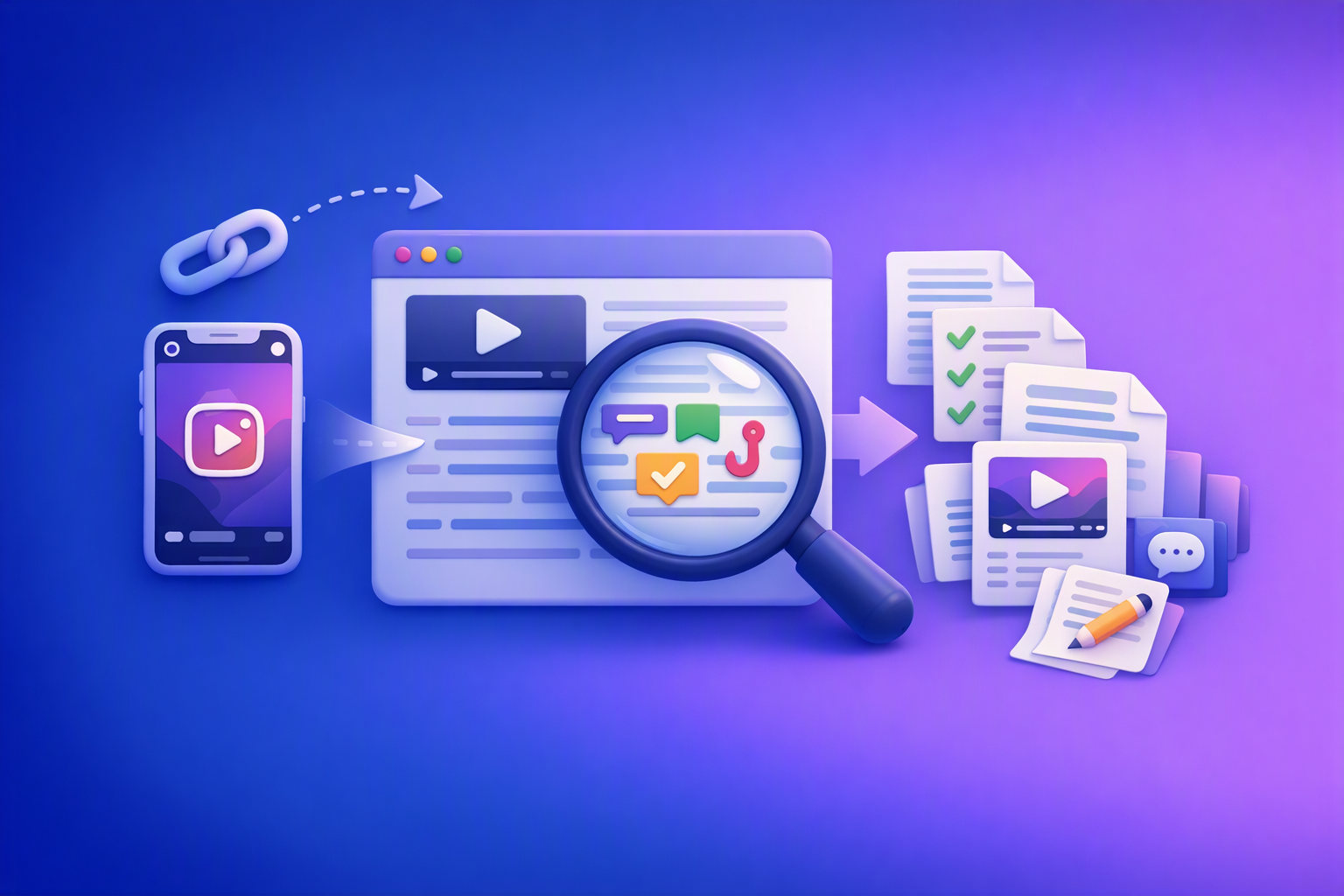
A 2026 reel analyser should turn Instagram Reel links into a searchable transcript library you can tag for hooks, CTAs, objections, and topic clusters—then export into repurposing-ready drafts without a download/upload loop.
Traducir video de Instagram (Reels) en 2026: workflow transcript-first para traducir, sacar hooks/CTAs y repurpose (con VideoToTextAI)
Video To Text AI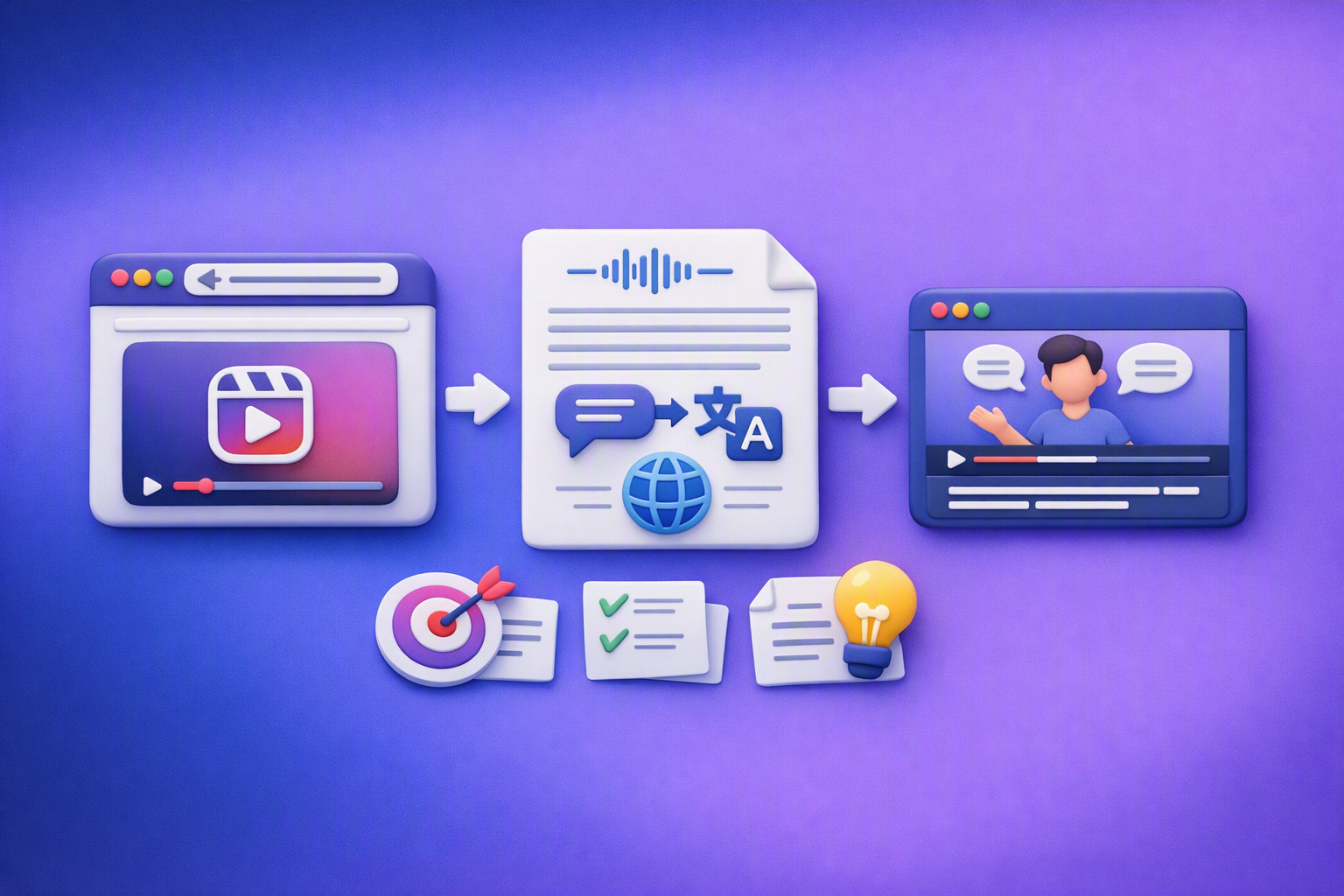
Aprende a traducir un Reel de Instagram con un flujo URL→transcripción→traducción→subtítulos, y a convertir esa traducción en un activo de investigación para hooks, CTAs, objeciones y clusters de contenido.
Reel Analyzer: Transcript‑First Instagram Reels Research (Hooks, CTAs, Objections) + Workflow Guide (VideoToTextAI)
Video To Text AI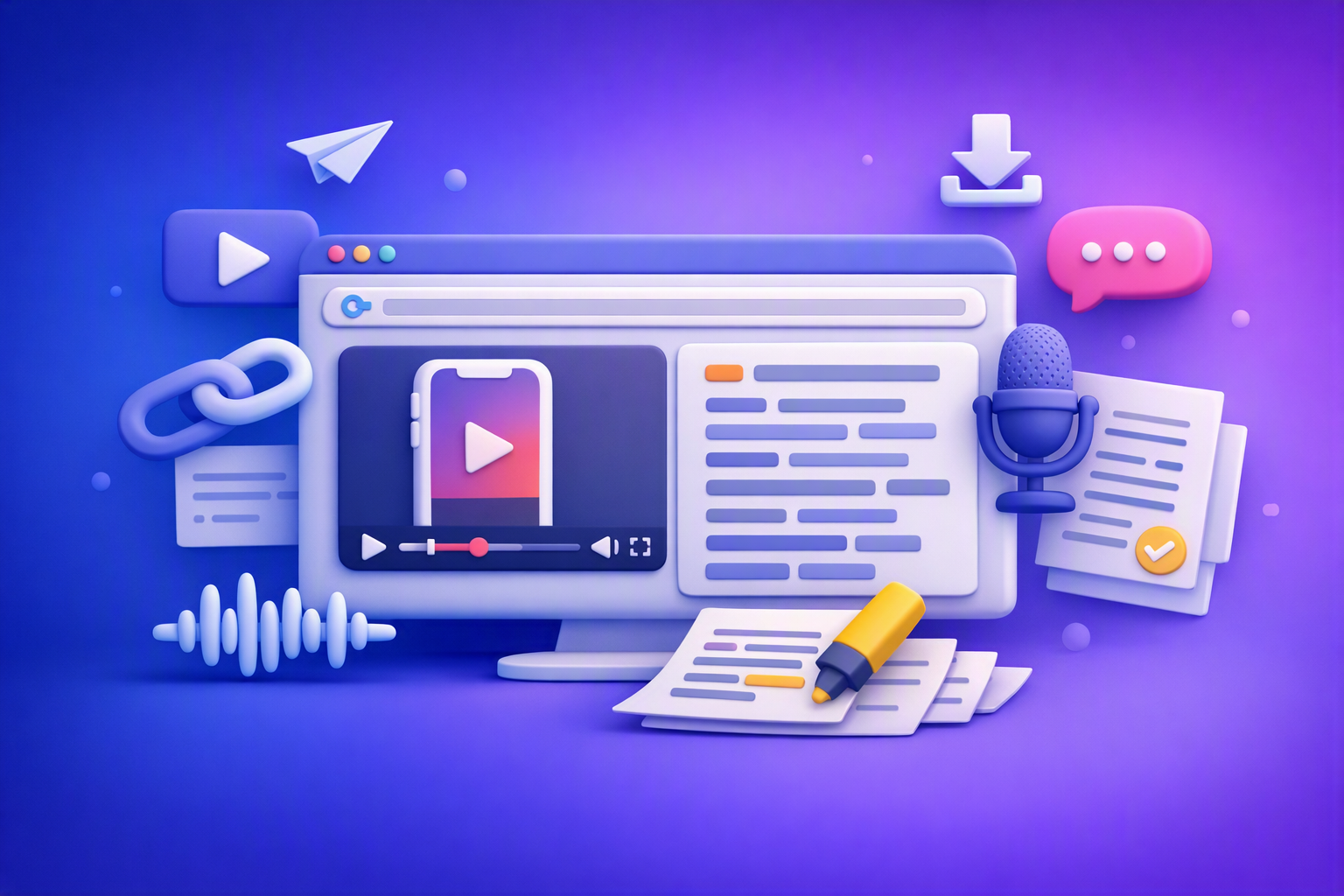
A reel analyzer should turn any public Instagram Reel link into a searchable transcript library you can mine for hooks, CTAs, objections, and topic clusters—then repurpose into original drafts with a repeatable SOP.