
Can ChatGPT Transcribe Video? What Actually Works in 2026 (Plus a Reliable Link → Transcript Workflow)
 Video To Text AI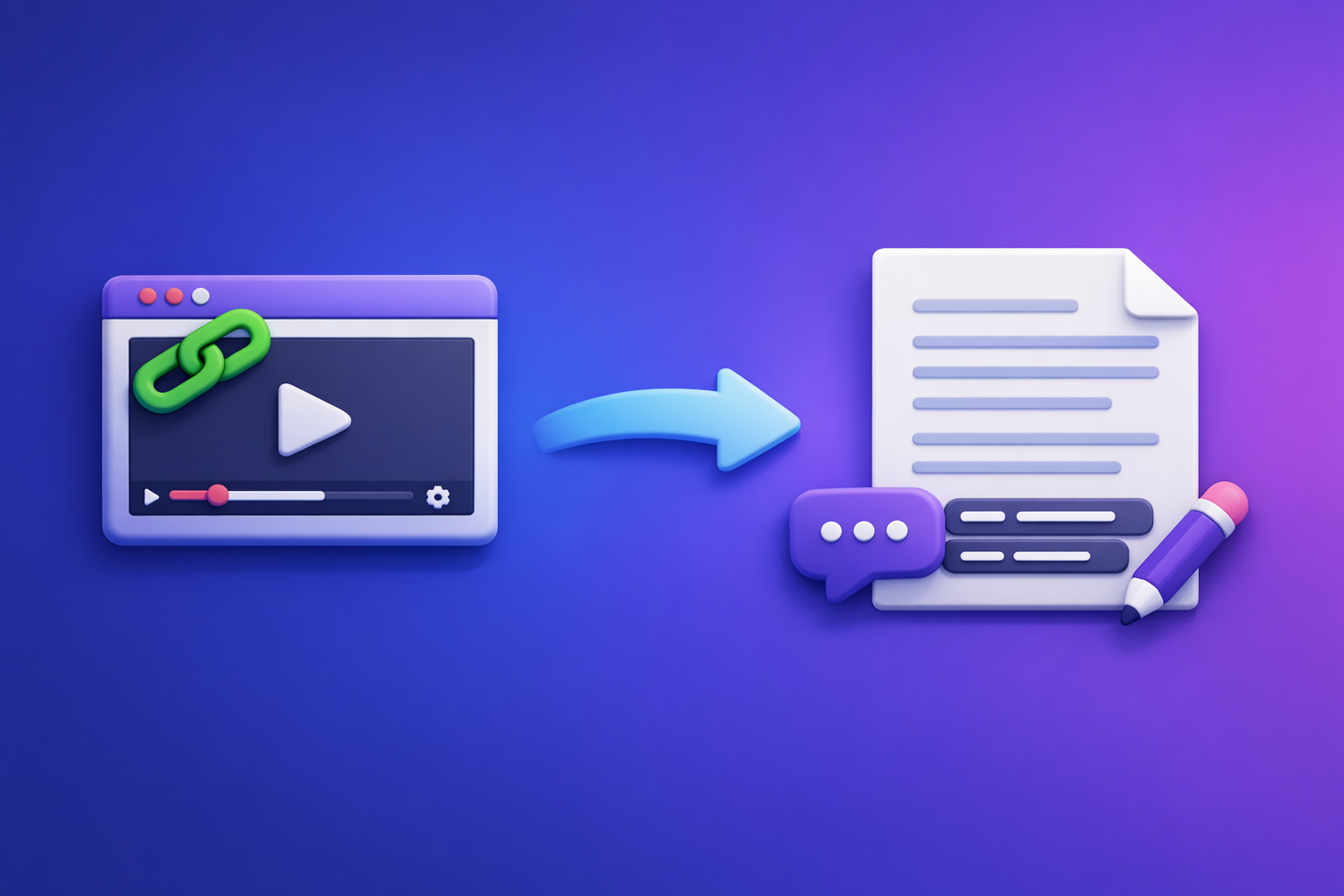
Can ChatGPT Transcribe Video? What Actually Works in 2026 (Plus a Reliable Link → Transcript Workflow)
If you need a dependable transcript or captions file, don’t rely on ChatGPT to “watch a video” from a link or handle long MP4s end-to-end. The stable 2026 approach is video link/MP4 → export-ready transcript/subtitles → ChatGPT for cleanup + repurposing.
Quick Answer (What You Can Expect From ChatGPT)
When ChatGPT can help with transcription
ChatGPT is excellent after you already have text.
Use it to:
- Fix readability (punctuation, paragraphing, consistent casing)
- Standardize formatting (speaker labels, headings, sections)
- Create derivatives (chapters, notes, blog drafts, social snippets)
- Translate (when you provide the source transcript and constraints)
When ChatGPT can’t reliably transcribe video (links, long files, exports)
In real workflows, ChatGPT is not a consistent “video → transcript” engine because:
- Links aren’t guaranteed accessible (permissions, region locks, platform changes)
- Long files hit limits (timeouts, upload constraints, session instability)
- Exports aren’t production-ready (SRT/VTT timing, line length rules, drift fixes)
- Team handoff breaks (repeatability matters more than “it worked once”)
The dependable workaround: video link/MP4 → transcript/subtitles → ChatGPT for polish + repurposing
The most reliable pipeline is:
- Extract text from the video using a dedicated tool that supports link-based workflows and export formats.
- Export as TXT/SRT/VTT depending on your deliverable.
- Use ChatGPT on the transcript to clean, structure, and repurpose—without inventing details.
This is also why downloading video files is an outdated workflow for creators and teams. Link-based extraction is the future of creator productivity: faster, less storage, fewer handoffs, and easier batching.
What “Transcribe a Video” Really Means (So You Get the Right Output)
Transcript vs captions vs subtitles (TXT vs SRT vs VTT)
These are different outputs with different requirements:
- Transcript (TXT / DOC): readable text for notes, blogs, search, and archives.
- Captions (SRT / VTT): timed text for the same language as the audio (accessibility).
- Subtitles (SRT / VTT): timed text often used for translations (viewer comprehension).
If your goal is publishing, you usually need SRT or VTT, not just a paragraph of text.
What “export-ready” means (timestamps, line length, speaker labels)
“Export-ready” means the file can be used immediately in tools and platforms:
- Accurate timestamps (no drift)
- Readable line breaks (no walls of text)
- Speaker labels (when needed for interviews/podcasts)
- Consistent punctuation (improves comprehension and SEO reuse)
Accuracy factors: audio quality, accents, crosstalk, music, jargon
Transcription quality depends more on the audio than the model name.
Common accuracy killers:
- Low volume or heavy compression
- Crosstalk / interruptions
- Background music
- Strong accents + fast speech
- Domain jargon (product names, acronyms, medical/legal terms)
Can ChatGPT Transcribe a Video Link (YouTube/TikTok/Instagram)?
Why “watch this link” fails in real workflows (permissions, length, inconsistent link access)
“Here’s a YouTube/TikTok/Instagram link—transcribe it” fails because:
- The model may not have consistent access to fetch and process the media.
- Links can require login, have age gates, or change availability.
- Even when access works, long-form processing is not stable for production.
For teams, “sometimes it works” is the same as “it doesn’t work.”
What to do instead: generate text from the link first, then use ChatGPT on the text
Do this instead:
- Use a link-based video-to-text tool to extract the transcript/captions.
- Export TXT/SRT/VTT.
- Paste the transcript into ChatGPT for cleanup, structure, and repurposing.
If you’re building a repeatable content pipeline, link-based extraction beats downloading files every time—downloads create friction, storage bloat, and broken handoffs.
If you already have a platform transcript (YouTube auto-captions): when it’s good enough vs not
YouTube auto-captions can be “good enough” when:
- Audio is clean and single-speaker
- You only need rough notes
- You don’t need strict timing or formatting
They’re usually not good enough when:
- You need publish-ready captions (SRT/VTT formatting rules)
- There are multiple speakers
- There’s jargon, names, or product terms
- You need consistent punctuation and casing for repurposing
If your goal is content reuse, start with a better base transcript and then polish.
Can ChatGPT Transcribe an MP4 File?
What’s possible depending on interface (file handling limits, timeouts, inconsistent support)
Depending on the ChatGPT interface you use, you may be able to upload media and get partial results. The problem is consistency:
- Upload limits vary
- Long videos can time out
- Outputs may not include export-ready timestamps
- Re-running the same job may produce different formatting
Why “upload video → full transcript” is not a stable pipeline for teams
Teams need:
- Repeatable outputs
- Standard formats (TXT/SRT/VTT)
- Batch processing
- Clear “definition of done” checks
A chat interface is great for editing and repurposing, but it’s not a reliable transcription pipeline for production.
Best practice: extract audio/transcript with a dedicated tool, then use ChatGPT for editing
Best practice in 2026:
- Use a dedicated tool to generate the base transcript/captions.
- Use ChatGPT to improve readability and structure.
- Keep the original meaning and claims intact.
The Reliable Workflow (VideoToTextAI): Link/MP4 → Transcript/Subtitles → ChatGPT
This is the workflow that stays stable as platforms, permissions, and file limits change.
Step 1: Choose input type (video link vs MP4 upload)
- Use video links when possible (faster, no downloads, easier batching).
- Use MP4 upload when the content is private/off-platform.
Related tools and guides:
Step 2: Generate the base transcript in VideoToTextAI
Generate a transcript that’s designed for export and reuse, not just “text in a chat window.”
If you want a stable link-based workflow (instead of downloading files), use VideoToTextAI: VideoToTextAI
Step 3: Export in the right format (TXT/SRT/VTT) for your use case
Pick the format based on the deliverable:
- TXT: notes, blogs, documentation, search indexing
- SRT: most caption editors and social platforms
- VTT: web players and some LMS/work tools
Helpful internal links:
Step 4: Use ChatGPT to clean + structure (without changing meaning)
ChatGPT’s job here is editorial, not extraction:
- Fix punctuation and paragraph breaks
- Normalize speaker labels
- Create headings and sections
- Preserve claims and numbers (no “creative rewriting”)
Step 5: Create deliverables (chapters, notes, blog, social posts, translations)
Once you have clean text, you can generate:
- YouTube-style chapters with timestamps
- Meeting notes / study notes
- Blog outline + draft
- Social post variants
- Translations (with constraints)
For repurposing, see:
Step-by-Step: Transcribe a Video From a Link (Implementation)
1) Copy the video URL (YouTube/Instagram/TikTok/etc.)
Grab the canonical URL.
For teams, standardize how links are stored:
- One row per video in a sheet
- Include owner, publish date, and target output (TXT/SRT/VTT)
2) Paste into VideoToTextAI and run transcription
Prefer link-based input whenever possible.
This avoids the outdated “download → upload → re-upload” loop that slows creators down.
3) Pick output: TXT for notes, SRT/VTT for captions
Choose based on where the text will live:
- Internal knowledge base → TXT
- YouTube/social captions → SRT
- Web player/LMS → VTT
4) Quality pass: fix names, acronyms, and domain terms
Do a fast pass for:
- Names (people, brands, products)
- Acronyms (expand or standardize)
- Industry terms (ensure correct spelling)
5) Export + store (naming convention + folder structure for teams)
Use a predictable naming convention:
YYYY-MM-DD_platform_title_language.format- Example:
2026-03-12_youtube_product-demo_en.srt
Store consistently:
/transcripts/txt//captions/srt//captions/vtt/
Step-by-Step: Transcribe an MP4 (Implementation)
1) Upload MP4 to VideoToTextAI
Use MP4 upload when:
- The video is private
- It’s from a webinar platform export
- You can’t access it via a stable link
2) Select transcript vs captions output
Decide upfront:
- Need readability and reuse → transcript
- Need timed overlays → captions/subtitles
3) Export SRT/VTT with correct timing
Spot-check timing early:
- Start
- Middle
- End
If timing drifts, regenerate timing or re-export in the correct format.
4) Optional: generate summary/chapters for navigation and SEO reuse
Chapters improve:
- Viewer navigation
- Watch time
- Search snippets and reuse in blog content
Related reading:
ChatGPT Prompts That Work After You Have the Transcript (Copy/Paste Templates)
Use these only after you have the transcript (TXT or timestamped text).
Prompt: clean transcript without removing meaning (keep timestamps if present)
You are editing a transcript for clarity without changing meaning.
Rules:
- Do not add new facts or claims.
- Keep all timestamps exactly as-is (if present).
- Fix punctuation, casing, and obvious mis-hearings.
- Add paragraph breaks every 2–4 sentences.
Return the cleaned transcript only.
Here is the transcript:
[PASTE]
Prompt: add speaker labels + consistent formatting
Add speaker labels and consistent formatting to this transcript.
Rules:
- Use Speaker 1, Speaker 2 (or names if clearly stated).
- Do not invent speakers.
- Keep wording faithful; only fix minor errors.
- Format as:
SPEAKER:
Paragraph...
Transcript:
[PASTE]
Prompt: create chapters with timestamps (YouTube-style)
Create 6–12 YouTube-style chapters from this timestamped transcript.
Rules:
- Use existing timestamps only; do not fabricate times.
- Chapter titles must be short and descriptive.
- Output format:
00:00 Title
mm:ss Title
Transcript:
[PASTE]
Prompt: turn transcript into meeting notes / study notes
Turn this transcript into structured notes.
Rules:
- No new facts.
- Use headings: Summary, Key Points, Decisions, Action Items, Open Questions.
- If something is unclear, mark it as [unclear] instead of guessing.
Transcript:
[PASTE]
Prompt: repurpose into blog outline + draft (preserve claims, avoid hallucinations)
Create a blog outline and a first draft from this transcript.
Rules:
- Preserve all claims; do not add statistics or examples not stated.
- If a claim lacks support, flag it as [needs source] rather than inventing.
- Keep the tone professional and concise.
Transcript:
[PASTE]
Troubleshooting (Common Failures + Fixes)
Problem: transcript is inaccurate → fix audio issues + rerun + glossary pass
Fixes:
- Use the highest-quality audio track available
- Reduce background music if you control the edit
- Rerun transcription
- Do a glossary pass for names/acronyms before ChatGPT cleanup
Problem: captions are out of sync → export format choice + timing regeneration
Fixes:
- Export SRT for most editors; VTT for web players
- Regenerate timing if drift appears at the end
- Avoid manual shifting until you confirm it’s not a format mismatch
Problem: long video → split strategy + batch processing workflow
Fixes:
- Split by chapters/segments (e.g., 20–40 minutes)
- Batch process links instead of downloading files
- Merge transcripts after cleanup (keep segment markers)
Problem: multiple speakers → diarization expectations + manual correction workflow
Fixes:
- Expect diarization to be imperfect with crosstalk
- Do a quick manual pass to correct speaker turns
- Then run ChatGPT formatting with strict “no invention” rules
Problem: heavy jargon → add custom terms list before cleanup
Fixes:
- Create a terms list (product names, acronyms, people)
- Apply it during review
- In ChatGPT prompts, include: “Use this glossary: …”
Checklist: “Done” Definition for a Usable Transcript/Captions File
Transcript checklist (TXT)
- Correct names/brands/products
- Paragraph breaks every 2–4 sentences
- Speaker labels (if needed)
- No missing sections (spot-check start/middle/end)
Captions checklist (SRT/VTT)
- Timing aligned (spot-check 5 random segments)
- Line length readable (no walls of text)
- Punctuation for readability
- Consistent casing + numerals
- Safe words filtered (if required by platform)
Competitor Gap
Most pages ranking for “can chat gpt transcribe video” focus on one-off hacks (a prompt, a plugin, a lucky upload) and skip what teams actually need: repeatability and export-ready deliverables.
What competitors miss—and what you should implement:
- A stable, repeatable workflow: link/MP4 → export-ready TXT/SRT/VTT → ChatGPT for editing
- A troubleshooting matrix for links, length limits, permissions, and timing drift
- Copy/paste prompt pack that assumes you already have the transcript (the only reliable starting point)
- A “definition of done” checklist so transcripts and captions can be handed off across a team
If you want the deeper breakdown of what works (and what doesn’t), see:
FAQ
Can you use ChatGPT to transcribe videos?
You can use ChatGPT to clean and repurpose a transcript, but it’s not a dependable way to transcribe video links or long files end-to-end. For reliable results, extract the transcript/captions first, then use ChatGPT for editing.
Can AI make a transcript of a video?
Yes. Dedicated transcription tools can generate export-ready transcripts and captions (TXT/SRT/VTT). ChatGPT is best used as the post-processing editor.
Can ChatGPT read text from video?
Sometimes, depending on the interface and upload support, but it’s not consistent for production workflows. If you need repeatable outputs and exports, use a dedicated video-to-text workflow first.
Can ChatGPT turn a video into notes?
Yes—once you have the transcript. Generate the transcript, then prompt ChatGPT to create structured notes, action items, chapters, and drafts without adding new claims.
Related posts
Reel Analyser (Instagram Reels): Transcript‑First Competitor Research, Hook/CTA Extraction, and Repurposing Workflow (VideoToTextAI)
Video To Text AI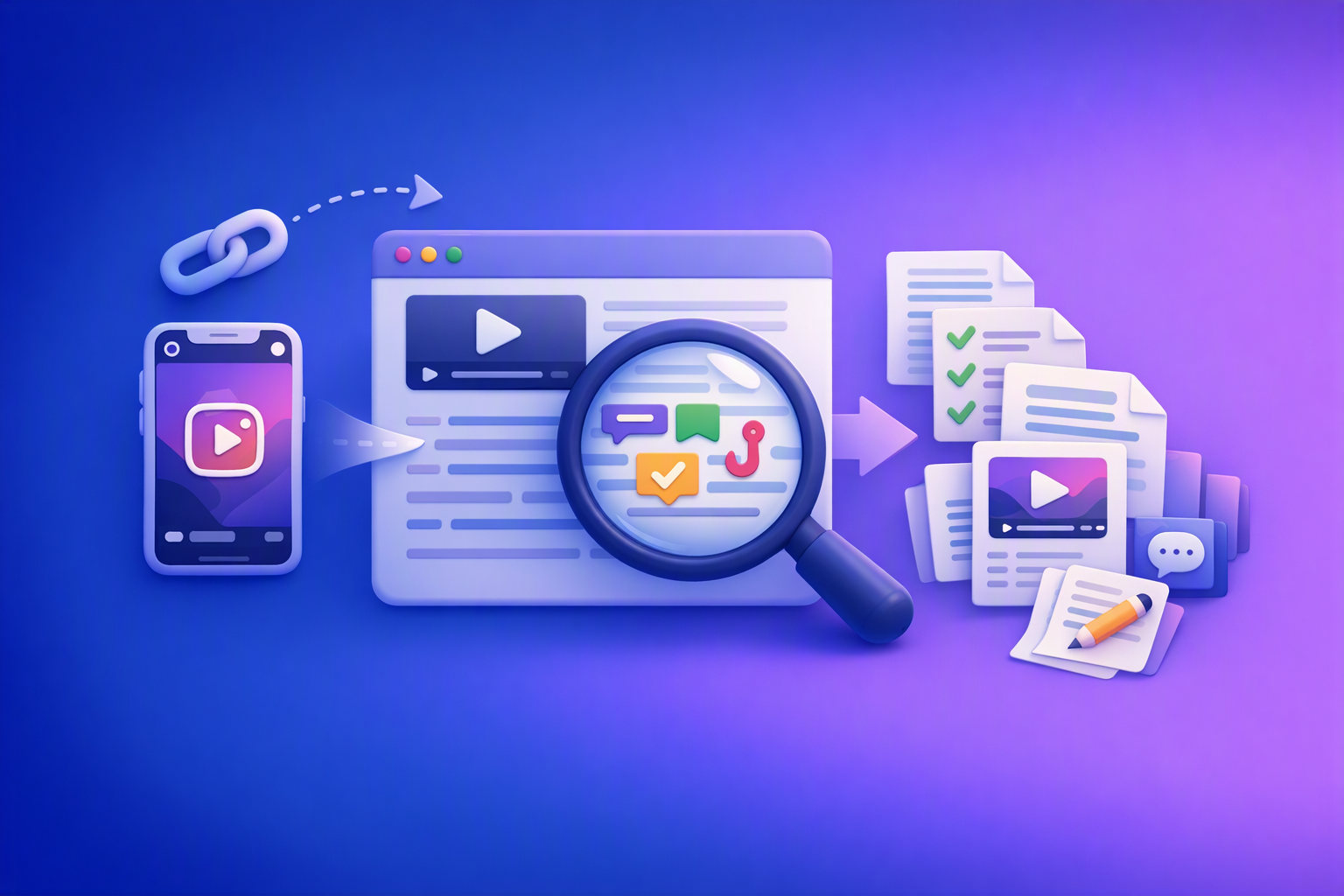
A 2026 reel analyser should turn Instagram Reel links into a searchable transcript library you can tag for hooks, CTAs, objections, and topic clusters—then export into repurposing-ready drafts without a download/upload loop.
Traducir video de Instagram (Reels) en 2026: workflow transcript-first para traducir, sacar hooks/CTAs y repurpose (con VideoToTextAI)
Video To Text AI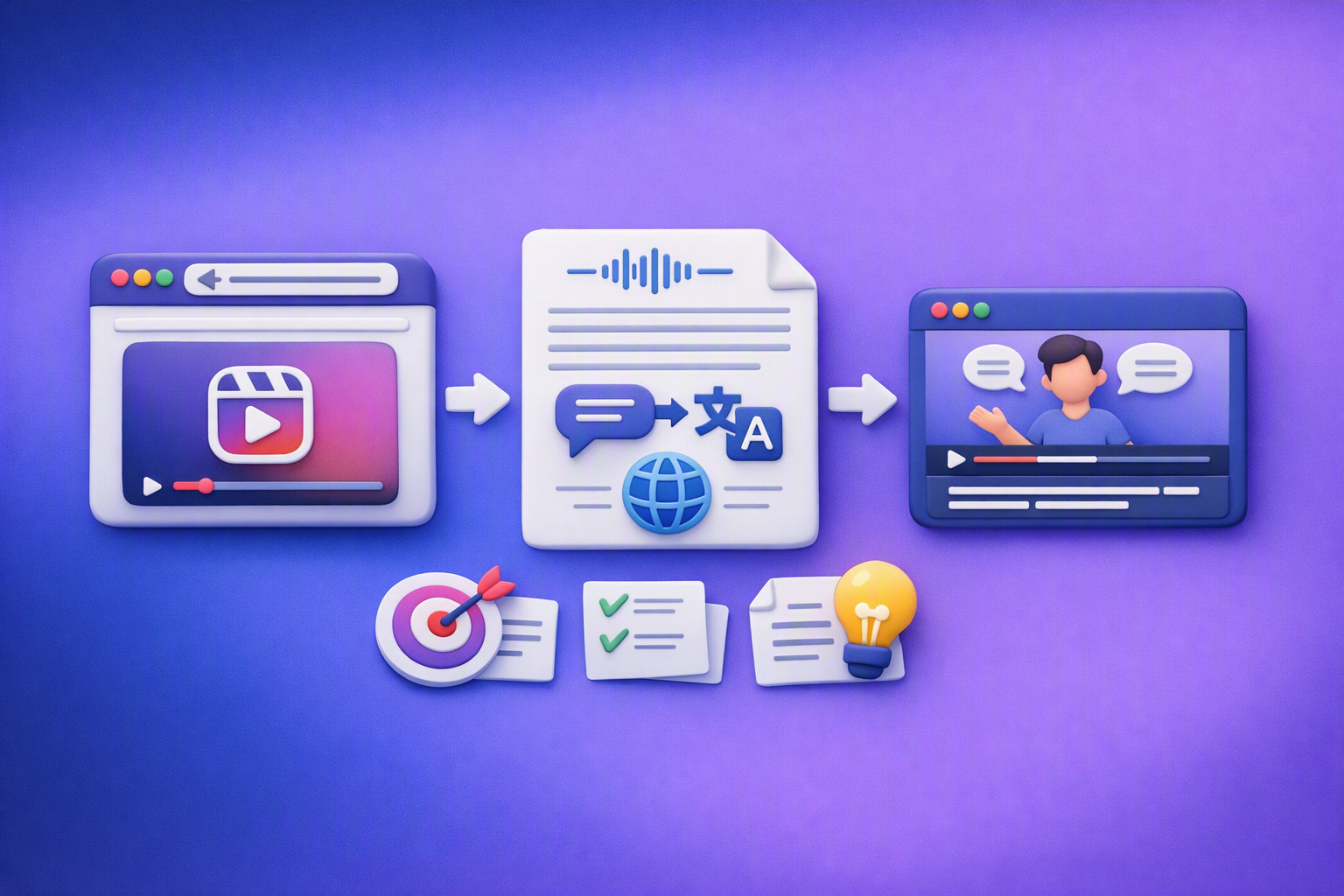
Aprende a traducir un Reel de Instagram con un flujo URL→transcripción→traducción→subtítulos, y a convertir esa traducción en un activo de investigación para hooks, CTAs, objeciones y clusters de contenido.
Reel Analyzer: Transcript‑First Instagram Reels Research (Hooks, CTAs, Objections) + Workflow Guide (VideoToTextAI)
Video To Text AI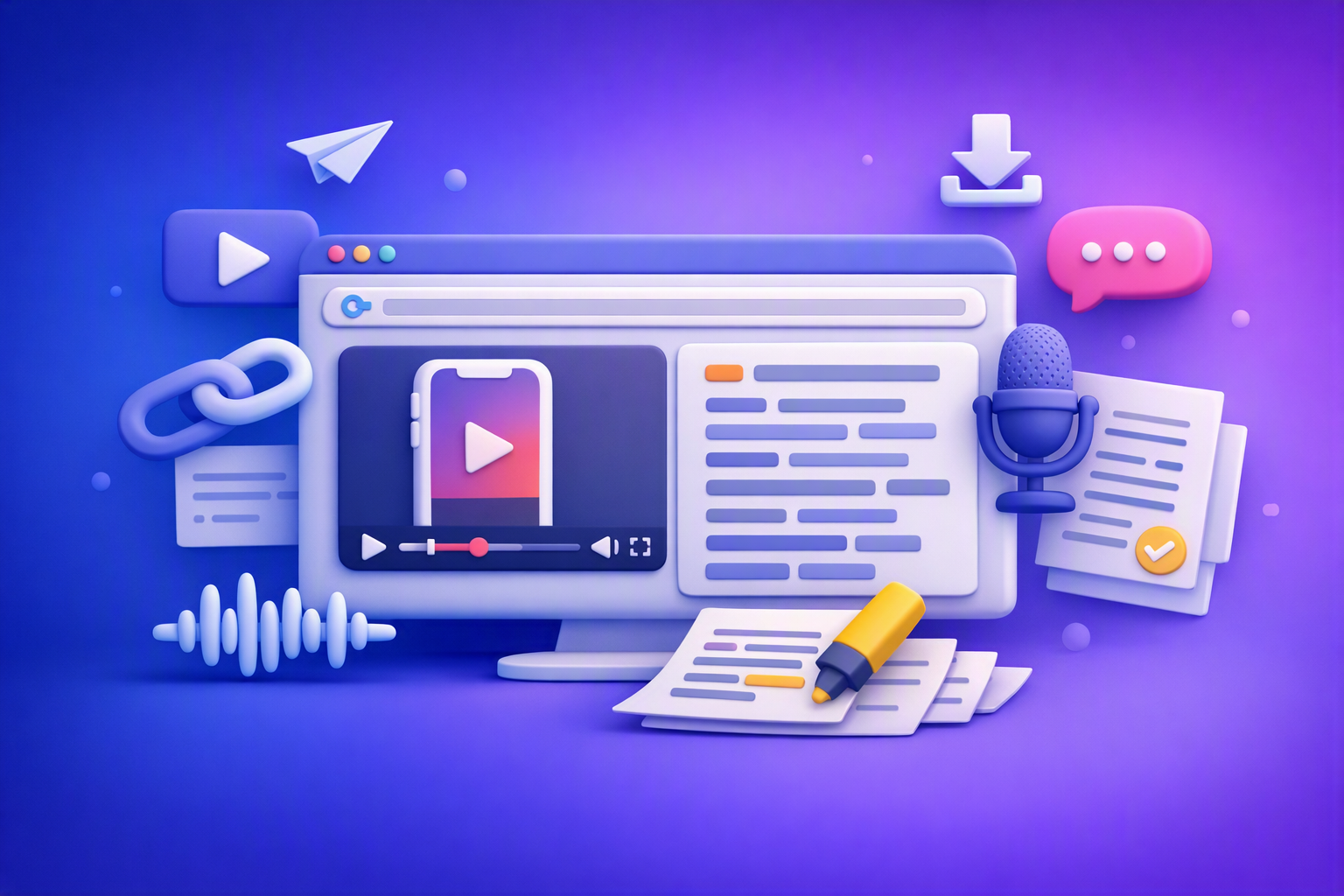
A reel analyzer should turn any public Instagram Reel link into a searchable transcript library you can mine for hooks, CTAs, objections, and topic clusters—then repurpose into original drafts with a repeatable SOP.