
Can ChatGPT Upload Video in 2026? What Actually Works (Plus a Reliable Link → Transcript Workflow)
 Video To Text AI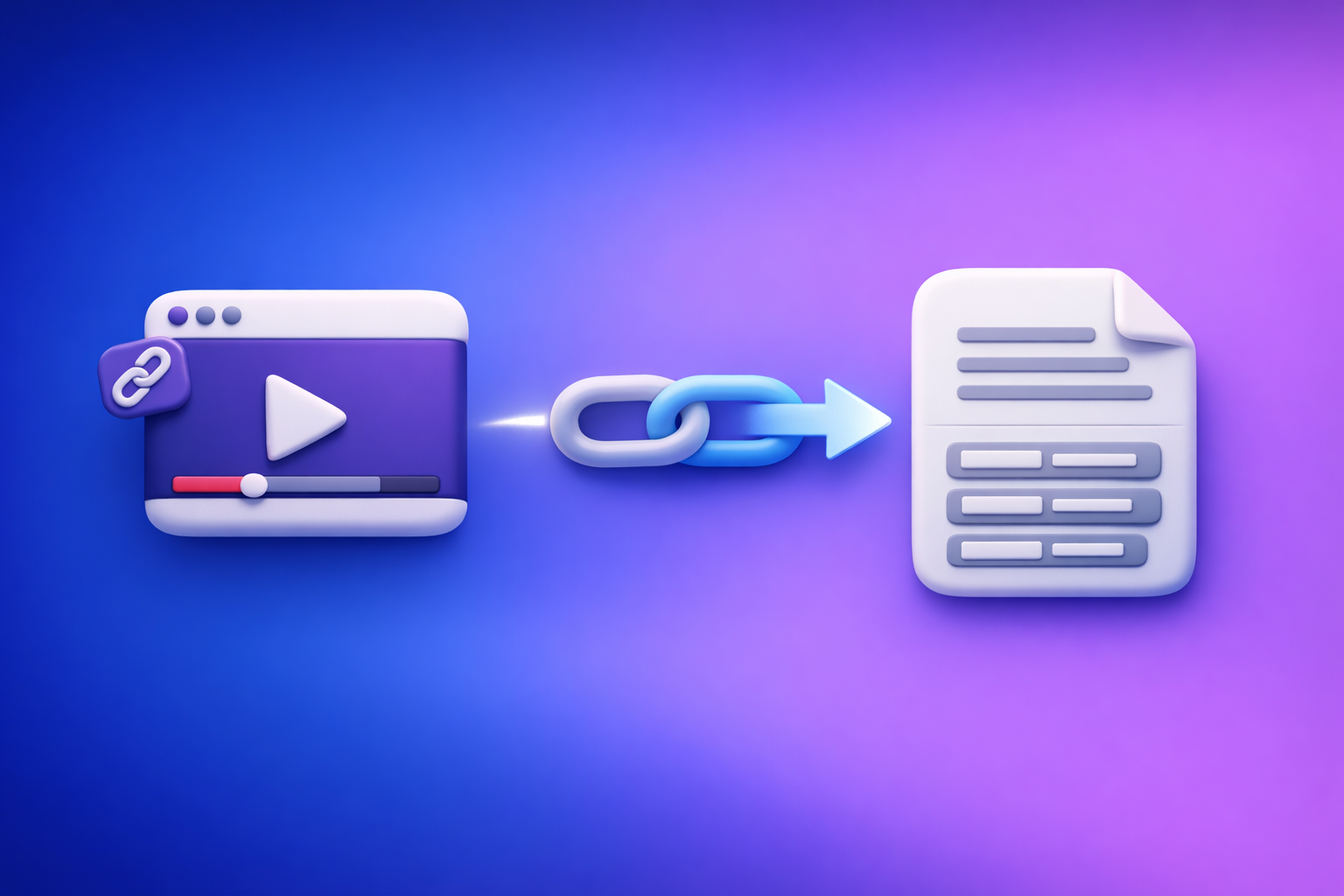
Can ChatGPT Upload Video in 2026? What Actually Works (Plus a Reliable Link → Transcript Workflow)
If you need a transcript, captions, or a blog post from a video, don’t rely on “uploading video to ChatGPT” as your primary workflow. The reliable approach in 2026 is video link → transcript/subtitles → ChatGPT for post-processing.
Quick Answer: Can ChatGPT Upload Video?
Sometimes—but it’s not dependable enough for production workflows. Whether you can upload video to ChatGPT depends on your account, client (web/mobile/desktop), and the specific model/tools enabled.
What “upload video” can mean (file upload vs. link vs. frames)
People use “upload video” to mean three different things:
- File upload: attaching an MP4/MOV file directly in chat.
- Link sharing: pasting a YouTube/Instagram/hosted MP4 URL and expecting ChatGPT to “watch” it.
- Frames/images: extracting still frames (or short clips) and asking ChatGPT to analyze visuals.
Only the last one (frames) is consistently feasible, and it’s still limited for long-form content.
The practical limitation: “uploading” ≠ reliably processing full video end-to-end
Even when an upload button exists, full video understanding is not guaranteed:
- Long duration videos can time out or be truncated.
- Audio transcription may be incomplete or inaccurate.
- Timestamps (SRT/VTT) are usually not generated reliably.
If your deliverable requires accurate text outputs, treat ChatGPT as a text processor, not a video ingestion pipeline.
When it works vs. when it fails (real workflow expectations)
It can work for:
- Short clips where you want a quick, rough summary.
- Visual inspection of a few frames (e.g., “what’s on screen?”).
It often fails for:
- Accurate transcripts (especially with multiple speakers).
- Captions with timestamps (SRT/VTT).
- Long videos, noisy audio, or jargon-heavy content.
What ChatGPT Can Do With Video (and What It Can’t)
Can ChatGPT “watch” a video you upload?
In some interfaces, ChatGPT can accept media and provide analysis. In practice, it’s best to assume partial processing and non-deterministic behavior (it may work today and fail tomorrow).
If you need repeatable outputs, use a dedicated workflow that produces export-ready text files first.
Can ChatGPT analyze a YouTube link directly?
Not reliably. A pasted YouTube URL does not guarantee that ChatGPT can:
- Access the page (geo/age/login restrictions).
- Fetch the media stream.
- Process the full audio track.
For consistent results, use a link-based transcript workflow such as youtube to blog (generate text first, then repurpose).
Can ChatGPT generate transcripts/captions from video by itself?
ChatGPT can help with transcription-like tasks, but it’s not a dependable captioning engine for:
- SRT/VTT timing
- speaker turns
- complete coverage (no missing segments)
If you need captions you can upload to YouTube or a video editor, generate SRT/VTT from a transcript workflow first (see mp4 to srt and mp4 to vtt).
Best-fit use cases for ChatGPT: post-processing text (summaries, chapters, repurposing)
ChatGPT is strongest after you already have text:
- Clean-up: punctuation, filler removal, readability.
- Structure: chapters, headings, key takeaways.
- Repurposing: blog posts, newsletters, social snippets, hooks.
That’s why the modern workflow is link → transcript → ChatGPT, not “upload video and hope.”
Why Video Uploads Fail in Real Workflows
Plan/interface variability (features differ across accounts and clients)
“Video upload” capabilities vary by:
- subscription tier
- region
- web vs. mobile app
- experimental tool rollouts
A workflow that depends on a UI button is fragile.
File size, duration, and processing time constraints
Common failure points:
- large files exceed upload limits
- long videos exceed processing windows
- background processing stops on mobile
- network interruptions corrupt uploads
This is why downloading and moving big video files around is an outdated workflow. Link-first extraction is faster, lighter, and easier to automate.
Permissions and link access issues (private videos, expiring URLs)
Even if you share a link, access can fail due to:
- private/unlisted settings
- expiring signed URLs
- login walls
- platform blocks
If a link requires authentication, you may need an MP4 fallback—but link-first should remain the default.
Accuracy risks: missing audio segments, speaker confusion, timing drift
When video ingestion is inconsistent, you’ll see:
- missing sections (especially intros/outros)
- merged speakers (“Speaker 1” becomes everyone)
- timing drift that makes captions unusable
If captions matter, SRT/VTT must be generated from a purpose-built pipeline before ChatGPT touches the content.
The Reliable Workflow (Recommended): Video Link/MP4 → Transcript/Subtitles → ChatGPT
This is the workflow we recommend at VideoToTextAI: stop treating video files as the unit of work. Treat the video link as the source of truth, generate text outputs, then use ChatGPT where it’s strongest.
Step 1: Start with a video link (preferred) or MP4 (fallback)
Prioritize link-based inputs whenever possible. It’s faster, avoids huge uploads, and fits modern creator pipelines.
Supported sources to prioritize (YouTube, Instagram/Reels, podcasts, hosted MP4)
Common link-first sources:
- YouTube (long-form, podcasts, tutorials)
- Instagram/Reels (short-form)
- podcast pages / RSS-hosted episodes
- direct hosted MP4 URLs (CDN links)
Relevant tools you can use depending on source:
When to choose MP4 instead of a link
Use MP4 when:
- the video is private and can’t be shared via accessible link
- you’re working with raw footage not yet uploaded
- the platform blocks extraction from your region/account
If you’re starting from a file, keep it simple and go straight to mp4 to transcript.
Step 2: Generate export-ready outputs (TXT/SRT/VTT) with VideoToTextAI
Use VideoToTextAI to produce deliverables you can ship:
- Transcript (TXT) for editing, SEO, and repurposing
- Subtitles/captions (SRT/VTT) for publishing and editors
If you want to run the workflow end-to-end with a link-first approach, use VideoToTextAI here: VideoToTextAI
Transcript (TXT) for editing and repurposing
TXT is your “source document” for:
- blog posts
- newsletters
- show notes
- knowledge base articles
Subtitles/captions (SRT/VTT) for publishing
SRT/VTT are your “distribution assets” for:
- YouTube captions
- web players
- editing tools that accept subtitle imports
What to verify before exporting (language, speaker labels, timestamps)
Before exporting, verify:
- language is correct (and consistent)
- names/acronyms are spelled correctly
- speaker labels are acceptable (if needed)
- timestamps align with speech (especially for SRT/VTT)
Step 3: Use ChatGPT on the transcript (not the raw video)
Once you have TXT, ChatGPT becomes predictable and fast.
Clean-up prompt: fix punctuation, remove filler, preserve meaning
Copy/paste prompt:
You are editing a transcript. Fix punctuation and capitalization, remove filler words (um/uh/like) only when it doesn’t change meaning, keep technical terms intact, and do not add new facts. Output clean paragraphs and keep speaker labels if present.
Structure prompt: chapters + headings + key takeaways
Copy/paste prompt:
Using the transcript below, create: (1) a 6–10 item chapter list with timestamps if provided, (2) H2/H3 headings for a blog post, and (3) 8 key takeaways. Do not invent claims not stated in the transcript.
Repurpose prompt: blog post + social snippets + newsletter summary
Copy/paste prompt:
Repurpose this transcript into: (1) a 1,200–1,800 word SEO blog post, (2) 10 short social posts with hooks, and (3) a 150-word newsletter summary. Keep all claims faithful to the transcript and flag any unclear sections as questions.
Step 4: Publish and reuse outputs across channels
Once you have TXT + SRT/VTT + ChatGPT outputs, publishing becomes a checklist, not a guessing game.
YouTube description + chapters
- paste the chapter list into the description
- add key takeaways and links
- upload SRT/VTT captions
Blog post + SEO sections
- use the headings and takeaways as your outline
- add screenshots or references as needed
- embed the video and include the transcript (optional)
Short-form captions + hooks
- turn key moments into hooks
- use captions as on-screen text
- keep claims aligned with the transcript
Step-by-Step: Exact Implementation (Copy/Paste Workflow)
A. Link-based workflow (fastest)
- Copy the video URL
- Paste into VideoToTextAI and generate TXT + SRT/VTT
- Skim the transcript for obvious errors (names, acronyms, jargon)
- Send transcript to ChatGPT with a specific output request (chapters, blog, captions)
- Export final assets and publish
If your goal is a written asset from YouTube, start here: youtube to blog.
B. MP4 workflow (when links aren’t available)
- Export MP4 from your device/editor
- Upload to VideoToTextAI and generate TXT + SRT/VTT
- Validate timestamps and speaker turns
- Use ChatGPT for formatting + repurposing
- Ship assets (captions, post, summary)
For file-based starts, use:
Troubleshooting: “ChatGPT Video Upload Failed” Scenarios
If the upload button isn’t there
- You’re likely on an interface/plan that doesn’t support video upload.
- Switch to the transcript-first workflow and paste text into ChatGPT instead.
If the video uploads but ChatGPT can’t analyze it
Common causes:
- file too large/long
- processing timeout
- unsupported codec/container
- the system only extracts partial frames
Fix: generate TXT/SRT/VTT first, then ask ChatGPT to work from the transcript.
If ChatGPT gives a partial/incorrect summary
This usually happens when:
- only part of the audio was processed
- the model guessed missing context
- the video had multiple speakers or crosstalk
Fix:
- rely on a complete transcript
- instruct ChatGPT: “Do not invent details; quote exact lines when unsure.”
If you need accurate captions with timestamps (why SRT/VTT first matters)
If you publish captions, timing is the product. ChatGPT is not a timing engine.
Fix: generate SRT/VTT first (then use ChatGPT only for text edits that don’t break timing).
If you’re on iPhone (share link vs. upload file decision)
On iPhone, uploading large videos is fragile.
Prefer:
- share the link (YouTube/Instagram) into a link-based workflow
- use MP4 only when the video is not hosted anywhere accessible
Checklist: Reliable Video → Text → Content Repurposing
Input checklist (before you start)
- Video link works without login (or you have the MP4)
- Audio is clear enough for transcription (minimal background noise)
- You know the target language and correct spelling for names/brands
Output checklist (before you publish)
- Transcript is complete (no missing sections)
- Speaker labels are correct (if needed)
- Captions are synced (SRT/VTT timing looks right)
- ChatGPT outputs match the transcript (no invented claims)
- Final assets exported for your platform (TXT/SRT/VTT + blog/social)
Competitor Gap
Most pages ranking for “can chat gpt upload video” focus on whether a button exists today. That’s not the real problem creators and teams face.
What competitors miss (and what this post adds):
- A repeatable, link-first workflow that doesn’t depend on ChatGPT’s changing video features
- Step-by-step implementation for both link and MP4 scenarios
- Troubleshooting mapped to failure modes (missing upload UI, partial analysis, link access)
- Publish-ready checklist + copy/paste prompts tied to real deliverables (TXT/SRT/VTT → blog/captions)
If you want the companion guide focused specifically on transcription, see Can ChatGPT Transcribe Videos? What Works in 2026 + The Reliable Link → Transcript Workflow (VideoToTextAI). For the broader upload question, reference Can ChatGPT Upload Video in 2026? What Actually Works (and the Reliable Link → Transcript Workflow).
FAQ
Can I upload a video to ChatGPT?
Sometimes, yes—but it’s inconsistent across plans and apps, and it’s not reliable for long videos or production deliverables. For dependable results, convert the video to TXT/SRT/VTT first, then use ChatGPT on the text.
Can ChatGPT watch videos you upload?
It may analyze parts of a video in some interfaces, but it’s not a dependable “watch the whole thing and understand it” workflow. Expect partial processing and use transcript-first for accuracy.
Can ChatGPT analyze videos from YouTube?
A YouTube link does not guarantee access or full analysis. The repeatable approach is YouTube link → transcript/subtitles → ChatGPT.
Can you upload videos to ChatGPT for free?
Free access varies and often excludes advanced media handling. Even when free upload exists, reliability is the bigger issue—use transcript-first workflows to avoid rework.
How to upload a video to ChatGPT from iPhone?
If upload is available, attach from Photos/Files, but large videos often fail. Prefer sharing a public link (YouTube/Instagram) into a link-based transcript workflow, then paste the transcript into ChatGPT.
Related posts
Reel Analyser (Instagram Reels): Transcript‑First Competitor Research, Hook/CTA Extraction, and Repurposing Workflow (VideoToTextAI)
Video To Text AI
A 2026 reel analyser should turn Instagram Reel links into a searchable transcript library you can tag for hooks, CTAs, objections, and topic clusters—then export into repurposing-ready drafts without a download/upload loop.
Traducir video de Instagram (Reels) en 2026: workflow transcript-first para traducir, sacar hooks/CTAs y repurpose (con VideoToTextAI)
Video To Text AI
Aprende a traducir un Reel de Instagram con un flujo URL→transcripción→traducción→subtítulos, y a convertir esa traducción en un activo de investigación para hooks, CTAs, objeciones y clusters de contenido.
Reel Analyzer: Transcript‑First Instagram Reels Research (Hooks, CTAs, Objections) + Workflow Guide (VideoToTextAI)
Video To Text AI
A reel analyzer should turn any public Instagram Reel link into a searchable transcript library you can mine for hooks, CTAs, objections, and topic clusters—then repurpose into original drafts with a repeatable SOP.