
Can ChatGPT Upload Video in 2026? What Actually Works (and the Reliable Link → Transcript Workflow)
 Video To Text AI
ChatGPT video uploads are not a dependable way to get transcripts, captions, or full-video analysis in 2026. The reliable solution is link/MP4 → export-ready transcript/captions → ChatGPT on text, which avoids upload failures and produces reusable assets.
Can ChatGPT Upload Video in 2026? What Actually Works (and the Reliable Link → Transcript Workflow)
Quick Answer (So You Don’t Waste Time)
What “upload video to ChatGPT” can mean (3 different asks)
People usually mean one of these:
- Attach a video file and ask ChatGPT to analyze it.
- Share a video link and ask ChatGPT to “watch” it.
- Get captions/transcripts from the video (SRT/VTT/TXT) and then generate content.
Only #3 is consistently repeatable for production workflows.
What’s reliably possible vs. inconsistent in real workflows
Reliable:
- Working from text inputs (transcripts, captions, notes).
- Summaries, chapters, titles, hooks, repurposing, SEO outlines from a transcript.
- Editing/cleaning transcripts without changing meaning.
Inconsistent:
- Uploading long videos without timeouts.
- Getting accurate, complete captions directly from a raw video upload.
- “Watching” a full video end-to-end from a link (especially private or long-form).
The dependable workaround: video link/MP4 → export-ready transcript/captions → ChatGPT on text
The modern creator workflow is link-first. Downloading and shuffling large video files is an outdated habit that slows teams down and breaks easily.
Use a link-based extraction workflow to generate:
- TXT for editing and SEO
- SRT/VTT for captions/subtitles
Then paste the text into ChatGPT for the creative and structural work.
What ChatGPT Can (and Can’t) Do With Video Files
Can you upload a video file directly into ChatGPT?
Sometimes, depending on:
- Your plan and account permissions
- Whether the feature is enabled for your region/device
- The interface (web vs. mobile)
- File size and encoding
Even when the upload option exists, it’s not a stable “production pipeline” for long videos.
Can ChatGPT “watch” a full video end-to-end?
In practice, not reliably for full-length videos. Long duration + heavy media processing increases the chance of:
- Partial processing
- Timeouts
- Incomplete understanding of the full timeline
If you need dependable outputs, treat video as an input to be transcribed first.
Can ChatGPT extract accurate captions/subtitles from video by itself?
Not consistently. Captions require:
- Accurate speech recognition
- Timing alignment (for SRT/VTT)
- Speaker changes and punctuation
- Handling accents, noise, and music
A transcript-first workflow is the only repeatable way to get export-ready captions.
When ChatGPT is useful: after you already have text (transcript, captions, notes)
ChatGPT shines when you provide clean text and ask for:
- Chapters, titles, and summaries
- Content repurposing (blog, LinkedIn, X threads)
- SEO structure (H2s, FAQs, key takeaways)
- Caption rewrites (shorter lines, better readability)
If your goal is creator productivity, the winning pattern is: extract text once, reuse forever.
Why Video Uploads Fail (Common Causes You Can Actually Fix)
File size/length limits and timeouts
Large files and long videos often fail due to:
- Upload timeouts
- Processing limits
- Network instability (especially on mobile)
Fix:
- Prefer link-first ingestion whenever possible.
- If you must upload, shorten the file or split it.
Unsupported formats and codec issues (why “MP4” still fails)
“MP4” is a container, not a guarantee. Failures often come from:
- Unsupported codecs (video/audio)
- Variable frame rate quirks
- Unusual audio tracks
Fix:
- Re-export with standard settings (H.264 video + AAC audio) if you must upload.
- Better: avoid file handling by using a link-based workflow.
Permissions problems (private links, expiring URLs, login walls)
Links fail when they are:
- Private/unlisted without access
- Behind a login wall
- Expiring (temporary share links)
Fix:
- Test the link in an incognito window.
- Use a stable share URL or upload the MP4 to your transcription workflow.
Interface differences (web vs. mobile) and feature rollouts
The upload UI can differ by:
- App version
- Web vs. iOS vs. Android
- Gradual rollouts/experiments
Fix:
- Try web if mobile is missing the feature (or vice versa).
- Don’t build a business workflow around a feature that appears/disappears.
“Upload succeeded” but analysis is incomplete (partial processing)
This is common with long videos. Symptoms:
- ChatGPT summarizes only the first portion
- Misses key segments
- Hallucinates details to “fill gaps”
Fix:
- Don’t ask ChatGPT to infer from partial media.
- Generate a transcript and work from the text source of truth.
Step-by-Step: The Reliable Workflow (VideoToTextAI → ChatGPT)
This workflow is built for repeatability: links in, export-ready text out. It’s also future-proof because it doesn’t depend on whether a chat UI supports video uploads this month.
Step 1: Choose your input method (link-first vs. MP4)
Use a link when possible (fastest, least brittle)
Link-first is the future of creator productivity because it:
- Avoids downloading huge files
- Reduces codec failures
- Keeps workflows shareable across teams
Common link sources:
- YouTube
- Public hosted MP4 URLs
- Share links that work without login
If you’re building a repeatable pipeline, start with link ingestion and treat file downloads as the exception.
Use MP4 when you must (local files, private recordings)
Use MP4 when:
- The video is private and cannot be shared via a stable link
- You only have a local recording
- The link is behind authentication you can’t bypass
If you go MP4, keep the file standard (H.264/AAC) to reduce failures.
Step 2: Generate export-ready outputs in VideoToTextAI
VideoToTextAI is designed for AI link-based video-to-text workflows so you can move from video to deliverables without brittle “upload and hope” behavior. Use it to generate transcripts, subtitles, captions, and repurposing-ready text—then use ChatGPT for the writing and structuring.
Output types and when to use each
-
TXT (clean transcript for editing/SEO)
Best for: blog drafts, SEO pages, show notes, internal documentation. -
SRT (timed subtitles for YouTube/IG/LinkedIn)
Best for: platform uploads that expect SRT timing and numbering. -
VTT (web captions, players, accessibility)
Best for: web players, accessibility tooling, modern caption pipelines.
If you want tool-specific paths, see:
Quality controls to set before exporting
Set these before you export so you don’t rework later:
-
Speaker labels (on/off)
Turn on for interviews, podcasts, panels. Turn off for solo creators if you want cleaner text. -
Timestamp granularity
Use tighter timestamps for editing and clip selection. Use lighter timestamps for reading. -
Language selection (and when to translate)
Select the spoken language for accuracy. Translate only after you have a clean source transcript.
Step 3: Paste the transcript into ChatGPT (what to ask for)
Once you have TXT/SRT/VTT, ChatGPT becomes extremely effective because it’s working from complete, searchable text.
Prompt: clean up transcript without changing meaning
You are editing a transcript. Fix punctuation, casing, and obvious transcription errors without paraphrasing. Keep wording and meaning the same. Preserve speaker labels and timestamps if present. Output as clean plain text.
Prompt: create chapters + titles + timestamps
Using this transcript, create 6–12 chapters. Each chapter needs: a short title, a 1–2 sentence summary, and the timestamp range. Use the transcript timestamps as the source of truth.
Prompt: generate captions and short clips script ideas
From this transcript, propose 10 short clip ideas. For each: hook line, clip title, start/end timestamp, and a 1–2 sentence description. Prioritize moments with clear takeaways and strong phrasing.
Prompt: repurpose into blog/LinkedIn/X threads from the same transcript
Turn this transcript into: (1) a blog outline with H2/H3s, (2) a LinkedIn post, and (3) a 12-tweet X thread. Keep claims factual and grounded in the transcript. Include a short summary and 5 key takeaways.
For a dedicated repurposing path, see:
Step 4: Publish/export checklist (so captions don’t break)
SRT/VTT formatting checks (line length, numbering, timing)
- Keep caption lines short (avoid walls of text).
- Ensure SRT numbering is sequential and timestamps are valid.
- Confirm timing doesn’t overlap or drift.
Accessibility checks (caption readability, punctuation, speaker changes)
- Add punctuation so captions are readable at speed.
- Break lines on natural pauses.
- Mark speaker changes clearly (especially for interviews).
SEO checks (title/H2s/summary pulled from transcript)
- Use transcript language for keyword alignment (don’t invent topics).
- Pull H2s from repeated themes and questions.
- Add a concise summary and “key takeaways” section.
CTA (after the workflow section)
If you’re tired of inconsistent uploads, use a link-first pipeline and let ChatGPT work on clean text: Generate TXT/SRT/VTT from a link in minutes with VideoToTextAI.
Implementation Checklist (Copy/Paste)
Inputs
- Video link works in an incognito window (no login required) OR MP4 is locally available
- Audio is clear enough (no heavy music over speech)
- Target output selected: TXT / SRT / VTT
In VideoToTextAI
- Generate transcript from link/MP4
- Export TXT for editing + SRT/VTT for captions
- Spot-check 60–90 seconds across 3 points in the video
In ChatGPT
- Clean transcript (no paraphrasing)
- Create chapters + summary + key takeaways
- Generate repurposed assets (blog outline, LinkedIn post, short captions)
Final
- Validate SRT/VTT formatting in your target platform
- Store transcript as the “source of truth” for future repurposing
Troubleshooting: Fixes for the Most Common “ChatGPT Video Upload Failed” Scenarios
If the upload button is missing
Likely causes:
- Feature not enabled for your account/plan
- Different UI on mobile vs. web
- Rollout/experiment changes
Fix:
- Try the web app and the mobile app.
- Update the app.
- Stop relying on direct video upload as your primary workflow.
Fallback:
- Use a transcript-first pipeline and paste text into ChatGPT.
If the upload stalls or errors out
Likely causes:
- File too large
- Network instability
- Codec incompatibility
Fix:
- Re-export to a standard MP4 (H.264/AAC).
- Shorten or split the file.
- Use a stable connection.
Fallback:
- Prefer link ingestion; avoid file transfers when possible.
If ChatGPT responds but clearly didn’t process the whole video
Likely causes:
- Partial processing due to length/time limits
- The model only “saw” a portion of the content
Fix:
- Don’t accept summaries without a text source.
- Generate a transcript and ask ChatGPT to cite sections from it.
Fallback:
- Work from TXT/SRT/VTT and request structured outputs (chapters, takeaways, clips).
If you only have a phone (iPhone/Android): fastest path to transcript + captions
Best practice on mobile:
- Use a shareable link whenever possible (link-first beats file juggling).
- If you only have a local video, upload the MP4 once to your transcription workflow, export TXT/SRT/VTT, then paste the transcript into ChatGPT.
This avoids the most common mobile failure modes: timeouts, backgrounding, and partial uploads.
Competitor Gap
Most answers to “can chat gpt upload video” are vague (“it depends”) and don’t ship a workflow you can run today. A better standard is:
- A repeatable, link-first workflow (because downloading video files is outdated and brittle).
- Export-ready deliverables (TXT/SRT/VTT), not vague “analysis.”
- A troubleshooting matrix (cause → fix → fallback) so teams can unblock fast.
- Reusable prompts + a checklist so execution is immediate, not theoretical.
If you want the deeper companion reads, see:
- Can ChatGPT Upload Video in 2026? What’s Actually Possible (and the Reliable Transcript-First Workflow)
- Can ChatGPT Transcribe Videos? What Actually Works in 2026 (Plus the Reliable Link → Transcript Workflow)
FAQ
Can I upload a video to ChatGPT?
Sometimes, but it’s inconsistent across accounts, devices, and video lengths. For reliable results, generate TXT/SRT/VTT first and use ChatGPT on the transcript.
Why can’t I upload videos to ChatGPT anymore?
It’s usually a rollout/UI difference, plan limitation, or a file/codec/timeout issue. Even when uploads “work,” long videos can be partially processed.
Can ChatGPT handle video?
ChatGPT can help with video tasks, but the dependable method is text-first: transcribe the video, then use ChatGPT to summarize, structure, and repurpose.
Can ChatGPT watch videos you upload?
Not reliably end-to-end for long videos in a way you can operationalize. If accuracy matters, treat the transcript as the source of truth and build from there.
Related posts
Reel Analyser (Instagram Reels): Transcript‑First Competitor Research, Hook/CTA Extraction, and Repurposing Workflow (VideoToTextAI)
Video To Text AI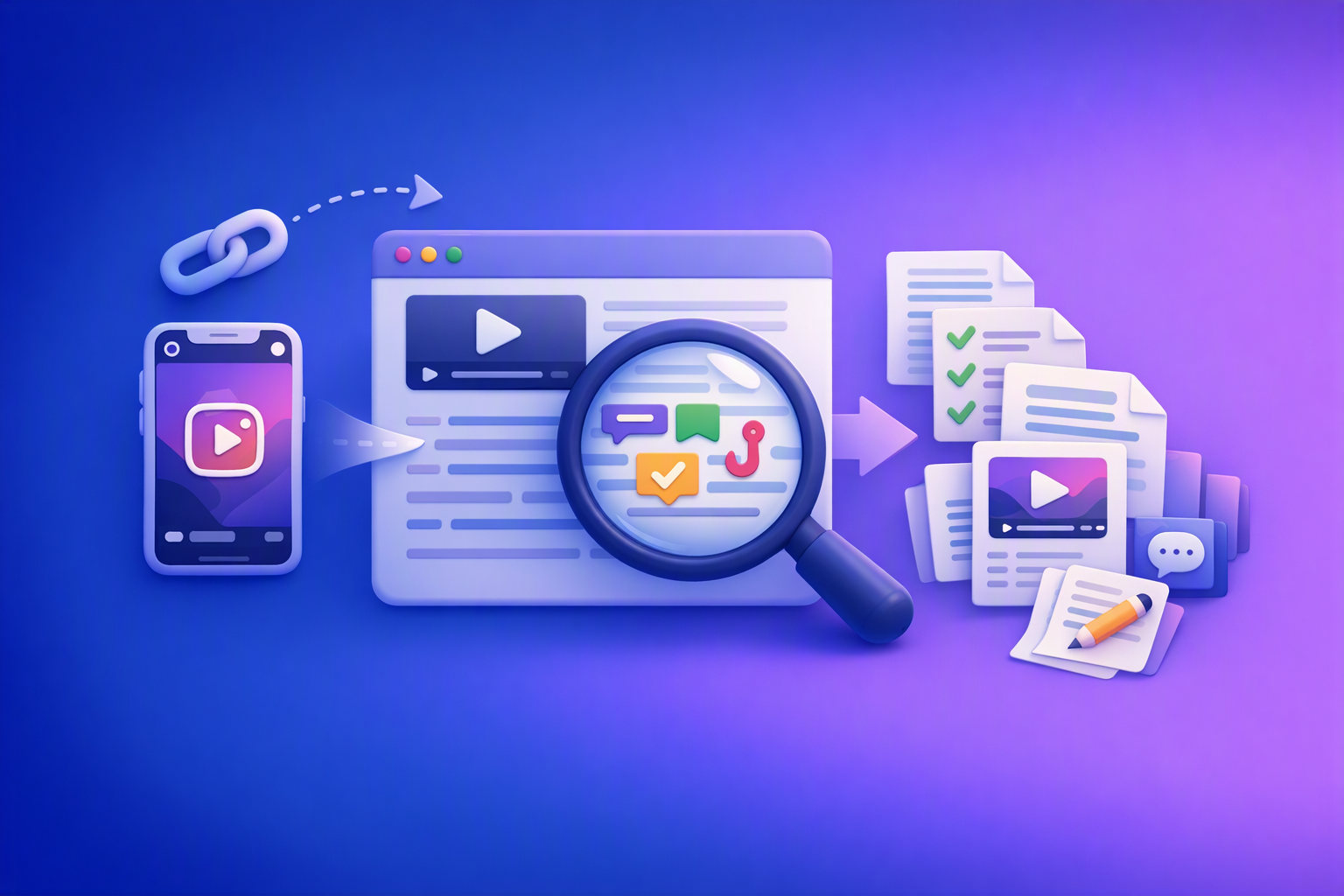
A 2026 reel analyser should turn Instagram Reel links into a searchable transcript library you can tag for hooks, CTAs, objections, and topic clusters—then export into repurposing-ready drafts without a download/upload loop.
Traducir video de Instagram (Reels) en 2026: workflow transcript-first para traducir, sacar hooks/CTAs y repurpose (con VideoToTextAI)
Video To Text AI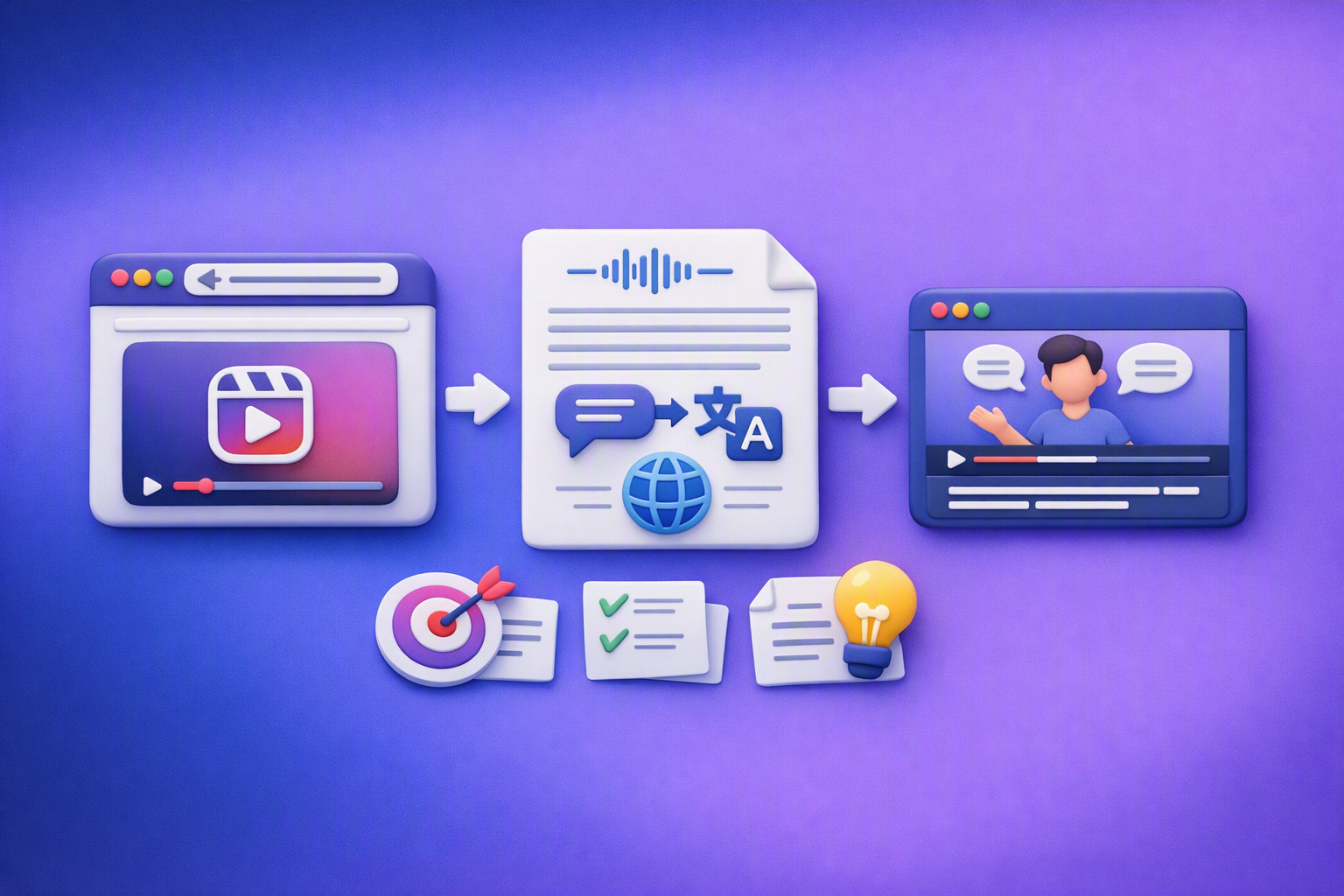
Aprende a traducir un Reel de Instagram con un flujo URL→transcripción→traducción→subtítulos, y a convertir esa traducción en un activo de investigación para hooks, CTAs, objeciones y clusters de contenido.
Reel Analyzer: Transcript‑First Instagram Reels Research (Hooks, CTAs, Objections) + Workflow Guide (VideoToTextAI)
Video To Text AI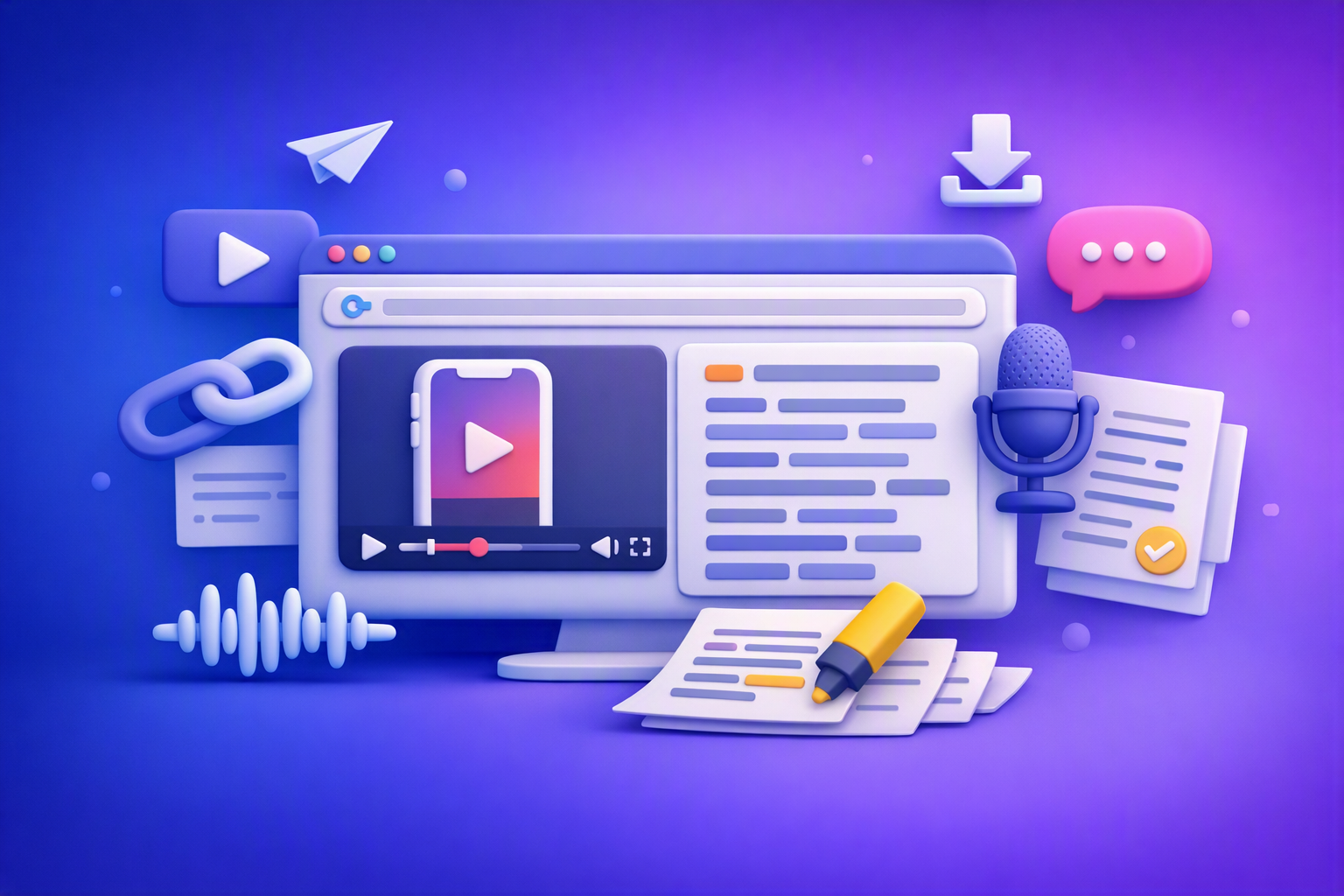
A reel analyzer should turn any public Instagram Reel link into a searchable transcript library you can mine for hooks, CTAs, objections, and topic clusters—then repurpose into original drafts with a repeatable SOP.