
ChatGPT “Upload Video” Feature: What Works, Why Uploads Fail, and the Production-Grade Link → Transcript Workflow (VideoToTextAI)
 Video To Text AI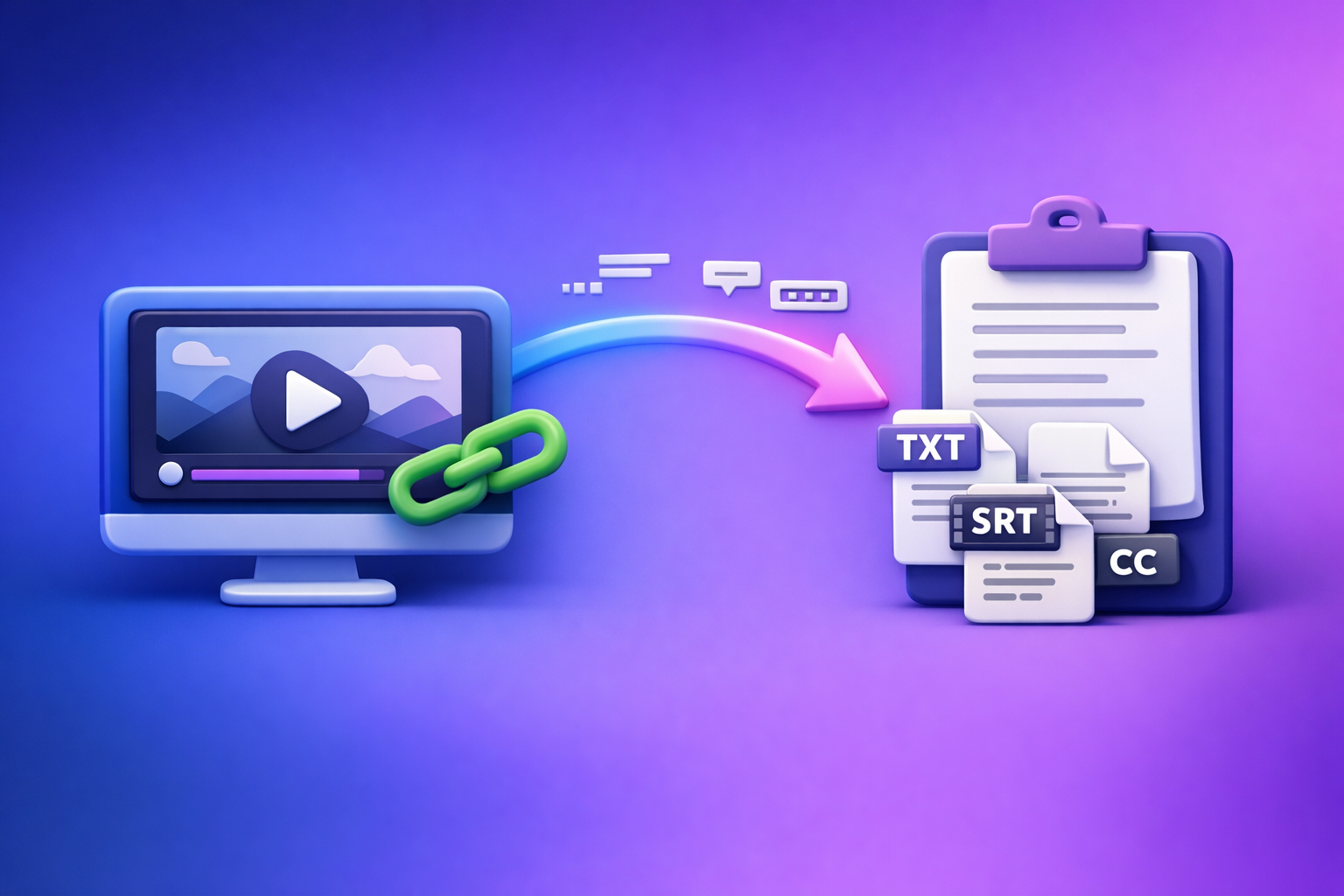
ChatGPT “Upload Video” Feature: What Works, Why Uploads Fail, and the Production-Grade Link → Transcript Workflow (VideoToTextAI)
If you need ship-ready captions or transcripts, don’t rely on the chatgpt “upload video” feature as your primary workflow. Use a deterministic pipeline: video link/MP4 → TXT + SRT/VTT → ChatGPT-on-text so outputs are consistent, exportable, and QA-able.
TL;DR (for teams who just need a reliable workflow)
When to use ChatGPT video upload
Use video upload when the goal is quick, non-export deliverables, such as:
- “What happens in this clip?” analysis
- Rough content ideas from a short segment
- Quick visual checks (objects, scenes, on-screen text)
- One-off internal review where formatting doesn’t matter
When to avoid it (and why)
Avoid it when you need repeatability and deliverables that ship:
- Full-length transcripts with completeness guarantees
- SRT/VTT captions with reliable timestamps
- Speaker labels that stay consistent across revisions
- Any workflow where you must re-run and get the same structure back
Video uploads are inherently variable: file constraints, processing timeouts, and formatting drift make them fragile for production.
The deterministic alternative: video link/MP4 → TXT + SRT/VTT → ChatGPT-on-text
The production-grade approach is artifact-first:
- Generate Transcript (TXT) for editing/search/prompting
- Generate Subtitles (SRT/VTT) for publishing
- Use ChatGPT on the text artifacts for summaries, chapters, hooks, and repurposing
This is also where the industry is going: downloading video files is an outdated workflow. Link-based extraction is the future of creator productivity because it removes file-handling friction and makes pipelines repeatable.
What the ChatGPT “Upload Video” feature actually does (and what it doesn’t)
“Analyze a clip” vs “generate export-ready captions”
ChatGPT video upload is best understood as analysis-first, not captioning-first.
- It can describe what it sees/hears and answer questions about the clip.
- It is not designed as a deterministic caption generator with strict formatting rules.
If your destination is YouTube captions, a podcast site transcript, or a client deliverable, you need export-ready artifacts (TXT + SRT/VTT) that can be validated.
Output limitations: formatting, timestamps, speaker labels, and consistency
Common limitations when using video upload as a transcription tool:
- Timestamps may be missing, approximate, or inconsistent
- Speaker labels can change mid-file (Speaker 1 → Host → Person)
- Line breaks and punctuation may not match caption standards
- Re-running the same request can produce different structure
Why “looks correct” ≠ shippable transcript/subtitles
A transcript can look “fine” in a chat window and still fail in production:
- Captions need timing, line length, and readability constraints
- Editors need stable text to revise without reflow chaos
- Teams need repeatable exports for QA and client sign-off
Common failure modes (and how to diagnose them fast)
Upload fails immediately
File size limits and duration constraints (symptoms + quick fixes)
Symptoms
- Upload button spins then errors
- “File too large” or generic failure messages
- Upload never begins
Quick fixes
- Trim to a shorter clip for analysis-only tasks
- If you need full transcription/captions, switch to a transcript pipeline that accepts links or handles longer media more reliably
Unsupported codecs/containers (what to re-encode to)
Symptoms
- Upload completes but processing fails
- “Unsupported format” errors
- Black video / no audio detected
Quick fixes
- Re-encode to MP4 (H.264 video + AAC audio)
- Avoid exotic containers/codecs (e.g., certain MOV variants, variable audio codecs)
Upload starts, then stalls or times out
Network instability and background processing timeouts
Symptoms
- Upload reaches a percentage then freezes
- Processing starts but never returns output
- Session resets or errors after waiting
Quick fixes
- Use a stable wired connection
- Avoid multitasking on unstable networks
- Prefer link-based extraction to reduce local upload fragility
Long videos and multi-speaker audio as failure multipliers
Long duration and multiple speakers increase:
- Processing time
- Diarization complexity
- Risk of partial outputs
If accuracy matters, treat long/multi-speaker content as artifact-first by default.
Output is incomplete or low quality
Missing sections, hallucinated lines, or paraphrased “transcripts”
Symptoms
- Skips entire segments
- “Cleans up” by paraphrasing instead of transcribing
- Adds lines that weren’t said
Quick fixes
- Use a dedicated transcript artifact (TXT) as the source of truth
- Run QA spot checks against the video before publishing
No reliable timestamps for SRT/VTT
Symptoms
- Captions can’t be imported
- Timing drifts
- No timestamp structure at all
Quick fixes
- Generate SRT/VTT directly from a transcription workflow designed to output timed captions
Export friction
Copy/paste artifacts, broken line breaks, and subtitle timing drift
Symptoms
- Captions import with broken formatting
- Extra spaces, missing line breaks
- Timing doesn’t align after edits
Quick fixes
- Keep TXT for editing and SRT/VTT for publishing
- Avoid editing captions in a chat window; edit in text tools, then re-export cleanly
The production-grade workflow: Link/MP4 → transcript + SRT/VTT → ChatGPT on text
Step 1: Start with a stable input (public link or MP4)
The most reliable input is a public video link because it avoids local file handling and upload failures. This is why downloading video files is increasingly outdated for modern creator teams.
Supported sources: YouTube, TikTok, Instagram Reels, podcasts, direct MP4
A production workflow should handle:
- YouTube (long-form, chapters, interviews)
- TikTok / Reels (short-form, fast repurposing)
- Podcasts (multi-speaker audio)
- Direct MP4 (private recordings, client assets)
Related tools you may use depending on the source:
Pre-flight: audio quality checks that improve transcription accuracy
Before you generate artifacts, check:
- Speech is louder than music (duck background tracks)
- No clipping (distortion kills accuracy)
- Consistent mic distance (avoid volume swings)
- Language(s) and accents are known upfront
Step 2: Generate deterministic artifacts (TXT + SRT/VTT)
What “artifact-first” means and why it prevents rework
Artifact-first means you produce exportable files before you ask ChatGPT to do anything creative.
- TXT becomes the source of truth for edits, search, and prompting
- SRT/VTT becomes the source of truth for timing and publishing
- ChatGPT becomes the post-processing layer, not the transcription engine
This prevents the “redo everything” loop when a chat output is incomplete or formatted wrong.
Choose the right format
TXT for editing, search, and LLM prompting
Use TXT when you need:
- Clean editing and version control
- Fast find/replace for names/terms
- Reliable prompts for summaries, posts, and scripts
SRT/VTT for publishing captions/subtitles
Use caption formats when you need:
- Platform imports (YouTube, players, LMS tools)
- Timing alignment with the video
- Readability constraints (line length, segmentation)
Helpful internal references:
Step 3: Use ChatGPT on the text (not the video) for repeatable outputs
Once you have TXT + SRT/VTT, ChatGPT becomes highly reliable because:
- Inputs are stable
- Outputs can be structured
- You can re-run prompts and compare diffs
Summaries, chapters, titles, hooks, and cut lists
Best uses on transcript text:
- Executive summary + key takeaways
- Chapter titles and time ranges (using SRT timestamps)
- Hook ideas and title variants
- Cut lists for editors (exact lines to clip)
Repurposing: blog post, LinkedIn post, Twitter/X thread
Transcript-first repurposing is faster because you can:
- Quote exact lines
- Preserve terminology
- Avoid “creative rewrites” that change meaning
Translation workflows (keep transcript as source of truth)
For multilingual workflows:
- Keep the original transcript as the canonical source
- Translate from TXT
- Generate localized captions while preserving timing constraints
Implementation: VideoToTextAI workflow (copy/paste steps)
Link-based extraction is the future of creator productivity because it removes the slowest step in most teams: downloading, renaming, uploading, and re-uploading files.
Option A — Link-based workflow (fastest)
- Paste the video URL into VideoToTextAI
- Select outputs: Transcript (TXT) + Subtitles (SRT/VTT)
- Generate and download artifacts
- Paste transcript into ChatGPT with a structured prompt (templates below)
- Export final deliverables (captions, post, chapters) from the text outputs
Use this when the video is accessible by link and you want the least friction.
Option B — MP4 workflow (for private files)
- Upload MP4 to VideoToTextAI
- Generate TXT + SRT/VTT
- Validate timestamps and speaker turns
- Use ChatGPT for repurposing on the transcript text
Use this when content is private, internal, or not link-accessible.
Exactly one CTA (use when you’re ready to implement): Run the link → transcript workflow with VideoToTextAI.
Prompt templates (designed for transcript-first workflows)
Use these with (a) TXT transcript and optionally (b) SRT/VTT for timestamps.
Template 1: Chapters + timestamps (from transcript + SRT)
You are given:
1) A transcript (TXT)
2) Subtitles (SRT) with timestamps

Task:
- Create 6–12 chapters.
- Each chapter must include:
  - Title (max 6 words)
  - Start timestamp (from SRT)
  - 1–2 sentence summary
Rules:
- Do not invent topics not present in the transcript.
- Prefer chapter boundaries where the speaker changes topic.
Output as a markdown table: Start | Title | Summary.
Template 2: Clean transcript for publishing (remove filler, keep meaning)
Clean this transcript for publishing.

Rules:
- Remove filler words (um, uh, like) and false starts.
- Keep meaning and technical accuracy.
- Preserve speaker labels if present.
- Do NOT paraphrase into new wording unless needed for clarity.
Output:
1) Clean transcript
2) List of any uncertain terms/names you want me to verify
Template 3: Caption variants (short, medium, long) from transcript
Create 3 caption sets from this transcript:
A) Short (max 60 chars/line, 2 lines)
B) Medium (max 70 chars/line, 2 lines)
C) Long (max 80 chars/line, 2 lines)

Rules:
- Keep original meaning.
- Keep numbers and names exact.
- No emojis.
Output each set as plain text blocks.
Template 4: Blog post outline + draft from transcript (with quotes)
Turn this transcript into a blog post.

Output:
1) SEO outline (H2/H3)
2) Draft (900–1400 words)
3) 6 pull quotes (exact wording from transcript)
Rules:
- Use quotes verbatim.
- Keep claims factual; don’t add new facts.
- Include a short TL;DR section.
Template 5: Cut list (best moments) with exact lines to clip
Create a cut list for short clips.

Output 8–12 moments with:
- Clip title
- Why it works (1 sentence)
- Exact transcript lines to use (verbatim)
- If SRT provided: start–end timestamps
Rules:
- Prioritize strong hooks, contrarian points, and actionable steps.
- Do not invent timestamps; only use those provided.
Checklist: ship-ready transcript/subtitles every time
Input checklist (before processing)
- Confirm video link accessibility (no login wall / region lock)
- Ensure audio is intelligible (music ducking, mic levels, background noise)
- Identify language(s) and number of speakers
- Confirm the goal: TXT editing, SRT/VTT publishing, or both
Output checklist (after processing)
- Transcript completeness (no missing segments)
- Speaker labeling (if needed) is consistent
- Subtitle timing sanity check (no overlaps, readable line lengths)
- Export format matches destination (SRT vs VTT)
QA checklist (before publishing)
- Spot-check 3–5 random segments against the video
- Verify names, numbers, and technical terms
- Confirm caption safe area and line breaks (platform-specific)
Troubleshooting decision tree (fast path)
If ChatGPT upload fails → do this
- Stop retrying blind.
- Switch to link/MP4 → TXT + SRT/VTT and proceed with ChatGPT on the transcript.
If captions need timestamps → do this
- Don’t ask ChatGPT to “add timestamps” from memory.
- Generate SRT/VTT artifacts and use them as the timing source.
If you need repurposed content → do this
- Generate TXT first.
- Prompt ChatGPT with structured templates (chapters, hooks, blog, cut list).
If accuracy is the priority → do this
- Improve audio quality (duck music, reduce noise).
- Use artifact-first transcription, then run QA spot checks.
- Use ChatGPT only for formatting and repurposing, not as the source of truth.
Use cases: where this workflow wins
Creators: turn one video into 5+ assets
- Transcript for accessibility and SEO
- Captions for platform reach
- Cut list for shorts
- Hooks and titles for packaging
- Newsletter/blog draft from the same source
Marketing teams: consistent captions + blog + social
- Standardized artifacts across campaigns
- Faster approvals (stable TXT/SRT)
- Repeatable prompts for brand voice and structure
Podcasters: episode transcript + show notes + clips
- Cleaner show notes from transcript
- Chaptering with timestamps
- Clip selection with exact quotes
Agencies: repeatable deliverables across clients and formats
- Same pipeline for every client
- Less time debugging uploads
- Easier QA and handoff (files, not chat logs)
Competitor Gap
Most guides stop at “try uploading again”; this outline adds:
- A deterministic, artifact-first pipeline (TXT + SRT/VTT) that’s export-ready
- A failure-mode diagnostic map (size/codec/timeout/output/export) with fixes
- Copy/paste implementation steps + prompt templates tied to transcript artifacts
- A QA checklist for captions/subtitles (timing, line length, completeness)
- A decision tree to choose: ChatGPT upload vs link/MP4 → transcript workflow
FAQ
Can ChatGPT transcribe a full video if I upload it?
It can sometimes produce a transcript-like output, but it’s not reliably complete, timestamped, or consistently formatted. For production deliverables, generate TXT + SRT/VTT first, then use ChatGPT on the text.
Why does ChatGPT video upload fail or time out?
Typical causes include file size/duration limits, unsupported codecs, unstable networks, and long processing times—especially with long videos or multiple speakers. Link-based workflows reduce these failure points.
What’s the best way to get SRT/VTT captions from a video link?
Use a workflow that outputs caption artifacts directly (SRT/VTT) from the link, then validate timing and readability. If you’re starting from MP4, use dedicated conversions like mp4 to srt or mp4 to vtt.
Is it better to use ChatGPT on the video or on the transcript text?
For repeatable, shippable outputs, use ChatGPT on the transcript text. Video upload is fine for quick analysis, but transcript-first is better for captions, chapters, and repurposing.
How do I turn a YouTube video into a blog post reliably?
Generate a transcript artifact first, then prompt ChatGPT using a structured blog template with verbatim quotes. For a direct path, see youtube to blog and keep the transcript as the source of truth.
Internal Link Plan (recommended placements)
- Background reading: ChatGPT “Upload Video” Feature (2026): How It Works, Why It Fails, and the Reliable Link → Transcript Workflow
- Related: ChatGPT “Upload Video” Feature in 2026: What Works, What Fails, and the Reliable Link → Transcript Workflow (VideoToTextAI)
- Tools: mp4 to transcript, mp4 to srt, mp4 to vtt, tiktok to transcript, instagram to text, youtube to blog
Related posts
Reel Analyser (Instagram Reels): Transcript‑First Competitor Research, Hook/CTA Extraction, and Repurposing Workflow (VideoToTextAI)
Video To Text AI
A 2026 reel analyser should turn Instagram Reel links into a searchable transcript library you can tag for hooks, CTAs, objections, and topic clusters—then export into repurposing-ready drafts without a download/upload loop.
Traducir video de Instagram (Reels) en 2026: workflow transcript-first para traducir, sacar hooks/CTAs y repurpose (con VideoToTextAI)
Video To Text AI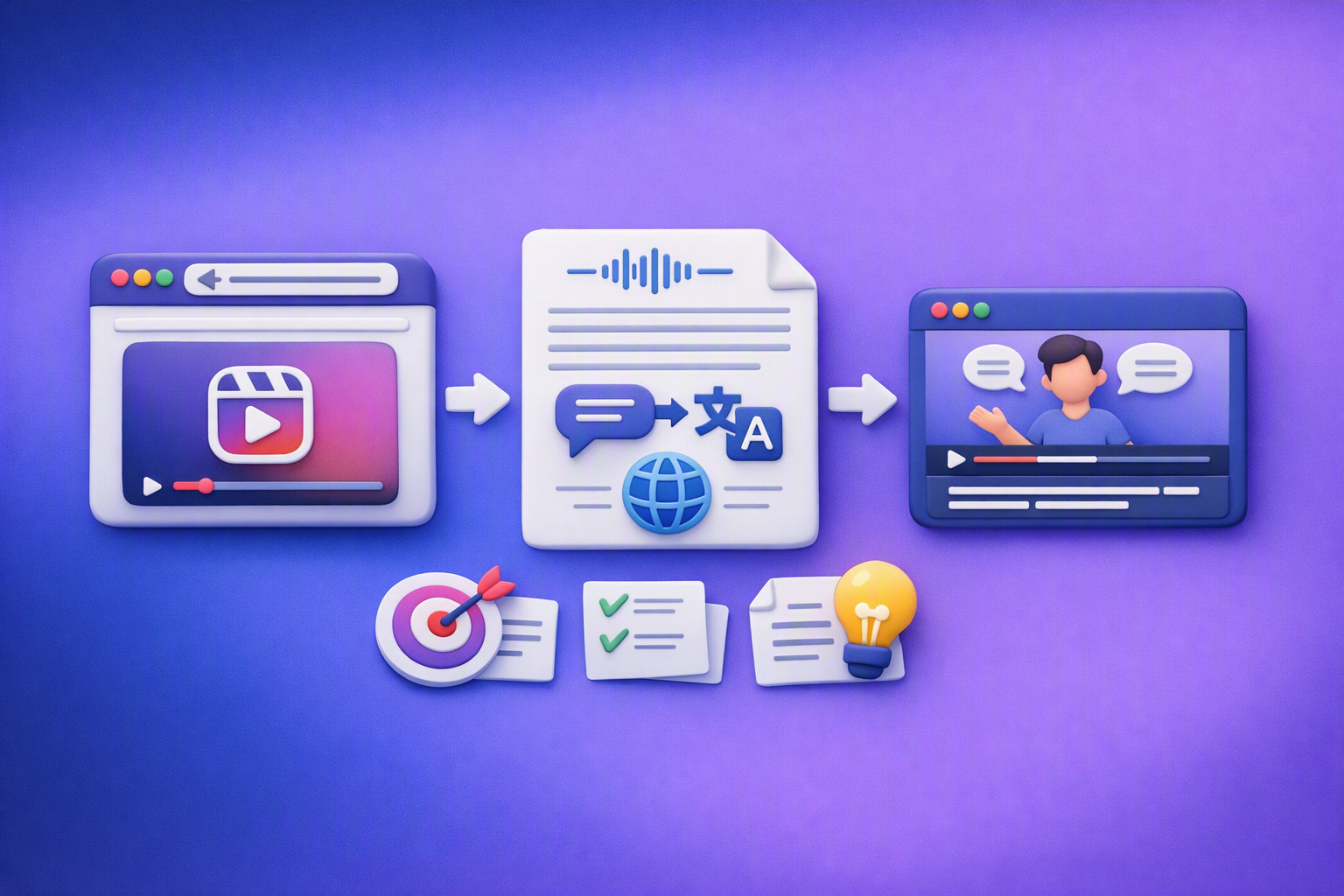
Aprende a traducir un Reel de Instagram con un flujo URL→transcripción→traducción→subtítulos, y a convertir esa traducción en un activo de investigación para hooks, CTAs, objeciones y clusters de contenido.
Reel Analyzer: Transcript‑First Instagram Reels Research (Hooks, CTAs, Objections) + Workflow Guide (VideoToTextAI)
Video To Text AI
A reel analyzer should turn any public Instagram Reel link into a searchable transcript library you can mine for hooks, CTAs, objections, and topic clusters—then repurpose into original drafts with a repeatable SOP.