
ChatGPT “Upload Video” Feature: What Works, Why Uploads Fail, and the Production-Safe Link → Transcript Workflow
 Video To Text AI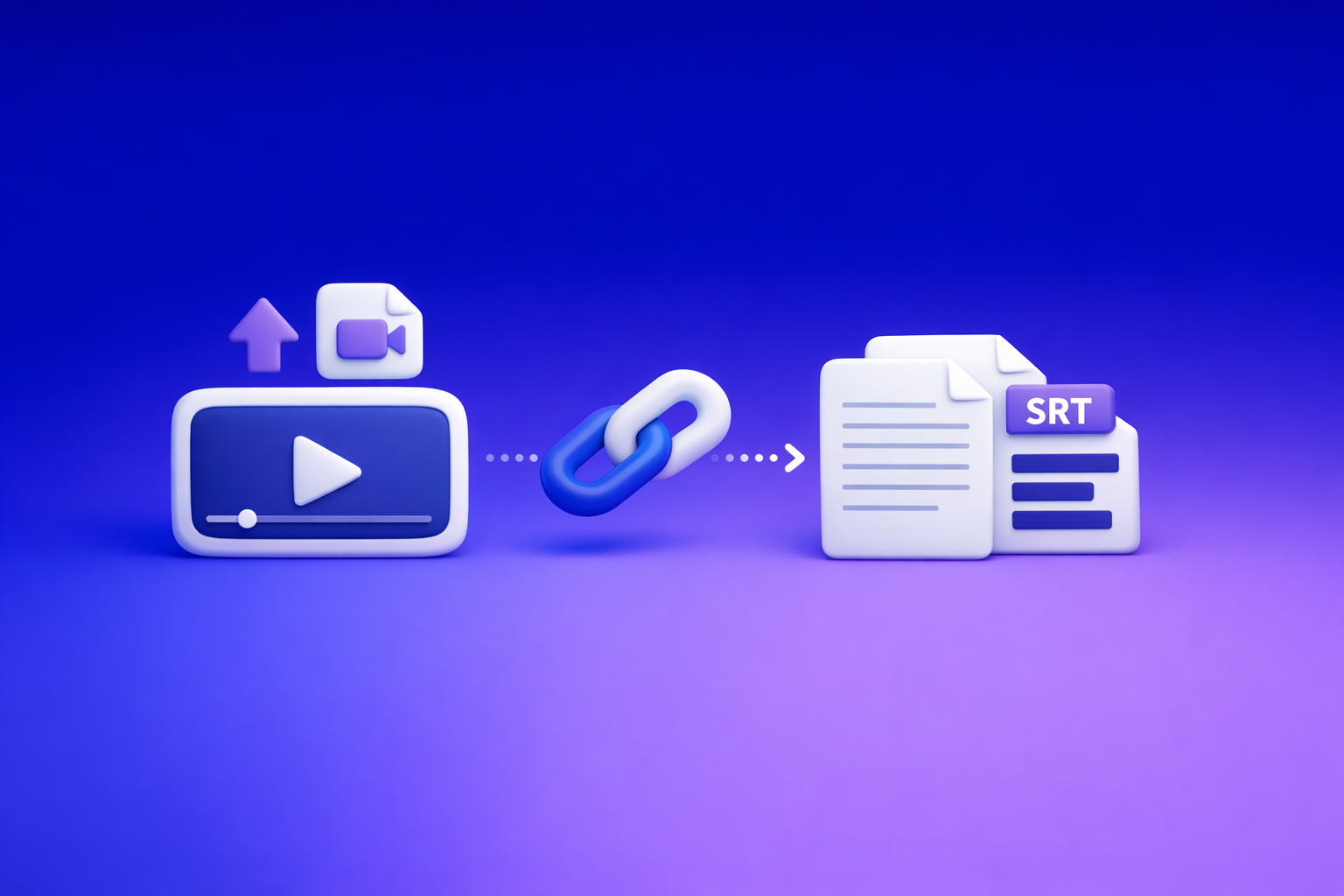
ChatGPT “Upload Video” Feature: What Works, Why Uploads Fail, and the Production-Safe Link → Transcript Workflow
If you need export-ready transcripts or captions, stop relying on ChatGPT’s “upload video” feature and switch to an artifact-first workflow: video link/MP4 → TXT + SRT/VTT → ChatGPT-on-text. You’ll ship faster because you can QA deterministic files (timecodes, formatting, completeness) instead of re-uploading and hoping the model processes the whole video.
TL;DR (for teams shipping transcripts/captions)
When ChatGPT video upload is worth using
Use ChatGPT “upload video” when the goal is understanding, not deliverables.
Good fits:
- Clip Q&A (“What did the speaker say about pricing?”)
- Rough scene descriptions for short content
- Quick summaries of a short segment you can re-check manually
When it’s the wrong tool (transcripts, SRT/VTT, timecodes, QA)
Avoid upload-first when you need:
- Accurate transcripts for publishing or compliance
- SRT/VTT captions with correct timecodes and formatting
- Long-form reliability (webinars, podcasts, lectures)
- Repeatable QA across editors, PMs, localization, and legal
The reliable workflow: video link/MP4 → TXT + SRT/VTT → ChatGPT-on-text
Production-safe path:
- Generate TXT + SRT/VTT from a video link (preferred) or MP4.
- QA once (names, drift, missing sections).
- Use ChatGPT on the text artifacts to create chapters, summaries, repurposed content, and caption variants.
This is also the future of creator productivity: downloading video files is an outdated workflow. Link-based extraction is faster, shareable, and easier to automate.
What the “Upload Video” feature in ChatGPT actually does (and what it doesn’t)
ChatGPT’s video upload experience is best understood as model-assisted analysis of a media file, not a captioning pipeline.
Upload vs link vs screen-recording: three different inputs with different failure modes
These are not equivalent:
- Upload (file): Most likely to hit size/duration/timeouts and encoding issues.
- Link (URL): Often blocked by permissions, expiring tokens, or geo restrictions.
- Screen recording: Adds compression artifacts and can degrade audio, causing worse transcription/understanding.
What outputs you can realistically expect
Think “assistive,” not “export-ready.”
Clip understanding and Q&A
- Answer questions about visible content
- Identify topics, objects, or on-screen text (varies by quality)
- Provide a high-level explanation of what happens
Rough summaries and scene descriptions
- Bullet summaries
- Scene-by-scene descriptions for short clips
- Draft outlines for editors to refine
What you should not expect: export-ready transcripts, accurate timecodes, compliant captions
Do not plan on:
- Complete transcripts for long videos
- Stable timecodes that match playback
- Caption formatting that meets platform specs (line length, reading speed, speaker labels)
- Repeatability across runs (the same upload can yield different results)
Supported inputs and practical constraints (what breaks first)
File size, duration, and timeout realities (why long videos fail)
Long videos fail for predictable reasons:
- Upload timeouts on slower networks
- Processing timeouts server-side
- Context limits that cause partial outputs (missing middle sections, truncated endings)
If you’re working with webinars, podcasts, or multi-minute creator content, assume upload-first will be fragile.
Codec/container pitfalls (MP4 ≠ always compatible)
“MP4” is a container, not a guarantee. Common breakpoints:
- Unusual audio codecs
- Variable frame rate edge cases
- Corrupted moov atom / streaming metadata issues
- HEVC/H.265 variants that some pipelines handle inconsistently
Audio quality issues that degrade results (music, crosstalk, low bitrate)
Even when analysis “works,” output quality drops fast with:
- Constant background music over speech
- Multiple speakers talking at once
- Room echo, low bitrate audio, or aggressive noise suppression
- Far-field mic recordings (conference rooms)
Access and permissions issues for links (private videos, expiring URLs, geo blocks)
Link-based inputs fail when:
- The video requires login
- The URL expires (signed URLs, temporary CDN links)
- Geo restrictions block access
- The platform throttles or blocks automated retrieval
Why ChatGPT video uploads fail: a diagnostic map
1) Upload fails immediately (client/UI, plan/rollout, network)
Symptoms:
- Upload button missing
- File never starts uploading
- Immediate error message
Likely causes:
- Feature not enabled for your plan/region
- Browser extensions interfering
- Corporate firewall/proxy
- Unstable Wi‑Fi or large file on mobile
2) Upload succeeds but analysis fails (processing timeout, unsupported encoding)
Symptoms:
- File attaches, then “can’t analyze” or stalls
Likely causes:
- Video too long for processing window
- Unsupported codec/encoding edge case
- Server-side queue or transient outage
3) Analysis works but transcript is incomplete (context truncation, long-form limits)
Symptoms:
- Transcript stops early
- Missing Q&A section
- Skips segments
Likely causes:
- Long-form limits and truncation
- The model prioritizes “summary” over full verbatim output
- Audio dropouts in the source
4) Captions are unusable (no timecodes, drift, formatting mismatches)
Symptoms:
- No timestamps
- Timestamps don’t align
- Lines too long, wrong segmentation
Likely causes:
- Not a captioning-first pipeline
- No deterministic alignment step
- Formatting not constrained to SRT/VTT rules
5) “It worked yesterday” failures (feature rollouts, server-side changes)
Symptoms:
- Same file, different day, different result
Likely causes:
- Gradual rollouts and model routing changes
- Load-based throttling
- Backend updates to media processing
10-minute triage: decide whether to keep trying upload or switch workflows
Step 1: Confirm the goal (summary vs transcript vs captions)
Be explicit:
- Summary: upload can be fine.
- Transcript: artifact-first is safer.
- Captions (SRT/VTT): artifact-first is the default.
Step 2: Run a 60–120s clip test (same source, same device)
Before you burn time:
- Export a 60–120s clip from the same video
- Upload it once
- Compare output to the actual audio
If the clip is already wrong, the full upload won’t magically improve.
Step 3: If you need deliverables, stop uploading and generate artifacts first
If your output must be:
- publishable transcript
- SRT/VTT captions
- timecoded chapters
…switch now. Repeated uploads are a rework loop.
Step 4: Choose the artifact set you need (TXT only vs TXT + SRT/VTT)
- TXT only: editing, summaries, repurposing.
- TXT + SRT/VTT: publishing subtitles, chapters, localization, compliance.
The production-safe workflow (recommended): Link/MP4 → Transcript/Subtitles → ChatGPT-on-text
Why “artifact-first” beats “upload-first”
Artifact-first means you generate files you can verify before you ask ChatGPT to write anything.
Deterministic outputs you can QA (TXT, SRT, VTT)
You can check:
- completeness (start to finish)
- timestamp alignment
- formatting rules
- speaker turns and terminology
Reusable across tools and teams (editors, PMs, localization)
A transcript and caption file can be used by:
- video editors
- web teams
- localization vendors
- knowledge base owners
Faster iteration: fix transcript once, regenerate many assets
Correct a name once, then reuse the corrected transcript to generate:
- blog drafts
- social posts
- email sequences
- cut lists
This is why downloading video files is outdated. Link-based extraction is the scalable path for creator and marketing teams.
Step-by-step: generate export-ready transcript and captions with VideoToTextAI
Step 1: Provide a video link or MP4 (what to use for YouTube/IG/TikTok vs local files)
Use the most stable input:
- YouTube / public URLs: use the link (preferred for speed and collaboration).
- TikTok/IG: use the share link when accessible; otherwise export MP4.
- Local recordings: upload MP4 when you must.
If you’re starting from a file download “because that’s how we’ve always done it,” treat that as technical debt. Link-first workflows reduce handoffs and storage churn.
Use VideoToTextAI for link-based video-to-text workflows: one pipeline for transcripts, subtitles, captions, and repurposing.
CTA: VideoToTextAI
Step 2: Export the right formats
Choose formats based on downstream needs:
-
TXT for editing and prompting
Best for: cleaning, summarizing, extracting insights, repurposing. -
SRT for subtitles (timecoded)
Best for: YouTube uploads, editing tools, most caption workflows.
Related tool page: MP4 to SRT -
VTT for web players
Best for: HTML5 players, web apps, some LMS platforms.
Related tool page: MP4 to VTT
If you only have an MP4, start here:
Step 3: Quick QA pass (what to check before you prompt ChatGPT)
Do a fast, repeatable QA:
-
Speaker names/turns
Ensure speaker changes are readable and consistent. -
Proper nouns/brand terms
Fix product names, people, locations, acronyms. -
Timecode drift (spot-check 3 timestamps)
Check early, middle, late timestamps against playback. -
Missing sections (intro/outro, ads, Q&A)
Verify the end isn’t truncated and transitions are captured.
Step-by-step: use ChatGPT on the transcript (prompts that ship)
Use ChatGPT as a text transformer. Paste the transcript (or chunk it) and reference timecodes from SRT/VTT when needed.
Prompt 1: Clean transcript for publishing (without changing meaning)
You are an editor. Clean the transcript for readability (punctuation, filler words, paragraph breaks) without changing meaning. Keep technical terms and proper nouns. Output as markdown with short paragraphs.
Prompt 2: Create chapters with timestamps (based on SRT/VTT timecodes)
Using the transcript and the provided SRT/VTT timestamps, create 8–12 chapters. Each chapter must include a timestamp in
MM:SSand a 6–10 word title. Do not invent sections not present in the transcript.
Prompt 3: Generate captions variants (short, medium, platform-specific)
Create three caption variants from this transcript:
- Short (max 60 chars/line, 2 lines)
- Medium (max 42 chars/line, 2 lines)
- TikTok-style (punchy, minimal punctuation)
Keep meaning, avoid paraphrasing key claims.
For TikTok workflows, this is a useful path: TikTok to Transcript
Prompt 4: Repurpose into assets (blog, LinkedIn, X, email)
Turn this transcript into:
- A blog outline with H2/H3s
- 5 LinkedIn posts (hook + body + CTA)
- 10 X posts (<= 280 chars)
- A 5-email nurture sequence
Only use information present in the transcript.
For a direct workflow from YouTube content: YouTube to Blog
Prompt 5: Extract quotes, hooks, and cut list (with time ranges)
Extract:
- 10 quotable lines (verbatim)
- 10 hooks (rewritten, but faithful)
- A cut list of 8 clips with start–end timestamps based on the SRT/VTT timecodes
Output as a table.
Implementation checklist (copy/paste)
Inputs checklist
- Video link works without login OR MP4 available
- Audio is intelligible (no constant music over speech)
- Target outputs defined: TXT / SRT / VTT / summary / blog
Transcription/caption checklist
- Exported TXT saved as source-of-truth
- SRT/VTT generated and spot-checked for drift
- Names/terms corrected once in transcript (then reused)
- Missing sections checked (intro/outro, ads, Q&A)
ChatGPT usage checklist
- Paste transcript (or key sections) instead of uploading video
- Ask for structured outputs (headings, bullets, JSON if needed)
- Validate against transcript (no invented claims)
Delivery checklist
- Captions meet platform constraints (line length, reading speed)
- Chapters align to real timestamps
- Repurposed content links back to the source video
Common production scenarios (choose your path)
Scenario A: You need accurate subtitles for publishing today
Do this:
- Generate SRT and spot-check drift
- Fix proper nouns once
- Upload SRT to the platform/editor
Use: MP4 to SRT
Scenario B: You need a blog post + social posts from a long video
Do this:
- Generate TXT
- Use ChatGPT prompts for outline + posts
- Add links and CTAs after editorial review
Use: YouTube to Blog
Scenario C: You need multilingual subtitles (translate after you have SRT/VTT)
Do this:
- Generate SRT/VTT in source language
- Translate while preserving timecodes and line constraints
- QA reading speed and line breaks per language
Use: MP4 to VTT
Scenario D: You need searchable knowledge base notes from webinars
Do this:
- Generate TXT
- Ask ChatGPT to produce structured notes (agenda, decisions, action items)
- Store in your KB with the transcript as the source-of-truth
Use: Podcast Transcription (also applies to webinar-style audio)
Competitor Gap
Most guides stop at “try smaller files” and ignore deliverables
Typical SERP advice focuses on upload troubleshooting:
- reduce file size
- try another browser
- shorten the clip
That helps you “get it to run,” but not to ship captions/transcripts.
Missing in typical SERP content: artifact-first workflow with QA and export formats
Most posts don’t explain:
- why SRT/VTT matters
- how to QA timecode drift
- how to reuse artifacts across teams
- why upload-first is inherently non-deterministic for long-form
What this post adds: deterministic link/MP4 → TXT + SRT/VTT pipeline + prompts + checklist
The practical difference:
- Artifacts first (TXT/SRT/VTT you can verify)
- ChatGPT second (turn verified text into deliverables)
This aligns with the modern reality: link-based extraction is the future, and downloading files is a slow, brittle habit.
What to measure: turnaround time, caption error rate, timecode drift, rework loops
Track:
- Time from video ready → captions published
- Number of caption corrections per minute
- Drift at 25%, 50%, 90% timestamps
- Rework loops caused by re-uploads or partial transcripts
FAQ (People Also Ask)
Can ChatGPT transcribe a video if I upload it?
It can sometimes produce text from an uploaded video, but it’s not consistent for long videos and it’s not designed as an export-ready caption pipeline. For production work, generate TXT + SRT/VTT first, then use ChatGPT to edit and repurpose.
Why does ChatGPT fail to upload or analyze my video?
Common causes include plan/rollout limitations, network timeouts, unsupported encoding, long duration, and server-side processing limits. If you need deliverables, don’t debug uploads for hours—switch to an artifact-first workflow.
Can ChatGPT generate SRT or VTT captions from a video upload?
Not reliably. Even when it outputs text, it often lacks correct timecodes and formatting. Use a workflow that exports SRT/VTT directly, then use ChatGPT for caption variants and copy edits.
What’s the best way to summarize a long YouTube video with ChatGPT?
Create a transcript from the YouTube link, then paste the transcript into ChatGPT with a structured prompt (summary, key takeaways, chapters). This avoids long-video upload failures and improves accuracy.
Is it better to upload the video or paste a transcript into ChatGPT?
For anything production-bound, it’s better to paste a transcript (and reference SRT/VTT timecodes). Uploading video is best reserved for short clip understanding, not transcripts/captions you must ship.
Internal Link Plan
Related posts
Reel Analyser (Instagram Reels): Transcript‑First Competitor Research, Hook/CTA Extraction, and Repurposing Workflow (VideoToTextAI)
Video To Text AI
A 2026 reel analyser should turn Instagram Reel links into a searchable transcript library you can tag for hooks, CTAs, objections, and topic clusters—then export into repurposing-ready drafts without a download/upload loop.
Traducir video de Instagram (Reels) en 2026: workflow transcript-first para traducir, sacar hooks/CTAs y repurpose (con VideoToTextAI)
Video To Text AI
Aprende a traducir un Reel de Instagram con un flujo URL→transcripción→traducción→subtítulos, y a convertir esa traducción en un activo de investigación para hooks, CTAs, objeciones y clusters de contenido.
Reel Analyzer: Transcript‑First Instagram Reels Research (Hooks, CTAs, Objections) + Workflow Guide (VideoToTextAI)
Video To Text AI
A reel analyzer should turn any public Instagram Reel link into a searchable transcript library you can mine for hooks, CTAs, objections, and topic clusters—then repurpose into original drafts with a repeatable SOP.