
How to Integrate VideoToTextAI APIs to Automatically Create VTT Files from Transcriptions
 Video To Text AI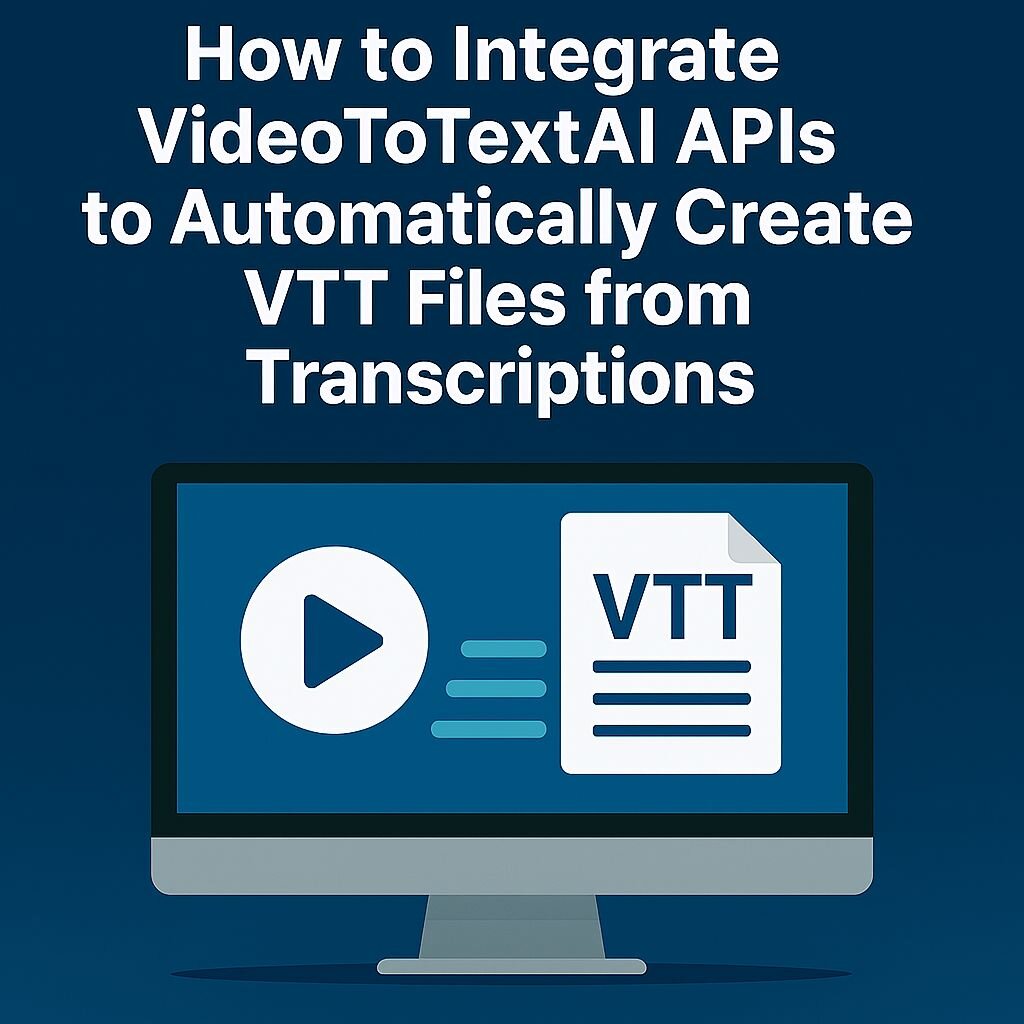
Automate Subtitles with the VideoToTextAI API
Creating subtitles for your video content is essential for accessibility, engagement, and SEO. With Video To Text AI, you can automate the entire process using our API — no manual transcription required. In this guide, we'll walk you through how to integrate Video To Text AI’s API to upload a video/audio file, transcribe it, and generate a .vtt (WebVTT) subtitle file you can use across platforms.
Step 1: Get Your API Key
Before you start, log in to the Video To Text AI dashboard to generate your API key. You'll need this for all authenticated API requests.
Step 2: Upload a File for Transcription
Use the /v2/upload/file endpoint to send a video or audio file for transcription.
Endpoint:
POST https://videototextai.com/v2/upload/file
Required Headers:
Content-Type: application/octet-streamContent-Disposition: attachment; filename="yourfile.mp4"x-api-key: <your-api-key>
Optional header:
X-user-content-language: en(Override language detection)
Sample:
curl -X POST "https://videototextai.com/v2/upload/file?process_async=true" \
  -H "x-api-key: <your-api-key>" \
  -H "Content-Type: application/octet-stream" \
  -H "Content-Disposition: attachment; filename=\"movie.mp4\"" \
  --data-binary @"./movie.mp4"
You'll receive a JSON response with a unique uuid_filename identifier for your uploaded file.
Step 3: Export the VTT File
Once the transcription is complete (which you can check with the status endpoint), use the uuid_filename to export the VTT file.
Endpoint:
POST https://videototextai.com/user/transcriptions/{uuid_filename}/export/vtt
Replace {uuid_filename} with the identifier returned in the upload step.
Headers:
x-api-key: <your-api-key>
Sample curl Request:
curl -X POST "https://videototextai.com/user/transcriptions/123abc456def/export/vtt" \
  -H "x-api-key: <your-api-key>"
This returns a VTT file containing the transcribed subtitles.
Bonus: Use Your VTT File Anywhere
You can use the downloaded .vtt file in video players like VLC, embed it on your website, or upload it to YouTube for captioning.
Final Notes
- File size limit: 10GB
- Supported formats: flac, m4a, mp3, mp4, mpeg, mpga, oga, ogg, wav, webm
- VTT export requires transcription to complete first. You can check status via the status API endpoint.
- Be sure to generate your API key by logging into the Video To Text AI UI
Ready to Automate?
With just a few API calls, you can turn your media into accessible, searchable content — automatically. Visit Video To Text AI to get started!
Related posts
Reel Analyser (Instagram Reels): Transcript‑First Competitor Research, Hook/CTA Extraction, and Repurposing Workflow (VideoToTextAI)
Video To Text AI
A 2026 reel analyser should turn Instagram Reel links into a searchable transcript library you can tag for hooks, CTAs, objections, and topic clusters—then export into repurposing-ready drafts without a download/upload loop.
Traducir video de Instagram (Reels) en 2026: workflow transcript-first para traducir, sacar hooks/CTAs y repurpose (con VideoToTextAI)
Video To Text AI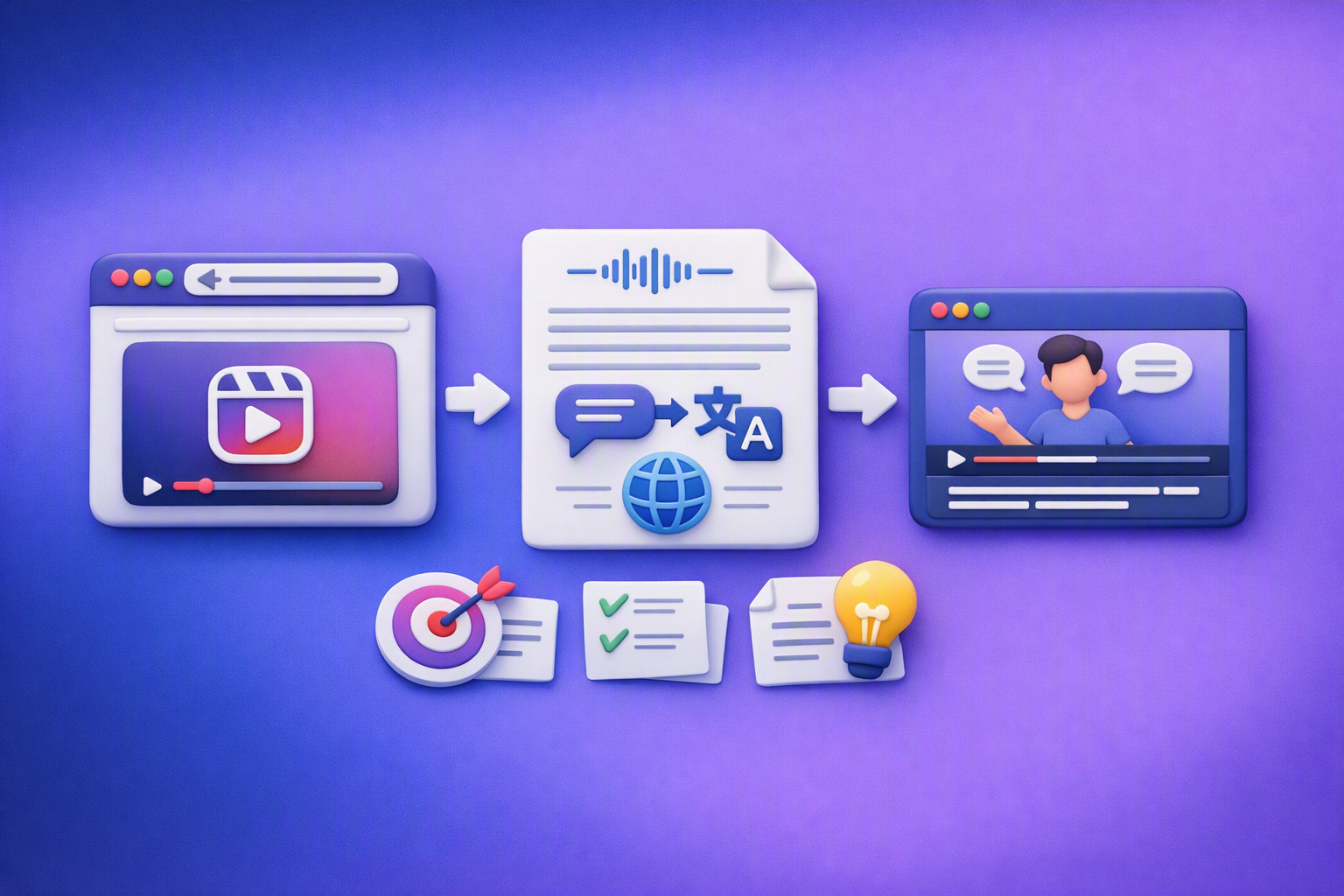
Aprende a traducir un Reel de Instagram con un flujo URL→transcripción→traducción→subtítulos, y a convertir esa traducción en un activo de investigación para hooks, CTAs, objeciones y clusters de contenido.
Reel Analyzer: Transcript‑First Instagram Reels Research (Hooks, CTAs, Objections) + Workflow Guide (VideoToTextAI)
Video To Text AI
A reel analyzer should turn any public Instagram Reel link into a searchable transcript library you can mine for hooks, CTAs, objections, and topic clusters—then repurpose into original drafts with a repeatable SOP.