
“Max 0 Uploads at a Time” in ChatGPT: What It Means, Why It Happens, and the Fast No-Upload Video→Text Workflow (2026)
 Video To Text AI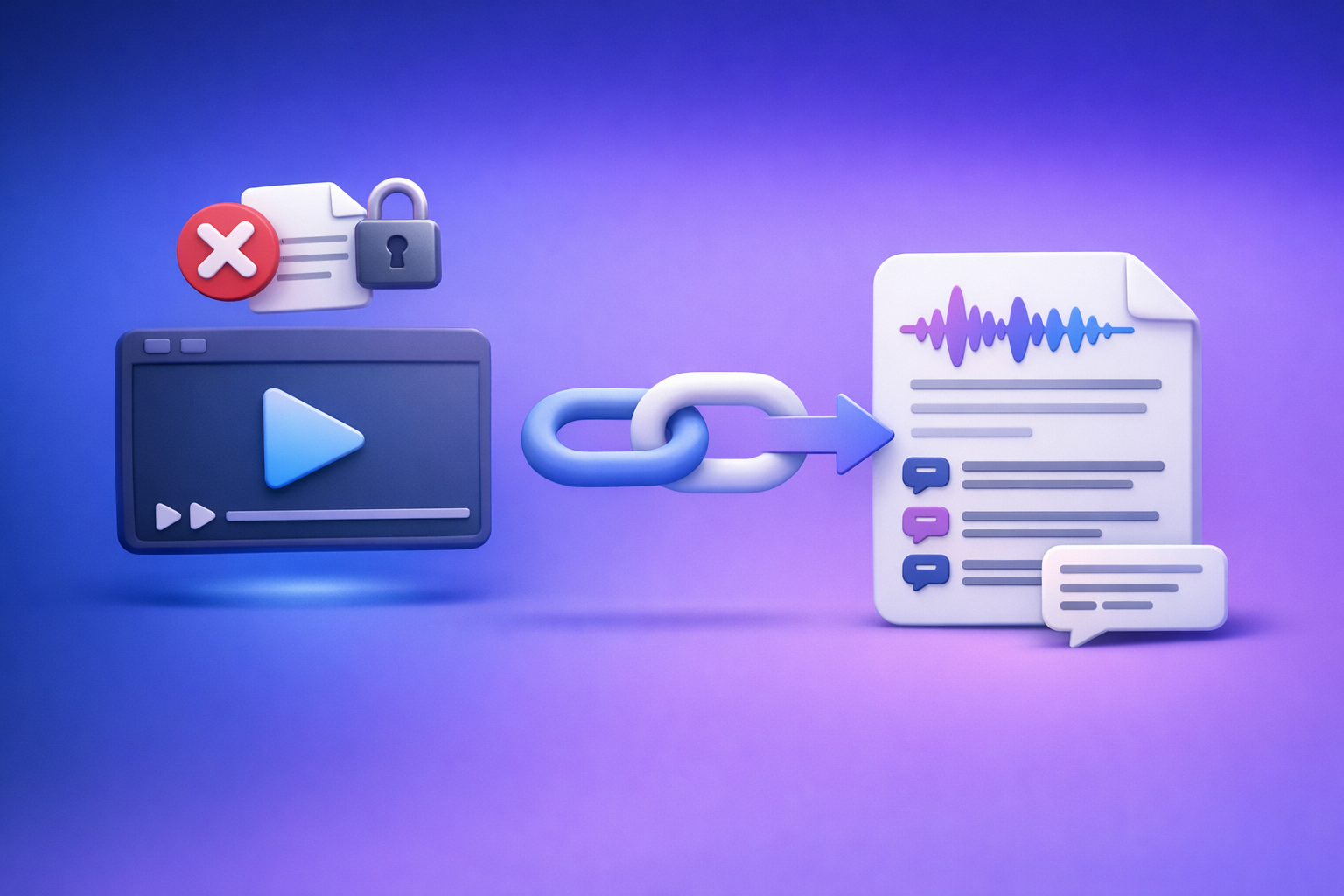
If ChatGPT says “max 0 uploads at a time”, stop trying to “fix the file”—your current ChatGPT context is blocking attachments. Use the 2‑minute isolation flow below, then either restore uploads fast or bypass uploads entirely with a transcript-first workflow that still ships TXT/SRT/VTT + repurposed content.
What “Max 0 uploads at a time” means in ChatGPT (plain-English)
It’s usually a context-level attachment block (not your file)
“Max 0 uploads at a time” typically means the UI is telling you the allowed attachment count is zero in the current context.
Common causes:
- The selected model/mode doesn’t support attachments in that chat.
- The thread is in a state where attachments are disabled.
- Your workspace policy (Team/Enterprise) blocks uploads.
- The surface (web/desktop/mobile) you’re using has attachments disabled or not available.
Where the limit is enforced (thread vs model vs surface vs workspace)
Think of uploads as gated at multiple layers:
- Thread-level: one chat allows attachments; another doesn’t.
- Model/tooling-level: some modes support files; others are text-only.
- Surface-level: web vs desktop vs mobile can differ.
- Workspace-level: admin policies can set attachments to zero.
How this differs from true rate limits and temporary outages
Rate limits/outages usually look like:
- Temporary errors, retries, “try again later,” or degraded performance.
- Uploads work again after time passes.
“Max 0 uploads at a time” is more often:
- A capability/permission state (allowed uploads = 0).
- Persistent until you change thread/model/surface/workspace.
Quick diagnosis (2 minutes): identify the exact blocker
Step 1 — Confirm the surface: Web vs Desktop vs Mobile
Check where you’re seeing the message:
- Web app in a browser
- Desktop app
- Mobile app
If it fails on one surface, test another. This isolates surface-specific limitations.
Step 2 — Confirm the model/tooling: does this chat support attachments?
In the same surface, verify the selected model/mode supports attachments. If you’re in a text-only mode, the UI may show 0 uploads by design.
Action:
- Switch to a mode that clearly supports attachments.
- If you can’t find one, it may be a plan/workspace restriction.
Step 3 — Check thread state: new chat vs existing chat
Attachments can be blocked in a specific thread.
Action:
- Create a new chat and check whether the attachment option returns.
Step 4 — Check account/workspace policy: personal vs Team/Enterprise
If you’re in a managed workspace:
- Uploads may be disabled by policy.
- Certain tools/models may be restricted.
Action:
- Confirm whether you’re using a personal account or a Team/Enterprise workspace.
Step 5 — Check network controls: VPN, corporate proxy, content filters
Corporate networks can block upload endpoints or file scanning flows.
Action:
- Disable VPN.
- Try a hotspot or home network.
- If you’re on a managed device, assume policy controls may persist.
Step 6 — Check browser/app state: extensions, cookies, cache, permissions
Extensions and corrupted site data can break attachment UI.
Action:
- Try incognito/clean profile.
- Disable extensions (ad blockers, privacy tools).
- Clear site data and re-authenticate.
Fixes that work (ordered, fastest-first)
Fix 1 — Start a new chat in the same surface (resets thread-level blocks)
This is the fastest “thread reset.”
Do:
- New chat → check if the attachment button returns.
- If it works, the issue was thread-scoped.
Fix 2 — Switch to a model/chat mode that supports attachments
If the mode is text-only, uploads will show as zero.
Do:
- Change model/mode → verify attachment UI changes.
- Re-test in a new chat after switching.
Fix 3 — Log out/in and re-check plan/workspace restrictions
Auth state can desync, especially across multiple orgs/workspaces.
Do:
- Log out → log in.
- Confirm you’re in the expected account/workspace.
Fix 4 — Try a different surface (Web ↔ Desktop ↔ Mobile)
Surface differences are common.
Do:
- If web fails, try desktop or mobile (or vice versa).
- If only one surface fails, focus on that app’s cache/permissions.
Fix 5 — Disable extensions and test in a clean profile/incognito
Extensions can block scripts that enable attachments.
Do:
- Incognito window (no extensions) → test.
- Or create a clean browser profile.
Fix 6 — Clear site data for ChatGPT and re-authenticate
If UI state is stuck, clearing site data often fixes it.
Do:
- Clear cookies + local storage for the site.
- Re-login and re-test.
Fix 7 — Remove VPN / switch networks / test on hotspot
If uploads are blocked at the network layer, changing networks is decisive.
Do:
- Disable VPN.
- Try hotspot.
- If hotspot works, your corporate network is likely blocking it.
Fix 8 — If on Team/Enterprise: request admin enablement (what to ask for)
If you’re in a managed workspace, assume policy until proven otherwise.
Admin request checklist (exact items to verify)
Ask your admin to confirm:
- File/attachment permissions enabled for your workspace
- Allowed tools/models include attachments
- DLP/CASB rules not blocking uploads
- Domain allowlist for required endpoints (if applicable)
When you should stop troubleshooting and bypass uploads
Decision rule: if uploads are still blocked after 10 minutes
If you’ve tried:
- New chat
- Attachment-capable mode
- Surface switch
- Clean profile/incognito
- Network switch
…and it still shows max 0 uploads, stop. You’re likely dealing with policy or persistent environment controls.
Common scenarios where uploads won’t return (policy + managed devices)
Uploads may remain blocked when:
- You’re on a managed device with enforced security tooling.
- Your workspace has attachments disabled for compliance.
- Your network uses content filtering that blocks upload flows.
In these cases, the fastest path is to avoid uploads entirely.
The reliable workaround: no-upload, transcript-first workflow (VideoToTextAI)
Downloading video files to “feed ChatGPT” is an outdated workflow. Link-based extraction is the future of creator productivity because it’s faster, repeatable, and doesn’t depend on whether a specific chat UI allows attachments.
Why “ChatGPT-on-text” is more reliable than “ChatGPT-on-video”
Text workflows avoid the most fragile parts of the pipeline:
- No attachment permissions needed
- No file size/format friction
- No corporate upload blocks
- Easy to store, diff, edit, and reuse
Once you have a clean transcript, ChatGPT becomes a content engine—without any uploads.
What you can produce without uploads
From a transcript + timestamps, you can generate:
- Clean transcript (TXT)
- Subtitles/captions (SRT/VTT)
- Summaries, chapters, hooks, repurposed posts
If you need dedicated exports, see:
Step-by-step: link-based video → transcript/captions → ChatGPT outputs
Step 1 — Paste a video link (YouTube/TikTok/Instagram) or use MP4
Use link-based input whenever possible:
- It’s faster than downloading and re-uploading.
- It’s easier to operationalize across a team.
Related tools:
Step 2 — Generate transcript + timestamps (choose TXT + SRT/VTT)
Export both:
- TXT for editing and prompting
- SRT/VTT for publishing captions
This keeps your workflow “production-safe” even when ChatGPT uploads are blocked.
Step 3 — Quality pass: speaker labels, punctuation, terminology
Before prompting ChatGPT, do a quick cleanup:
- Add speaker labels (Host/Guest)
- Fix proper nouns (brands, names)
- Normalize jargon and acronyms
- Ensure punctuation is readable for captions
Step 4 — Repurpose in ChatGPT using the transcript (no attachments required)
Paste transcript text directly into ChatGPT and request outputs like:
- Blog outline + draft
- LinkedIn post + carousel copy
- Short-form clip captions + hooks
- SEO metadata (title tags, descriptions, FAQs)
If you want deeper context on the upload issue, cross-reference:
- ChatGPT “Upload Video” Feature (2026): How It Works, Limits, Fixes, and the Reliable No-Upload Workflow
- “Attachments Disabled for” ChatGPT: What It Means, Why It Happens, and Fixes (2026)
Implementation prompts (copy/paste) for ChatGPT using transcript text
Prompt A — Turn transcript into an SEO blog post (with headings + FAQs)
You are an SEO editor. Using the transcript below, write a publish-ready blog post.
Requirements:
- Use H2/H3 headings, short paragraphs, and bullet lists.
- Keep claims factual; don’t invent stats.
- Include a “Key takeaways” section.
- Add 5 FAQs at the end (question + 2–3 sentence answers).
- Provide SEO title tag (<=60 chars) and meta description (<=155 chars).

Transcript:
[PASTE TRANSCRIPT HERE]
Prompt B — Create SRT/VTT improvements (timing + readability rules)
You are a caption editor. Improve readability of these captions without changing meaning.
Rules:
- Max 42 characters per line, max 2 lines per caption.
- Prefer sentence-case, add punctuation.
- Split long captions at natural pauses.
- Keep timestamps in order; suggest timing adjustments only when necessary.

Captions (SRT or VTT):
[PASTE CAPTIONS HERE]
Prompt C — Extract chapters + key moments + clip ideas
From the transcript below, create:
1) 8–12 chapters with timestamps (mm:ss) and titles.
2) 10 key moments worth clipping with a 1-sentence rationale each.
3) 15 short-form hook options (<=12 words) aligned to the best moments.

Transcript with timestamps:
[PASTE TRANSCRIPT HERE]
Checklist: fix uploads OR ship without them (one-page)
Upload restoration checklist
- New chat created
- Attachment-capable model selected
- Surface switched (Web/Desktop/Mobile)
- Extensions disabled / clean profile tested
- Site data cleared and re-login completed
- Network tested (no VPN / alternate network)
- Workspace admin settings verified (if applicable)
No-upload shipping checklist (VideoToTextAI)
- Video link/MP4 ready
- Transcript exported (TXT)
- Captions exported (SRT/VTT)
- Transcript cleaned (names, jargon, punctuation)
- Repurposed assets generated from text (blog/social/email)
VideoToTextAI vs Competitors
Comparison criteria (what you should evaluate)
Evaluate tools on operational fit, not hype:
- Input method: link-based vs upload-only
- Output formats: TXT + SRT + VTT (export-ready)
- Workflow reliability when ChatGPT uploads are blocked
- Repurposing speed: transcript → blog/social assets
- Editing controls: timestamps, speaker labels, readability
Comparison table (based on available research)
Competitor research was not provided in the request payload (the research block indicates SERP data was skipped). To avoid inventing claims, the table below compares workflow approaches at a high level without naming unsupported competitors.
| Criteria | VideoToTextAI | Upload-only transcription tools | In-app caption editors | ChatGPT attachments (when available) |
|---|---|---|---|---|
| Link-based input (YouTube/TikTok/Instagram) | Yes (designed for link workflows) | Sometimes (varies) | Rare | No (requires file/attachment) |
| Export-ready formats (TXT/SRT/VTT) | Yes | Often | Sometimes | Not the primary output |
| Works when ChatGPT shows “max 0 uploads at a time” | Yes (no-upload path) | Yes (if not blocked) | Yes | No |
| Repurposing speed (transcript → content) | Fast: transcript-first | Medium | Slow | Fast (but depends on uploads) |
| Operational repeatability for teams | High (standardized link → exports → prompts) | Medium | Low | Medium (fragile if attachments blocked) |
Where VideoToTextAI fits best
VideoToTextAI is best for:
- Teams that need a production-safe workflow that doesn’t depend on ChatGPT attachments
- Creators repurposing YouTube/TikTok/Instagram into text assets
- Marketers needing captions + SEO content from the same source
If your only goal is quick manual trimming or styling inside a single social platform, an in-app editor can be fine. For repeatable publishing pipelines, link-based transcript extraction wins.
Competitor Gap
What most “fix” articles miss (and this post will cover)
Most posts stop at “clear cache” and “try another browser.” What actually helps is:
- A strict isolation flow: thread → model → surface → workspace → network → browser
- A stop-rule to prevent endless troubleshooting (10 minutes max)
- A no-upload workflow that still produces deliverables (TXT/SRT/VTT + repurposed content)
- Implementation prompts and a ship-today checklist
If you want the longer reference version of this guide, see:
“Max 0 Uploads at a Time” in ChatGPT: What It Means, Fixes That Work, and a No-Upload Video→Text Workflow
Use cases: what to do once you have the transcript (fast wins)
YouTube video → SEO blog post + FAQ schema-ready questions
Workflow:
- Generate transcript + timestamps
- Prompt ChatGPT for a structured article + FAQs
- Publish with FAQ section ready for schema markup
If you want a direct path from video to written content, use:
YouTube to Blog
Podcast episode → show notes + chapters + quote bank
Workflow:
- Transcript-first
- Extract chapters, key takeaways, and quotable lines
- Create a quote bank for social scheduling
Deliverables:
- Show notes
- Chapter list
- 20–30 quotes with speaker attribution
TikTok/Instagram Reel → hook variants + captions + LinkedIn post
Workflow:
- Link-based transcript
- Generate 15 hook variants
- Produce a LinkedIn post + carousel copy from the same transcript
Tooling reference:
FAQ (People Also Ask aligned)
Why does ChatGPT say “max 0 uploads at a time”?
Because your current context has attachments set to zero allowed uploads—usually due to the selected model/mode, the specific thread, the surface you’re using, or workspace policy.
How do I enable uploads in ChatGPT again?
Try, in order:
- New chat
- Switch to an attachment-capable mode
- Log out/in
- Switch surfaces (web/desktop/mobile)
- Clean profile/incognito + disable extensions
- Clear site data
- Switch networks / disable VPN
If you’re on Team/Enterprise, ask your admin to verify attachment permissions and DLP/CASB rules.
Is “max 0 uploads at a time” a rate limit or a permissions issue?
Most often it’s a permissions/capability issue, not a temporary rate limit. “Max 0” indicates the system is configured to allow no attachments in that context.
Why can I upload in one chat but not another?
Because attachments can be thread-level. A new chat can reset the state, or a different thread may be using a different mode/tool configuration.
What can I do if my workspace/admin disabled attachments?
Use a no-upload workflow:
- Convert video to TXT/SRT/VTT
- Paste transcript text into ChatGPT for repurposing
If you need a production workflow that avoids downloading files, use link-based extraction—that’s the future of creator productivity. Learn more at https://videototextai.com.
Related posts
Reel Analyser (Instagram Reels): Transcript‑First Competitor Research, Hook/CTA Extraction, and Repurposing Workflow (VideoToTextAI)
Video To Text AI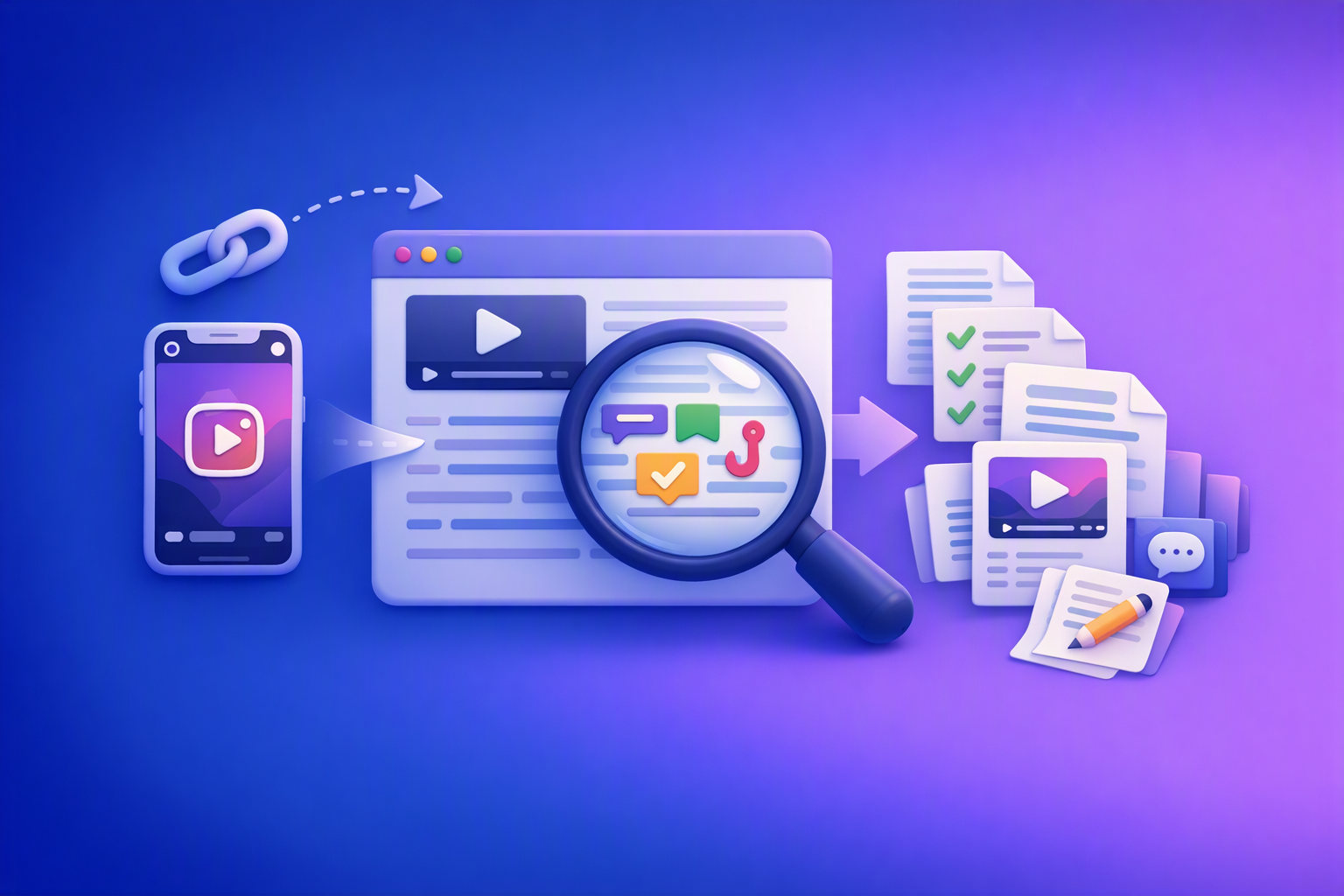
A 2026 reel analyser should turn Instagram Reel links into a searchable transcript library you can tag for hooks, CTAs, objections, and topic clusters—then export into repurposing-ready drafts without a download/upload loop.
Traducir video de Instagram (Reels) en 2026: workflow transcript-first para traducir, sacar hooks/CTAs y repurpose (con VideoToTextAI)
Video To Text AI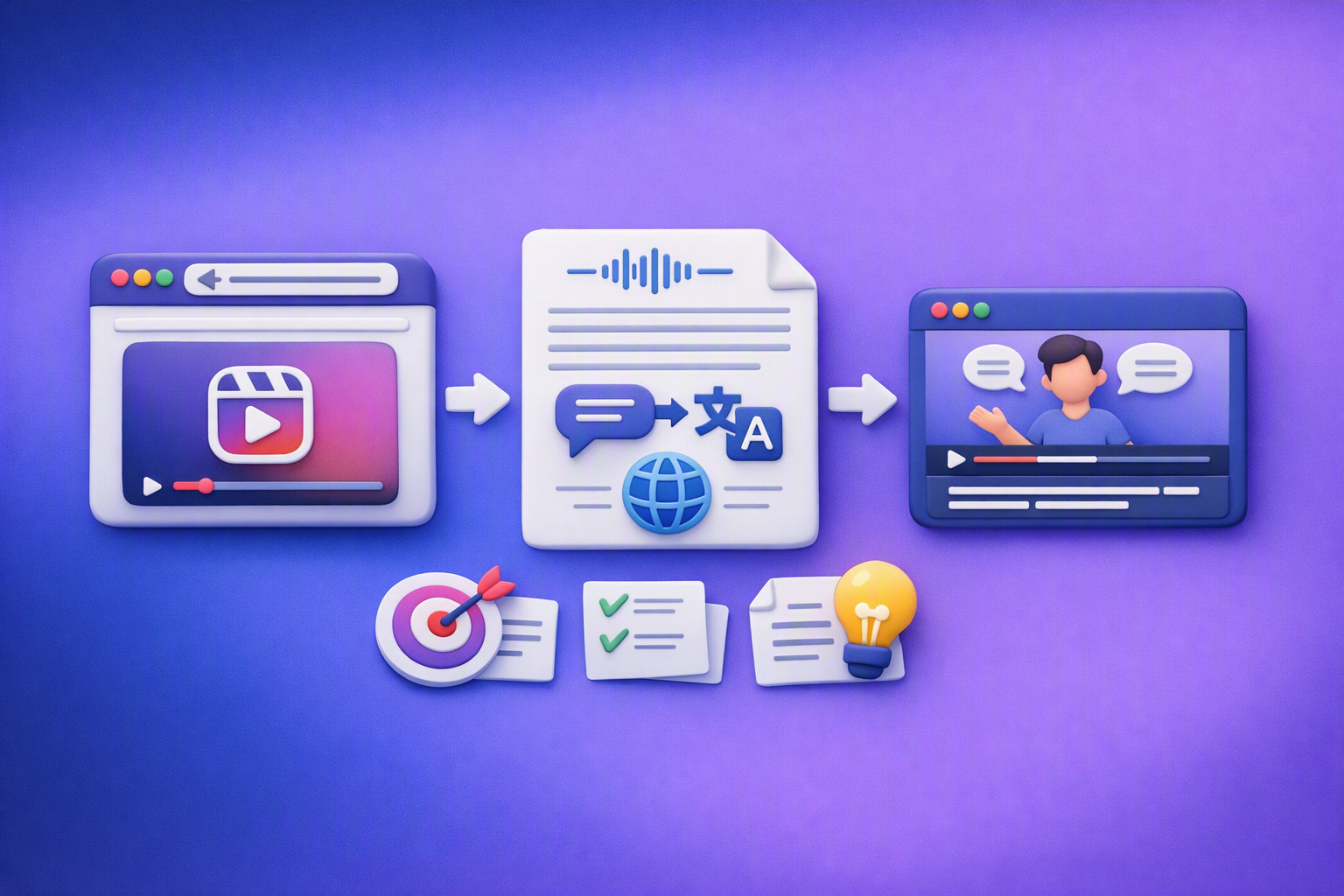
Aprende a traducir un Reel de Instagram con un flujo URL→transcripción→traducción→subtítulos, y a convertir esa traducción en un activo de investigación para hooks, CTAs, objeciones y clusters de contenido.
Reel Analyzer: Transcript‑First Instagram Reels Research (Hooks, CTAs, Objections) + Workflow Guide (VideoToTextAI)
Video To Text AI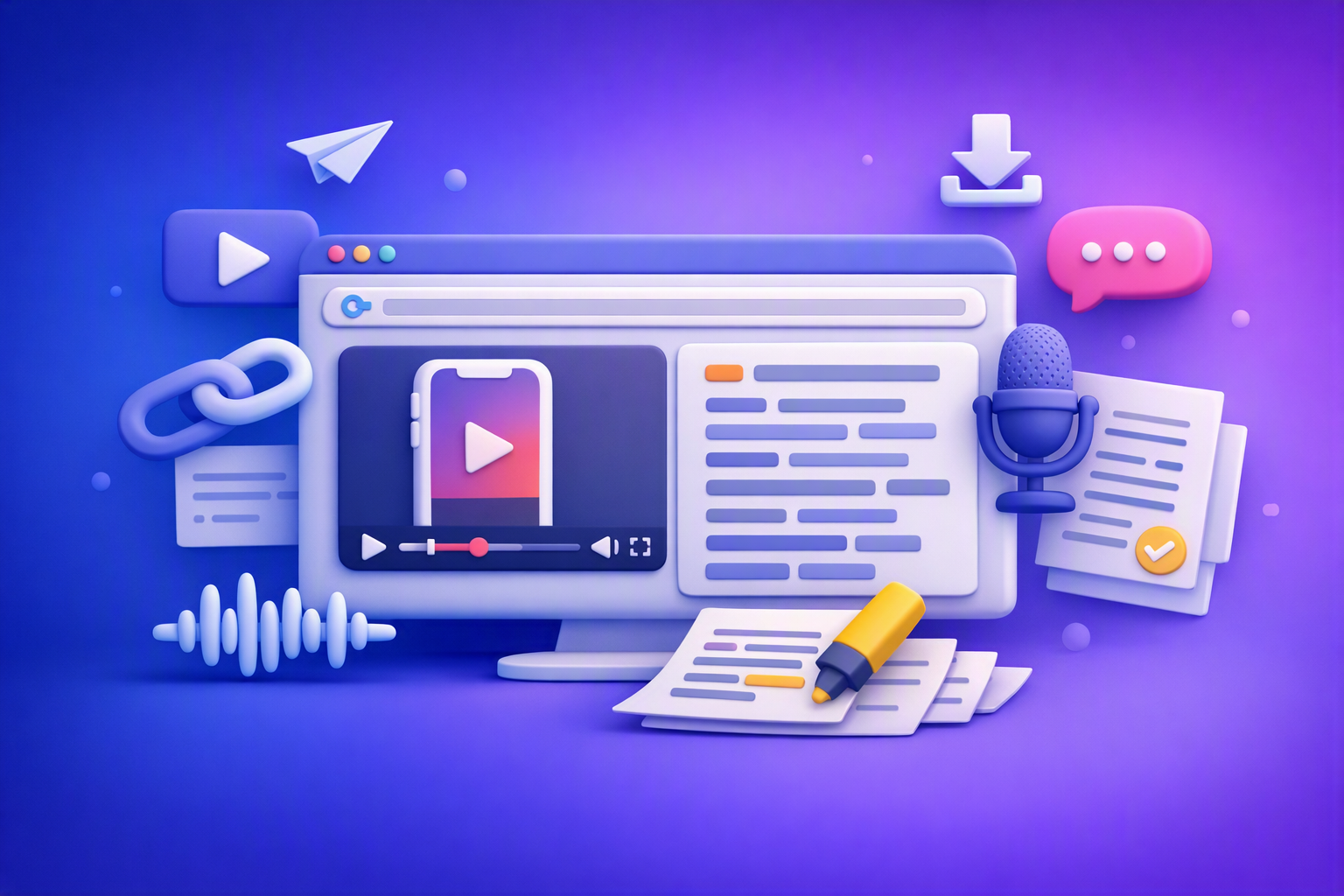
A reel analyzer should turn any public Instagram Reel link into a searchable transcript library you can mine for hooks, CTAs, objections, and topic clusters—then repurpose into original drafts with a repeatable SOP.